Gusion
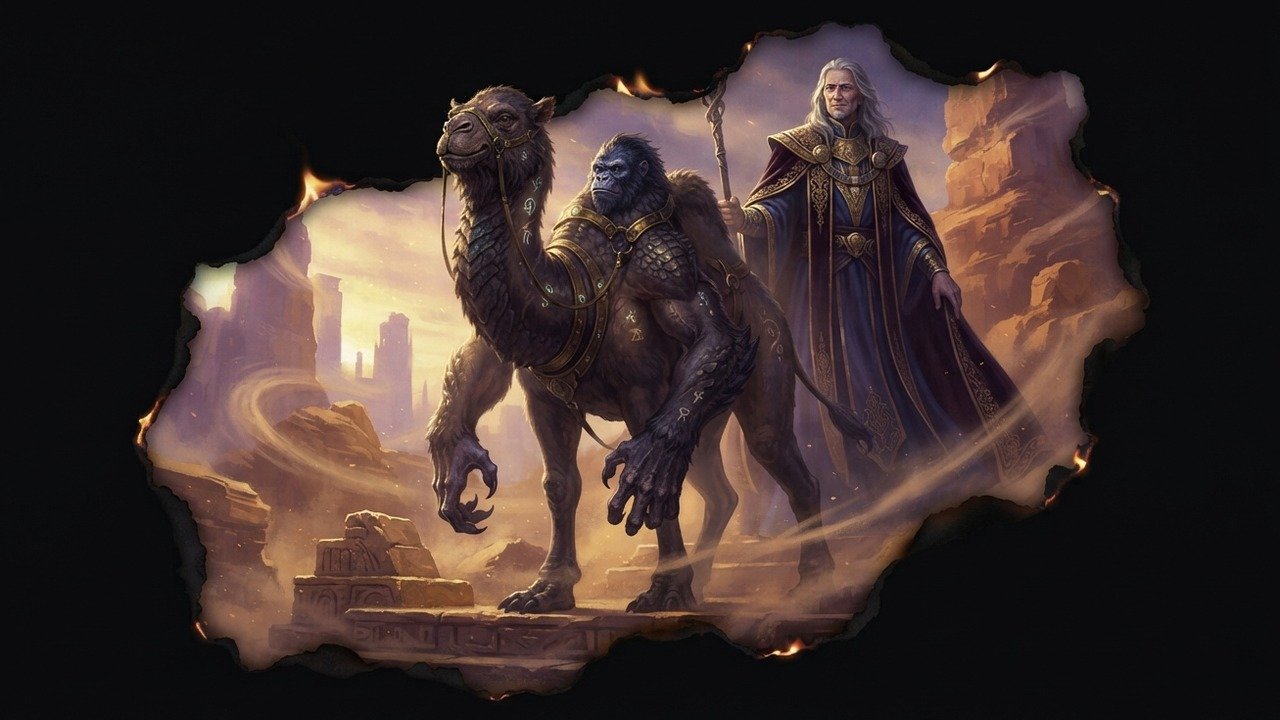
The Legacy of Gusion: The Great Duke of Clarity, Triune Time, and Rectitude of the Spirit
Origin and Legend: The Oracle of Time and the Ancestral Scales
To find the primordial root of Gusion—recorded in ancient catalogs as Gusoin, Gusoyn, or Gusayn—it is necessary to turn our gaze toward the ancient oracular cults and the wisdom deities of the Mesopotamian steppes and the eastern Mediterranean basin. In the primeval pantheon, Gusion was not a demon of destruction or infernal shadows, but a guardian spirit of incorruptible Time and an administrator of divine justice.
His name bears a close philological relationship to archaic roots referring to immediacy, upright diplomacy, and the contemplation of what lies hidden. When the Solomonic tradition organized the Goetia in works such as Johann Weyer's *Pseudomonarchia Daemonum* and the *Lemegeton*, Gusion was elevated to the rank of Great and Mighty Duke of Hell, commanding forty legions of spirits. The ancient keys preserved the essence of his myth: he was cataloged as an entity of immense dignity who does not respond to human baseness, whose primary function is to reveal all things—past, present, and future—, resolve riddles, reconcile enmities, and bestow honor and position upon whoever stands firm in the truth.
Historical Evolution: From Enigmatic Creature to Judge of Destiny
The iconography of Gusion in medieval and Renaissance grimoires underwent one of the most peculiar transformations in demonology. It was stipulated that, when summoned, he manifested in the appearance of a creature called Xenophilus (a Greek word that literally translates as "one who loves strangers" or "friend of the foreign"). Later literature, confused by the term, translated it interchangeably as a creature shaped like an ape, a camel, or a chimeric figure difficult to catalog.
This visual distortion failed to overshadow his true nature in the eyes of true theurgists and practitioners of high magic. While the inquisitorial vision attempted to reduce him to a specter of illusion, alchemists and astrologers recognized Gusion as the "Impartial Judge" of the Goetia. He ceased to be perceived as an exotic monstrosity and came to be respected as the archetype of incorruptible consciousness: an intelligence that is not swayed by the passions or laments of the operator, but instead weighs reality with the precision of a perfect scale.
Esoteric Meaning: Chronosophy and the Alchemy of Reputation
In the architecture of the Qliphothic Kabbalah and Left-Hand Path magic, Gusion represents the light of the intellect that transcends the illusion of linear time and the value of personal dignity.
**The Archetype of Triune Time (Chronosophy):** Gusion embodies the perception where Past, Present, and Future coexist on the same plane. He teaches the practitioner's mind to detach from the illusion of chronological time (*Chronos*) to access qualitative time (*Kairos*), allowing them to understand the deep causes of past events and accurately project the unfolding of the future.
**The Judge of Truth and Dignity:** He is the custodian of genuine honor. In practical magic, he does not grant empty fame or fleeting popularity; he molds the individual's character so that their very presence commands respect. He is the solvent of lies, gossip, and false accusations.
**The Rational Conciliator:** Unlike Amon, who works reconciliation through emotional fire and desire, Gusion achieves peace through reason, equity, and calculating diplomacy, showing the opposing parties the undeniable truth of their actions.
Practice and Manifestation: The Presence, the Bond, and Sovereignty
Gusion's energy is exceptionally serene, cold, heavy, and endowed with a judicial majesty. His presence does not instill the terror of fire or the acceleration of hysteria, but rather a solemn calm that silences any mental agitation in the ritual chamber.
**The Manifestation of His Energy:** When evoked, the atmosphere of the room usually experiences a notable density, accompanied by a sensation of absolute stillness, similar to that of an ancient courtroom or an impassable vault. In spiritual vision, after the vague shadow of the Xenophilus dissipates, Gusion presents himself as a man of majestic bearing, dressed in robes of royal cut and wearing the dignity of an ancient magistrate or diplomat of antiquity.
**Action on the Individual:** When Gusion operates on the practitioner's psyche, he eliminates emotional drama and self-deception. He grants the operator an objective view of their own life and the intentions of others. He awakens strategic patience, impeccable diplomacy, and the ability to speak only with words of weight that demand to be heard.
**Approach, Protection, and Respect:** Gusion is a Duke of unwavering rectitude who abhors falsehood, flattery, and victimization. Presenting oneself before him attempting to justify one's own faults through lies or asking for unearned favors causes an immediate rejection of his energy, leaving the practitioner in a state of disorientation and loss of authority before their surroundings.
**The Sovereignty of the Magician:** To bond with the Great Duke Gusion, the operator must assume absolute responsibility for their truth. True protection against the weight of his judgment is not a defensive magical formula, but personal integrity, honor, and equanimity. Whoever presents themselves before Gusion with an upright spirit and willing to hear the naked truth of the universe finds in this Great Duke the ultimate mentor to govern their own destiny with the serenity of a king.
Comments
Share information, an experience, or a source to help enrich this entry. They are automatically reviewed before being published.
Loading comments...