Glasya-Labolas
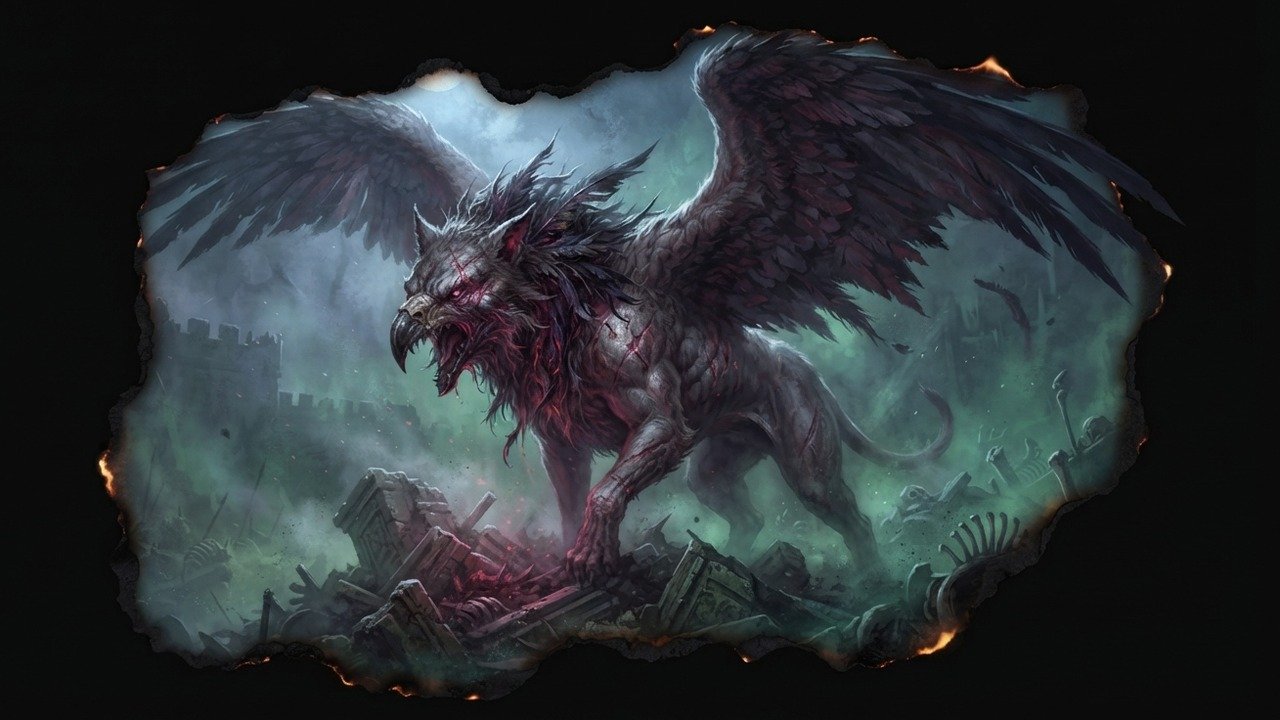
GLASYA-LABOLAS:
The Legacy of Glasya-Labolas: The Count of Homicide and Bloody Knowledge
Origin and Legend: The Roots of the Epidemic and the Spear
To unravel the primordial stratum of Glasya-Labolas, one must distance oneself from Renaissance grimoires and descend toward the chthonic cults and deities of havoc in the Fertile Crescent. Before its cataloging in European demonology as the thirty-first spirit of the Goetia, this force traced its roots back to the archaic notion of the god of plague and fratricidal slaughter, similar to the Mesopotamian attributions of Erra or the darker facets of the Phoenician Resheph. It was not born from Christian theological perversion, but from the personification of air corrupted by miasma, the ferocity of combat without honor, and the bloody outbreak of sudden epidemics. In primitive pantheons, it was not a demon in the modern sense, but an avatar of nature's destructive whim: the uncontrollable force that decimates armies before they even wield the sword, and the blind intelligence that guides the murderous blow in the shadows.
Historical Evolution: From Canine Demon to the Great Promoter of the Mist
With the systematization of demonic magic in Johann Weyer's Pseudomonarchia Daemonum and the Lemegeton (16th century), the entity was reconfigured under the title of Count and President of Hell. Medieval and Renaissance iconography fixed him indelibly: a massive dog equipped with griffin wings, a chimera merging carrion and nocturnal bird of prey. During the rise of the Inquisition and Renaissance rationalism, Glasya-Labolas underwent a profound esoteric redefinition. He ceased to be perceived solely as an instigator of massacres, transforming instead into the master of "liberal arts stained with blood," the revealer of the past and the future, and, above all, the architect of invisibility. Seventeenth-century dark alchemy recognized him not as a mere butcher, but as the force that dissolves the perception of others, allowing the practitioner to walk unseen through the manipulation of the astral field.
Esoteric Significance: The Dark Alchemy of Murder and Intellect
In the Dark Kabbalah and the psychology of deep archetypes, Glasya-Labolas dwells on the reverse side of the sphere of Geburah (Judgment/Strength), embodying violence stripped of justice: pure destruction. He is the archetype of the hyper-rational mind put at the service of systematic annihilation, the mathematical coldness that calculates entropy and collapse. In advanced Goetic magic, this entity does not represent blind chaos, but rather the disturbing synthesis between physical violence and superior intellect. He represents the psyche's capacity to completely detach from empathy in order to execute a drastic transformation. He is the manifestation of "swift death," the violent resolution of spiritual or earthly stagnations, and the alchemical understanding that destruction is, ultimately, the indispensable prelude to all dissolution and creation.
Practice and Manifestation: The Winged Hound in the Initiate's Reality
Glasya-Labolas does not operate with emotional subtleties; his action on the dense plane is abrupt, sharp, and freezing.
Manifestation in the Individual: He reveals himself as a sudden overload of cold lucidity, accompanied by drastic impulses to break away or a total detachment from the well-being of others in favor of survival or personal victory. In the physical environment, his presence generates dense atmospheric tensions, a penetrating sensation of canine breath, or gusts of freezing air that precede conflict or sudden illness.
Approach and Protection: Working with this energy demands a posture of absolute sovereignty and iron self-control. Glasya-Labolas devours emotional weakness and guilt; any loophole of doubt during his approach is channeled toward the magician's own self-destruction. To contain his destructive vector and prevent the fire of discord from consuming the practitioner's life, the safeguard does not lie in invoking external sacred names out of fear, but in the inflexible boundary of personal will. His influence must be channeled exclusively toward dissolving insurmountable obstacles or veiling one's own being from hostile gazes, keeping the mind as impassive as the blade of a scythe.
Comments
Share information, an experience, or a source to help enrich this entry. They are automatically reviewed before being published.
Loading comments...