Furcas
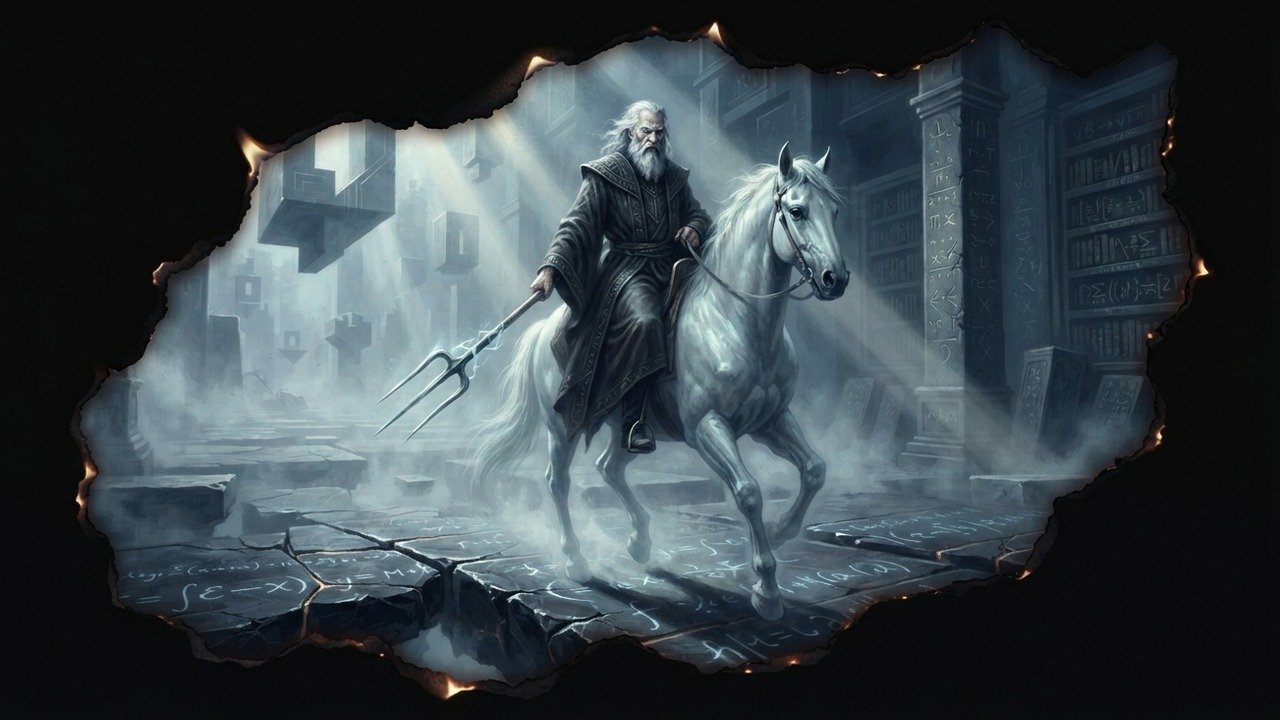
The Great Duke of Steel and the Logic of the Abyss
Origin and Legend
To find the genesis of Furcas, one must move away from monotheistic dogmas and descend into the earliest strata of Renaissance demonological taxonomy. He is prominently recorded in Johann Weyer's Pseudomonarchia Daemonum (1577) and later in the Lemegeton: Goetia (17th century). Unlike other spirits whose origins trace back to displaced deities of the Sumerian or Phoenician pantheons, Furcas embodies a direct abstraction of metallurgical rigor and medieval military discipline. His primordial iconography is not that of an amorphous monster, but of an old man of implacable physiognomy, bearded and white-haired, who holds the title of Knight or Infernal Duke. He invariably rides a pale or phosphorescent horse and holds a javelin or a three-pronged pitchfork in his right hand. The steel of his weapon and the rigid course of his mount are not theatrical ornaments; they represent the analytical penetration and the inflexibility of the material laws that govern the decay and order of matter.
Historical Evolution
In the inquisitorial and grimoire literature of the 16th and 17th centuries, Furcas was cataloged as one of the coldest and most mathematical spirits of the infernal hierarchy. He did not tempt devotees through the pleasures of the flesh or the promise of fleeting riches. The Church demonized him, identifying him as the inspirer of pagan philosophy and profane sciences that challenged blind faith. However, in the alchemical treatises and underground esoteric academies of the Enlightenment, his figure underwent a profound reevaluation. He ceased to be seen as a torturer of the underworld and came to be understood as the archetype of stern logic. He was recognized as the master teacher of the traditional sciences: astronomy, rhetoric, logic, chiromancy, and pyromancy. His evolution was that of a force destroying illusions to an architect of analytical thought within classical Hermeticism.
Esoteric Significance
In the structure of the Dark Kabbalah and the map of the Qliphoth, Furcas is the condensation of the rigor that dissects ignorance. He represents the mind without sentimental shackles, the clinical intelligence that operates like a scalpel on the ego. Within the alchemical plane, he embodies the phase of Calcinatio: the dry and unwavering fire that reduces the individual's opinions and fantasies to ashes, leaving only the mineral structure of truth. Psychologically, he is the archetype of indomitable inner discipline. He is the ability to contemplate personal chaos or decay without flinching, using the intellect not to justify weakness, but to categorize, understand, and subdue it. Furcas is not the passion that burns, but the bone structure that supports the mind when emotions have dissolved.
Practice and Manifestation
The influence of Furcas is not perceived through emotional jolts or convulsive apparitions; his presence is a current of freezing glacial air and extreme lucidity.
Manifestation in the individual: It expresses itself when the individual experiences absolute mental clarity, stripped of drama, fear, or self-pity. It is the axiomatic thought that allows a complex problem to be solved by isolating its variables.
Interaction and Sovereignty: This energy does not respond to sentimentalism or pleas. Working with the vector of Furcas demands the posture of an impartial observer. To channel his edifying aspect—mastery of the analytical arts and the reading of the laws of cause and effect—the operator must approach reality from a strict mental neutrality.
Protection and Balance: An excess of this current without proper integration leads to paralysis by analysis, destructive cynicism, and the atrophy of the emotional body. Protection against his dark polarity does not require dogmatic exorcisms, but rather the deliberate counterweight of bodily vitality and empathy. Balance is maintained by remembering that logic is a tool for ordering, but not the entirety of life.
Comments
Share information, an experience, or a source to help enrich this entry. They are automatically reviewed before being published.
Loading comments...