Ipos
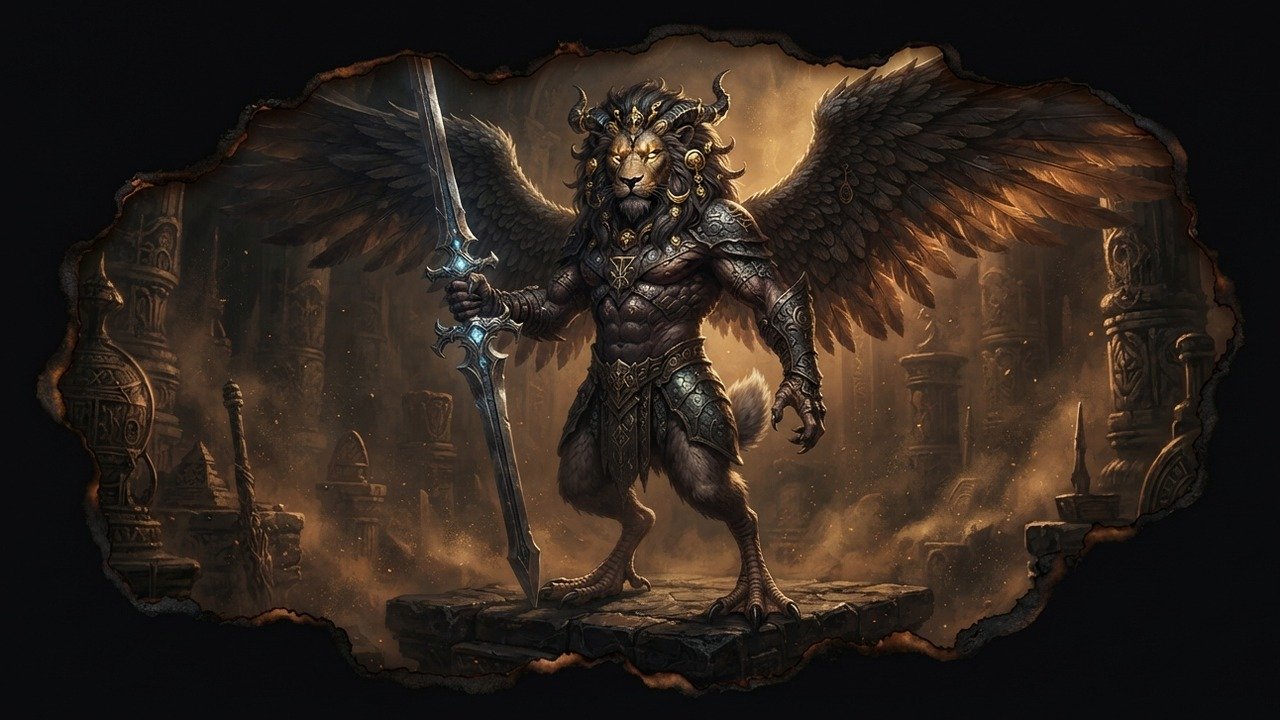
Ipos
The Prince of Intuition and Imposing Presence
1. Origin and Legend
Ipos traces his roots back to the sacred iconography of the ancient Mesopotamian and Egyptian empires, where figures composed of parts of a lion, a goose, and a hare symbolized the synthesis of opposing divine virtues. In the original myth, he was not a demon, but a representation of nocturnal vigilance and cunning. The lion represented courage and royal dominion; the goose, hypervigilance and the ability to detect danger from a great distance; the hare, quickness of response and adaptive intuition. These qualities made his archetype the guardian of mysteries and of kings in times of conflict.
2. Historical Evolution
In medieval grimoires such as the Pseudomonarchia Daemonum, Ipos was relegated to the status of Count and Prince of Hell, commanding thirty and sixty legions of demons. Demonology described him as an angel with the head of a lion, the feet of a goose, and the tail of a hare (or a lion with parts of these animals). Despite his grotesque appearance in medieval ecclesiastical illustrations, the texts maintained the attribution of his original gifts: making men bold, perceptive, and capable of knowing the future and the past, transforming awkwardness into eloquence and majesty.
3. Esoteric Significance
Ipos represents the mastery of presence and the development of Esoteric Charisma. In the work of the Left-Hand Path, he is the archetype of Augmented Mental Strength and Psychic Processing Speed. He symbolizes the integration of brute strength (lion) with sensory acuity (goose) and the capacity for strategic evasion (hare). In mental alchemy, Ipos helps dissolve shyness, fear of others' judgment, and indecision, allowing the individual to occupy their space with authority and project an aura of invulnerability and personal magnetism.
4. Practice and Manifestation
This current acts directly on the mind, the nervous system, and the electromagnetic field of the individual. Ipos's energy is perceived as an acceleration of thought, an instantaneous sharpening of the senses, and an unwavering firmness in the voice and body posture. It manifests in moments of crisis where drastic and immediate decision-making is required, or in social situations where leadership must be exercised. To work with this force, the practitioner must cultivate temperance and anger control; excessive arrogance breaks the balance of this energy and leads to recklessness. Protection lies in absolute emotional self-control.
Comments
Share information, an experience, or a source to help enrich this entry. They are automatically reviewed before being published.
Loading comments...