Loch Ness Monster
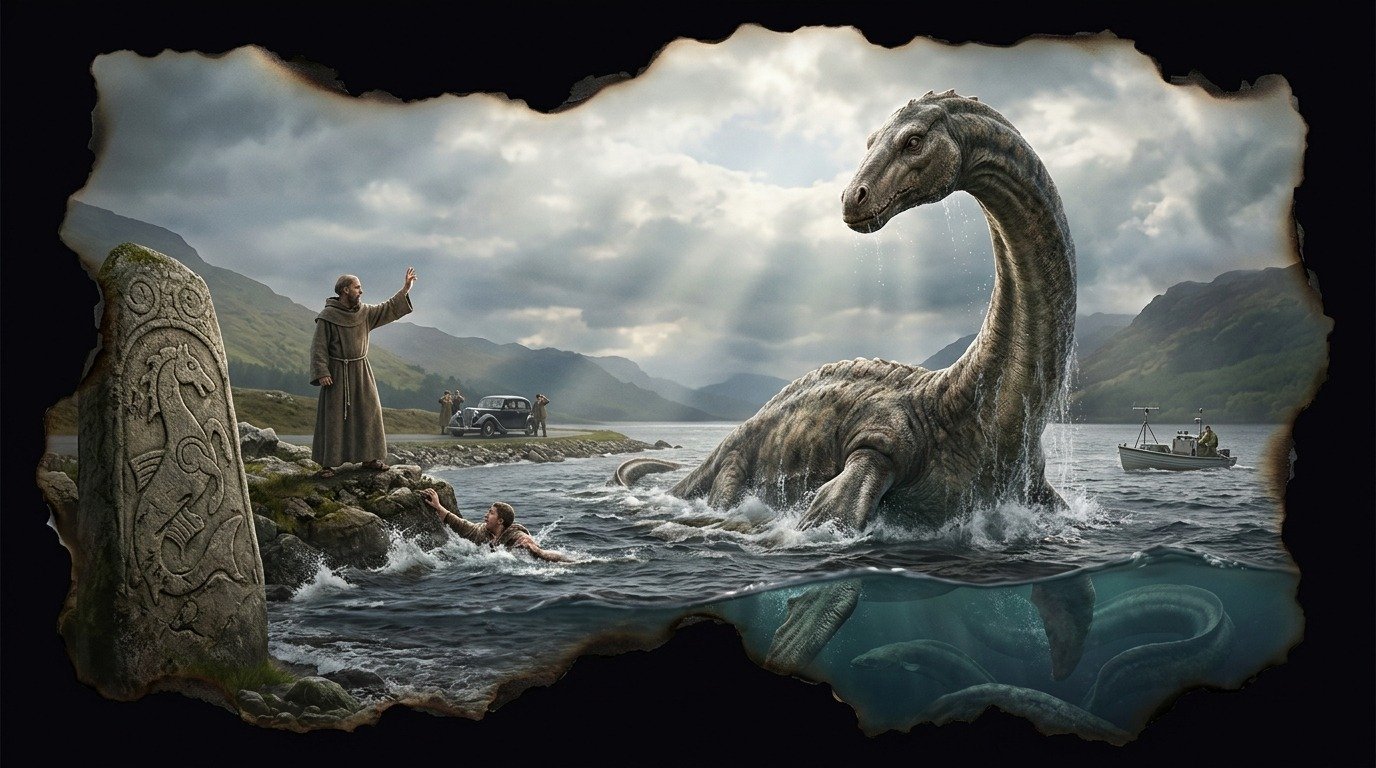
Nessie: The Fluvial Mystery of the Highlands
Pictish Origins and Celtic Hagiography
In the heart of the Scottish Highlands, the Great Valley (*Great Glen*) is home to Loch Ness, a massive tectonic trench of cold, dense, peat-laden water that reaches depths of over two hundred meters (656 feet). The record of a serpentine entity in these waters does not begin with the era of tourism, but with the stone carvings of the Picts, the ancient confederation of Celtic tribes that inhabited northern Scotland. On their stelae from the 1st to the 4th century AD, a stylized aquatic animal with flippers, a long neck, and a horse-like head repeatedly appears, known by archaeologists as the "Pictish Beast." La first detailed written mention of the creature is found in the *Vita Columbae* (Life of Saint Columba), written in the 7th century AD by Abbot Adomnán of Iona. The text relates an event that occurred in the year 565 AD on the banks of the River Ness. Saint Columba, the holy apostle who Christianized the Picts, saved a local who was being attacked by a "water monster" (*aquatilis bestia*). According to the hagiography, Columba raised his hand, made the sign of the cross in the air, and ordered the creature to retreat with the words: *"You shall go no further. Do not touch the man. Go back immediately."* The being obeyed, submerging into the dark depths to the astonishment of the pagans present, an event that led to their conversion to Christianity.
The Fever of 1933 and the Technological Era
The ancestral myth of the *Each-Uisge* (the water horse of Gaelic mythology) mutated into a global mass phenomenon in 1933. The construction of the A82 road along the northern shore of the loch cleared the dense shoreline vegetation, offering a clear panoramic view of the water's surface for the first time. In May of that year, the *Inverness Courier* newspaper published the sighting by the married couple Aldie and John Mackay, who described seeing a huge creature agitating the water of the loch. Months later, George Spicer and his wife claimed to have seen a long-necked prehistoric animal cross the road in front of their car, heading toward the loch. The iconic "Surgeon's Photograph," allegedly taken by gynecologist Robert Kenneth Wilson and published in the *Daily Mail* in 1934, defined the archetypal image of "Nessie" as a surviving plesiosaur from the age of the dinosaurs. Although in 1994 it was revealed that the image was a hoax perpetrated with a toy submarine and plasticine by Christian Spurling and Marmaduke Wetherell, the cultural impact was already irreversible. Over the decades, the loch has been the subject of exhaustive sonar sweeps. Notable among these are the Boston Academy of Applied Sciences expedition led by Robert Rines in the 1970s—which obtained blurry underwater images of what appeared to be a rhomboidal flipper—and Operation Deepscan in 1987, which deployed a fleet of boats equipped with side-scan sonar, obtaining contacts of large moving targets traveling at inexplicable depths. In 2019, an environmental DNA (eDNA) study led by geneticist Neil Gemmell of the University of Otago analyzed the water of the loch, ruling out the presence of giant reptiles or marine mammals, but revealing a massive amount of genetic material from giant eels (*Anguilla anguilla*), which opened a new avenue of scientific explanation for the phenomenon.
The Water Serpent Archetype
From the standpoint of Western esotericism and comparative mythology, the Loch Ness Monster represents the archetype of the primordial serpent of the depths, the Leviathan or the water dragon that guards hidden knowledge at the bottom of the abyss. Still, dark water is the perfect symbol of the human unconscious; Nessie is that which dwells in the deepest layers of the mind, a chthonic force that periodically emerges to the surface of waking consciousness before submerging once again into the inscrutable. At the end of the 19th century, the famous occultist Aleister Crowley acquired Boleskine House, located on the southern shore of Loch Ness, in order to perform the complex rituals of theurgic magic contained in *The Book of the Sacred Magic of Abramelin the Mage*. The choice of location was not accidental: Crowley considered the Loch Ness area to be a natural energy vortex of great power, a portal where the barriers between the physical plane and the subtle planes were extraordinarily thin, suggesting that the "beast" of the loch was an astral manifestation or a guardian of that threshold.
Phenomenology and Patterns of the Loch
For observers of the loch, it is essential to distinguish physical anomalies from potential biological or metaphysical manifestations: * **Seiches and Standing Waves:** Loch Ness is prone to water surface oscillations caused by wind and temperature differences between water layers (thermocline). These standing waves can create the optical illusion of a wake or the back of an animal swimming against the current. * **Temperature Mirages:** The refraction of light over cold water on warm days can distort floating logs or waterfowl, making them appear as colossal structures on the horizon line. * **Sonar Anomalies:** Internal currents and dense sediments falling from the steep walls of the loch often generate false readings that mimic moving bodies. Anyone seeking to attune to the energy of the loch must understand that the mystery does not reveal itself to invasive technological scrutiny. It is in the twilight hours, when the northern mist covers the surface of the water and the wind ceases, that the threshold opens for those endowed with the patience of the silent observer.
Comments
Share information, an experience, or a source to help enrich this entry. They are automatically reviewed before being published.
Loading comments...