Jersey Devil
Jersey Devil: The Thirteenth Beast of the Pine Barrens
The Outlawed Lineage: History and Genesis of the Legend
The origin of the Jersey Devil is deeply rooted in the Anglo-Saxon colonization of North America, specifically in the inhospitable and dense forested region known as the Pine Barrens in southern New Jersey. The historical genesis of the creature is set in the year 1735 and revolves around the real-life figure of Deborah Leeds, known in local folklore as "Mother Leeds." Married to Japhet Leeds, a man of violent temperament, and overwhelmed by poverty in a hostile environment, Mother Leeds discovered she was pregnant with her thirteenth child. In a fit of despair, she cursed the unborn child, crying out: "Let this one be a devil!"
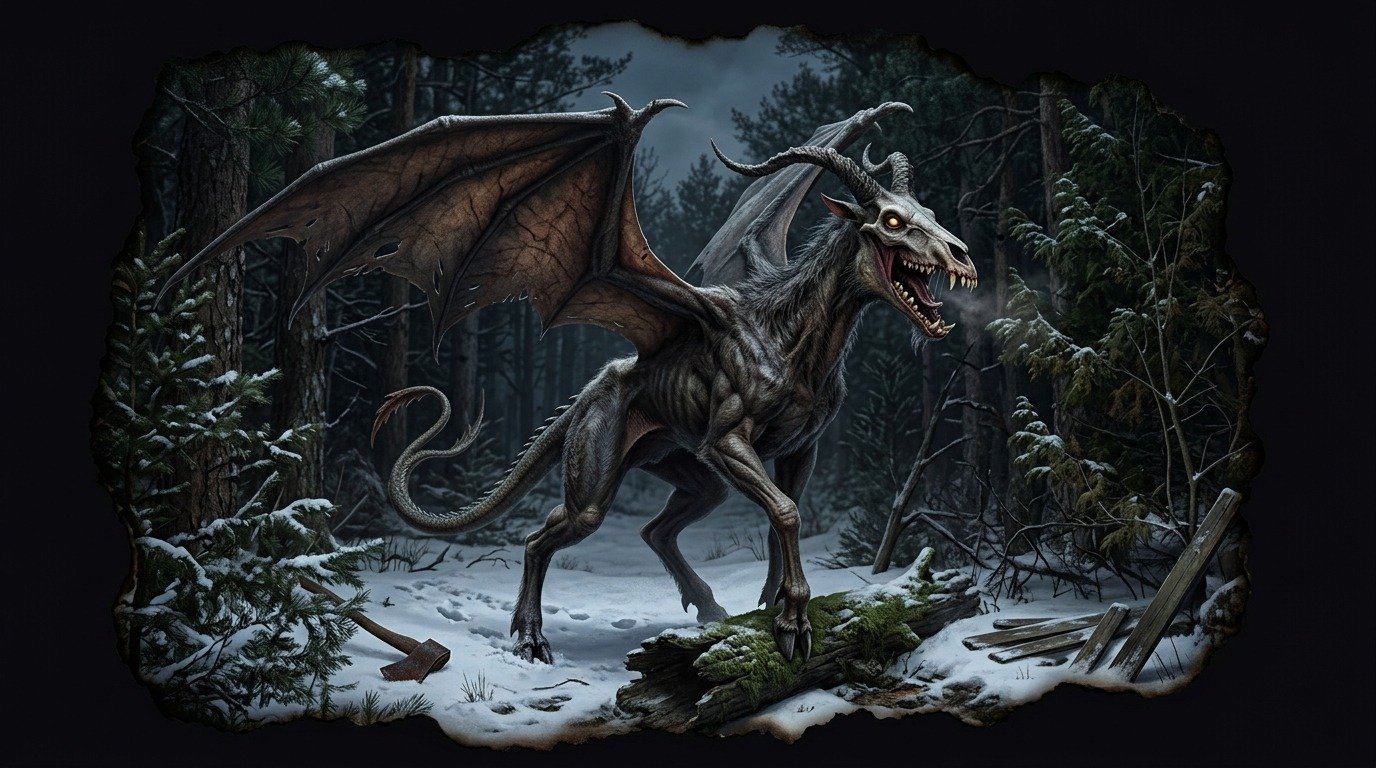
Legend has it that, during a stormy night, the birth took place in the remote town of Estellville. The child was initially born with a normal human appearance, but within minutes it mutated before the horrified eyes of the midwife and the family members present: it sprouted bat wings, cloven hooves, a forked tail, and the head of a horse or goat. After emitting a shrill shriek that curdled the blood of those present, the creature killed everyone there and escaped through the chimney into the vastness of the pine barrens.
However, behind the folkloric myth lies a complex web of political and religious disputes from the colonial era. Daniel Leeds, a Quaker astrologer and almanac publisher who resided in the area in the late 17th century, was outlawed by his community due to his esoteric and pagan-leaning publications. His political and theological rivals, including Benjamin Franklin, branded him a "Satanist" and used the figure of a heraldic monster in pamphlets to ridicule the Leeds lineage. Over the decades, this political propaganda merged with the colonists' fear of the unexplored forest, giving physical birth to the myth.
Metamorphosis of a Chimera: From Pamphlet to Forest
The evolution of the Jersey Devil is a testament to how psychosocial tension can shape perceived reality. During the 19th century, the specter of the Pine Barrens ceased to be a mere colonial superstition and became an active physical presence on the fringes of the nascent industrial civilization. It was blamed for livestock slaughter, terrifying noises on winter nights, and chance encounters on rural roads.
The environment of the Pine Barrens facilitated this assimilation. It is a vast ecosystem of sandy soil, iron-stained acidic waters, and dense pine and cedar forests that seems to actively resist human domestication. In this green wilderness, the creature found its sanctuary. Unlike other monsters of European folklore that underwent a process of demystification during the Enlightenment, the Jersey Devil grew stronger, becoming the symbol of the untamed nature that stalks the outskirts of the prosperous colonial cities of Philadelphia and New York.
The 1909 Wave and the Footprint of the Beast
The most documented and massive manifestation of the phenomenon occurred between January 16 and 23, 1909. During this week, the state of New Jersey and adjacent parts of Pennsylvania experienced a collective hysteria unprecedented in the modern era. Thousands of people claimed to have seen the creature or to have found its tracks in the snow.
The tracks took the form of cloven hooves that crossed impossible distances, traversing rooftops, jumping high walls, and disappearing under fences. The panic was of such magnitude that schools closed, factories suspended their night shifts for fear of workers being attacked on their commutes, and armed militias were deployed in the forests. Even the Philadelphia Zoo offered a $10,000 reward for the capture of the specimen, leading various hoaxers to exhibit painted kangaroos with artificial wings glued to their backs.
During this wave, police and fire patrols claimed to have shot at the monster in places like Camden and Bristol, but the bullets seemed to have no effect on its leathery skin. Testimonies agreed in describing a sharp, metallic scream, capable of paralyzing those who heard it with terror.
Occult Anatomy and Esoteric Symbolism
The Jersey Devil is a living compendium of the classic iconography of the adversary and the scapegoat. Its anatomy combines elements of various heraldic and symbolic beasts:
* **The head of a horse or goat:** Associated with the pagan god Pan and the he-goats of the witches' Sabbath. It represents the lowest instincts and the wild fertility of untamed nature. * **Bat wings:** A symbol of the night, of spiritual blindness, and of the underworld. Unlike the feathered wings of angels, the bat's membranes denote a chthonic nature. * **Cloven hooves:** The classic attribute of the biblical devil, symbolizing division, imbalance, and the inability to walk upright according to divine precepts.
From the perspective of depth psychology, the Jersey Devil represents the collective "Shadow" of Puritan and Quaker communities. By rejecting and repressing the darkest, wildest, and most magical aspects of human existence, these colonists projected their fears onto the immense forests that surrounded them. Mother Leeds' thirteenth child is, ultimately, the return of the repressed: a monster birthed by moral rigor and geographical isolation.
Comments
Share information, an experience, or a source to help enrich this entry. They are automatically reviewed before being published.
Loading comments...