Chupacabras
Chupacabras: The Bloodthirsty Scourge of Deep America
The Puerto Rico Outbreak (1995)
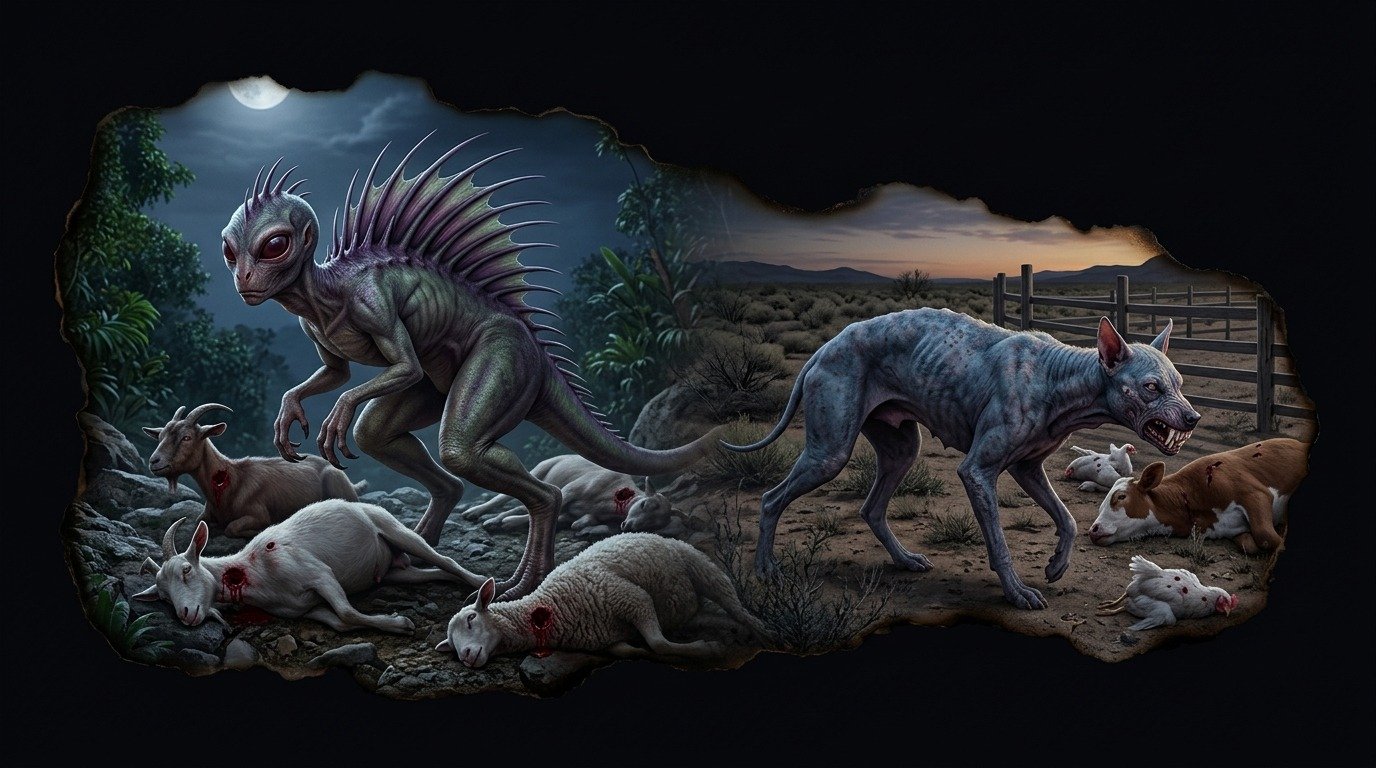
Unlike cryptids whose origins fade into the centuries, the Chupacabras possesses a precise date and geographical epicenter of appearance. In March 1995, in the municipality of Canóvanas, in the northeast of the island of Puerto Rico, massive and systematic deaths of farm animals—goats, sheep, horses, and poultry—began to be recorded. The victims presented a common and terrifying characteristic: they showed no signs of tearing or meat consumption by common predators; instead, they exhibited small, deep, circular holes in the neck or chest area through which their bodies had been completely drained of blood. The foundational description of the creature was provided by witness Madelyne Tolentino in August 1995. Her testimony detailed a bipedal being, approximately three to four feet (1 to 1.20 meters) tall, with large, almond-shaped black or reddish eyes, short arms with three-fingered claws, strong hind legs adapted for making great leaps (similar to those of a kangaroo), and a row of membranous spines or flexible quills along its back that seemed to change color. This physiognomy, which vividly recalled classical representations of grey aliens crossed with elements of contemporary cinematic science fiction (particularly the design of the hybrid being from the movie *Species*, released that same year), unleashed a collective hysteria baptized by Puerto Rican comedian and entrepreneur Silverio Pérez as "El Chupacabras."
Continental Transmutation (The Mangy Canid)
As the phenomenon expanded geographically toward the Dominican Republic, Mexico, Central America, and the southwestern United States (Texas, New Mexico, Arizona) in the late 1990s and early 2000s, the creature's morphology underwent a radical mutation in reports. The bipedal, alien figure of Puerto Rico was replaced by a quadrupedal being, canine or feline in appearance, devoid of hair, with wrinkled bluish-grey skin, prominent jaws, and hypertrophied fangs. Scientific and veterinary investigations of the carcasses of these "canine chupacabras" shot by ranchers in Texas and northern Mexico yielded conclusive results in the vast majority of cases analyzed by universities such as Michigan: they were coyotes (*Canis latrans*), feral dogs, or foxes suffering from extreme cases of sarcoptic mange (*Sarcoptes scabiei*). The disease, by destroying the hair follicle, contracting the skin around the mouth to give the appearance of a skeletal grin, and inflaming peripheral blood vessels, transformed a common predator into a nightmare creature. Unable to hunt fast wild prey due to their physical weakness, these sick animals resorted to domestic livestock enclosed in pens, attacking in an erratic and inefficient manner, which explained the puncture wounds and deaths without consumption of muscle tissue.
Symbology of Modern Vampirism and State Paranoia
From a socio-anthropological and historical perspective, the myth of the Chupacabras is a reflection of political tensions, Cold War paranoia, and distrust of secret government experiments. In Puerto Rico, the phenomenon was initially concentrated in areas near the El Yunque National Forest and the military facilities of the Roosevelt Roads Naval Station. Popular rumors suggested that the creature was the result of a US military genetic engineering experiment that had escaped from a high-security laboratory. Esoterically, the modern Chupacabras updates the ancestral archetype of the vampire. It represents the physical and parasitic entity, the invisible force that extracts the vital essence (blood) of the innocent and helpless without its presence being perceived until the damage is already lethal. In modern cosmology, it replaces the ancient incubus and succubus demons of medieval Europe, adapting to the technological and extraterrestrial iconography characteristic of the information age.
Attack Record and Identification
For the field investigator evaluating potential livestock mutilations attributed to the Chupacabras, it is necessary to apply a rigorous forensic exclusion protocol: * **Wound Analysis:** Common attacks by wild canids present irregular tears, broken bones, and consumption of viscera. Chupacabras wounds are characterized by one, two, or three perfect cylindrical incisions, between 0.4 and 0.8 inches (one and two centimeters) in diameter, with cauterized or clean edges, penetrating directly into the prey's carotid artery or heart. * **Absence of Rigor Mortis:** A recurring pattern in reports of anomalous attacks is that the victims' bodies remain flexible and warm for hours after clinical death, with an almost total absence of coagulation of the remaining blood within the circulatory system. * **Animal Behavior:** The presence of the predator is usually preceded by absolute silence in the nocturnal environment; common guard dogs refuse to bark or show extreme terror, seeking shelter under structures before the attacks occur. Traditional protection against this parasitic energy involves the use of sulfur scattered around the perimeters of the pens, constant high-intensity artificial light during the night, and, on the esoteric level, the runic consecration of entry barriers to prevent the passage of entities operating on the margins of physical perception.
The First Caribbean Wave: The Bio-Synthetic Cryptid
The victims of Canóvanas presented a recurring clinical pattern: perfectly circular puncture incisions in the jugular or pectoral area, total extraction of the blood mass without surrounding spillage, absence of accelerated cadaveric decomposition, and, in multiple cases, the surgical removal of internal organs without adjacent muscle laceration.
In another version of Madelyne Tolentino's testimony, the being measured 4 to 5 feet (1.20 to 1.50 meters) tall, with a graceful and insectoid aesthetic, an oval head with disproportionate large red eyes, scaly or greyish skin with a damp texture, atrophied arms ending in sharp claws, and a row of flexible spines or crests along the spine that seemed to change luminous coloration. This bipedal variant of extraterrestrial appearance dominated the first wave of collective panic in the Caribbean, Mexico, and Central America.
From the Caribbean to Texas: Two Creatures in One
The transition of the entity offers a unique case study on the malleability of folklore in the era of mass information. In 1995, in Puerto Rico and the Caribbean, the Chupacabras was bipedal and bio-robotic, with giant red eyes and a luminous spinal crest, with an origin attributed to extraterrestrials or US laboratories; in the 2000s, in the US Southwest, it became a canine quadruped with bare blue skin due to mange, an opportunistic predator attributed to canid mutations.
DNA analyses performed on carcasses shot by farmers in Texas (such as the famous "Cuero specimen") revealed that these creatures were actually coyotes (*Canis latrans*), feral dogs, or hybridizations of both devastated by severe cases of sarcoptic mange (*Sarcoptes scabiei*). The hyperkeratosis caused by the mite causes the skin to thicken, lose hair, become dark grey pigmented, and wrinkle to the point of drastically modifying the appearance of the canid.
The Monster of the Global Laboratory
Despite the biological explanations for the quadrupedal variant, the original bipedal Chupacabras of Puerto Rico functions as a sociological archetype of the fear of scientific experimentation and military invasion. The cradle of the myth is not accidental: Puerto Rico has historically been a territory subjected to secret military maneuvers and pharmaceutical trials (such as the US Navy's chemical experiments on the island of Vieques or contraceptive testing in the 1950s).
The Chupacabras is the monster of the global laboratory, the embodiment of the state secret. It is perceived not as a spiritual demon from sacred texts, but as a bio-synthetic product, a "test wall" or a genetic specimen that escaped the control of the El Yunque Radar Complex or underground facilities outside local sovereignty. It symbolizes the fear of uncontrolled technology that parasitizes the primary rural economy (subsistence livestock) on an island trapped between colonial isolation and forced modernization.
Field Marks of the Caribbean Wave
The phenomenology associated with the Caribbean Chupacabras includes highly unusual field marks gathered by researchers of the era, such as sociologist Jorge Martín: * **Anomalies at Mutilation Sites:** The total absence of footprints around the victims, despite being found on muddy ground after heavy tropical rains. Histological analysis of the incisions on the animals' skin showed cauterized or clean edges, incommensurable with the bite marks of known predators of the Antillean fauna (such as the mongoose or the feral dog). * **Sulfurous and Acoustic Phenomena:** Direct testimonies in Canóvanas and Naguabo coincided in reporting a dense stench of sulfur or ammonia in the minutes before and after the discovery of the dead animals, accompanied by a high-frequency hum that caused sudden panic in surrounding domestic animals. * **Sighting Protocol:** Unlike traditional vampires, the Chupacabras does not respond to sacred religious symbols or classic apotropaic plants. Central American popular wisdom recommended the use of high-intensity lighting to blind the creature (due to the photosensitivity of its large eyeballs) and the containment of pens through electromagnetic or reinforced steel infrastructure.
Comments
Share information, an experience, or a source to help enrich this entry. They are automatically reviewed before being published.
Loading comments...