Bunyip
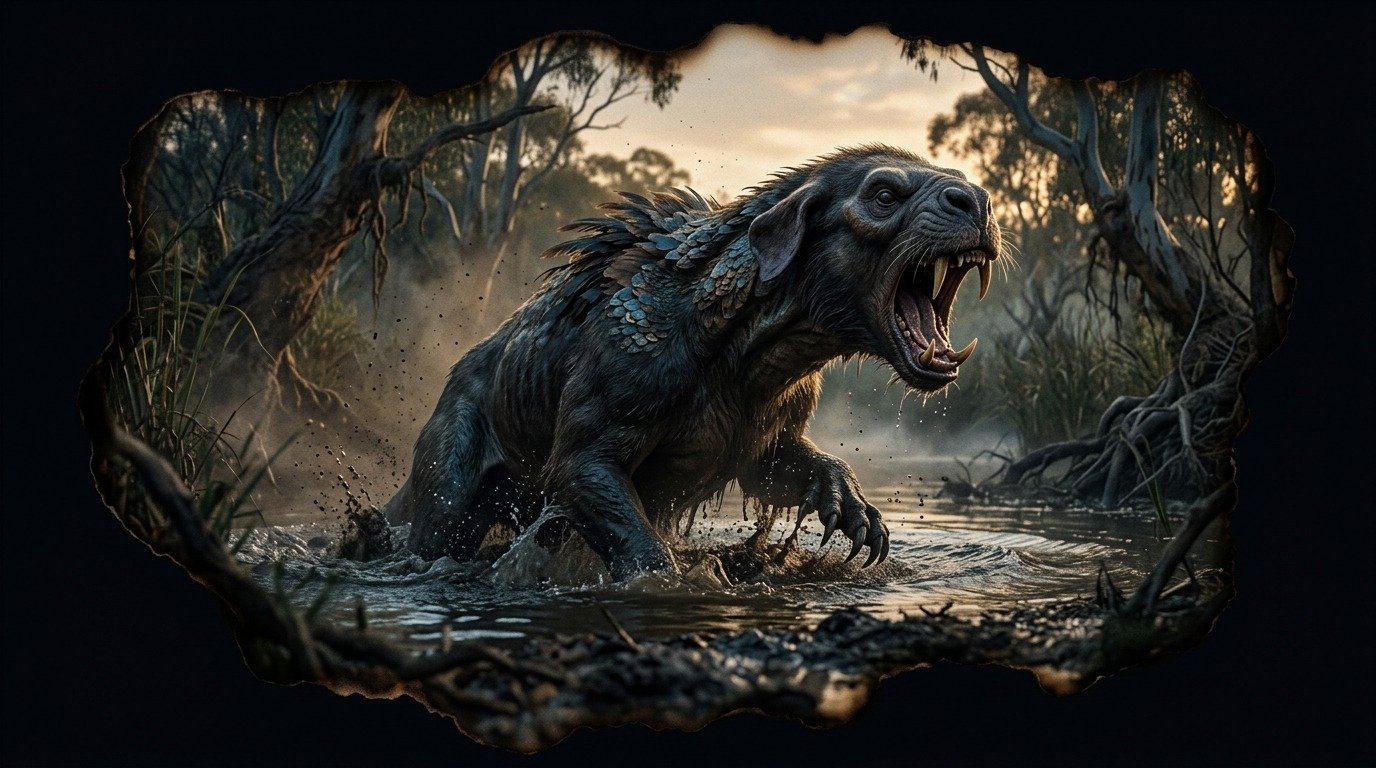
Bunyip: the devouring clamor of the Australian billabongs
The Aboriginal Root and Regional Variations
The term "Bunyip" has its roots in the Wemba-Wemba (or Wergaia) language of southeastern Australia, traditionally translating as "demon," "evil spirit," or "water deity." Unlike the lake monsters of the Northern Hemisphere, whose physiognomy is usually reptilian or plesiosaurian, the Bunyip is a creature of a markedly chimeric and protean character, whose descriptions vary drastically depending on the geography and the Aboriginal tribe recounting its presence. For some communities in the interior of New South Wales and Victoria, the Bunyip manifests with the face of a giant dog or seal, dark fur, prominent fangs, and floppy ears. For other tribes of the desert plains, it is a long-necked amphibious creature with iridescent feathers or scales and hind legs equipped with sharp claws. However, all traditions agree on its habitat: *billabongs* (abandoned meanders or seasonal lagoons), swamps, dark waterholes, and rushing rivers. The Bunyip is the undisputed lord of stagnant waters, a territory where life and death meet in constant tension.
Colonization and Cryptozoological Classification
For the European settlers who arrived on the Australian continent in the late 18th and during the 19th centuries, the hostile and unfamiliar landscape fostered the rapid assimilation of the Bunyip myth. What began as a native superstition soon became an obsession for Western naturalists. In 1846, the discovery of an unusual skull on the banks of the Murrumbidgee River, which exhibited characteristics of an unknown mammal with elevated eye sockets and powerful jaws, was temporarily cataloged by newspapers of the time as the skull of a legitimate Bunyip, before being stolen from the Sydney Museum and subsequently identified as the malformed skull of a colt or a calf. Modern scientists and paleontologists suggest that the Bunyip myth has a real historical basis grounded in the collective Aboriginal memory of the extinct Pleistocene megafauna, specifically the *Diprotodon optatum*—a rhinoceros-sized herbivorous marsupial that lived near water sources—or the *Palorchestes azael*, a marsupial with a small trunk similar to that of a tapir.
Social Warning and Ecological Preservation
In the context of survival in the unforgiving Australian outback, the Bunyip myth fulfilled a vital pedagogical, social, and safety function. Tribe elders used the dread inspired by the creature to keep children away from the muddy and unstable banks of the *billabongs*, where the danger of drowning or attacks by freshwater crocodiles and venomous snakes was constant. Likewise, the terrifying roar attributed to the Bunyip during stormy nights—which naturalists today identify as the call of the Australasian bittern (*Botaurus poiciloptilus*), a nocturnal heron with a deep, booming call—served as a natural warning system to prevent clans from settling in areas prone to flash flooding.
Esoteric and Psychic Dimension
From an esoteric perspective, the Bunyip is the materialization of the terror of the hidden in the Australian landscape; it represents the hostile and retributive spirit of an old land that refuses to be tamed by the parameters of European reason. While the colonizer attempts to drain the swamps and parcel out the land for agriculture, the Bunyip emerges from the mire as a reminder of primordial chaos. It is the archetype of the water guardian on a continent ravaged by extreme drought: a devouring force that punishes the desecration of scarce sacred and purifying water sources, reminding us that the water that gives life also possesses the capacity to devour those who do not respect its untamable nature.
The Dreamtime: Mulyawonk and Kianpraty
In the cosmologies of the Dreamtime (*Alcheringa* or *Dreamtime*), this entity is not a mere cryptozoological animal, but a spiritual force linked to bodies of freshwater: *billabongs*, swamps, deep creeks, and muddy lagoons. The *wemba-wemba* word belongs to the Kulin linguistic group of southeastern Australia. For the peoples of the Murray-Darling basin, such as the *Ngarrindjeri*, the creature is known as *Mulyawonk*, a river deity who punishes those who transgress fishing laws and disturb the balance of the water. Other regional variants, such as the *Kianpraty* along the inland rivers of Victoria, describe it as an implacable predator that waits beneath the green mantle of algae. Far from being a unified legend, the Bunyip is an amalgam of hydrographic terrors: each clan possessed its own name and its own taboo regarding the gloomy spots where water stagnates and the wind whistles through the reeds.
The swamp chimera in the colonial press
With the arrival of European settlers in the 19th century, the Aboriginal myth was reinterpreted through the prism of Gothic terror and Victorian scientific taxonomy. In 1845, *The Geelong Advertiser* newspaper reported the discovery of a fossilized bone integrated into the anatomy of an alleged specimen, describing the Bunyip as a chimera that united characteristics of a giant bird and an alligator: the head of an emu, a long bill tipped with serrated projections, highly powerful hind limbs, and curved claws. Other chronicles offer a canine- or seal-like creature with dark, sleek fur, flashing eyes, prominent fangs, and a deafening roar that curdled the blood of gold prospectors on moonless nights. In addition to the *Diprotodon* (the giant marsupial extinct about 46,000 years ago) and the *Palorchestes*, modern researchers propose the erratic sighting of sea lions (*Neophoca cinerea*) that traveled up inland river systems during floods, disoriented and emitting their characteristic guttural bellows.
The betrayal of water
On the plane of deep psychology and telluric esotericism, the Bunyip represents the threshold between the domesticated and the unfathomable. Australia is a continent of climatic extremes, where drought and flood dictate survival. The Bunyip is the personification of the betrayal of water: the well that quenches thirst is also the place where sudden death dwells. It is the herald of the "Great Shadow of the Earth," an archetype that reminds us that stagnant water is not synonymous with stillness, but with a slow and silent digestion of life.
Protocols of respect and preservation
For the investigator of the arcane or the traveler venturing into the river basins of the Australian interior, the traditional guidelines of the custodians of the land are of strict compliance: * **The Silence of Twilight:** One must not disturb the surface of an isolated *billabong* after sunset. Unnecessary vibrations attract the updrafts that folklore attributes to the movement of the Bunyip. * **The Prohibition of Waste:** The blood and entrails of game or fish must never be thrown into stagnant water. The *Mulyawonk* tracks the desecration of the vital resource through the scent of death. * **The Recognition of the Clamor:** If during the night a dull bellow is heard, similar to the rumble of underground thunder that makes the clay soil vibrate near riverbeds, one must retreat immediately to high ground. It is not an atmospheric sound, but the acoustic warning that the territory has been claimed by its oldest inhabitant.
Comments
Share information, an experience, or a source to help enrich this entry. They are automatically reviewed before being published.
Loading comments...