Bigfoot Sasquatch
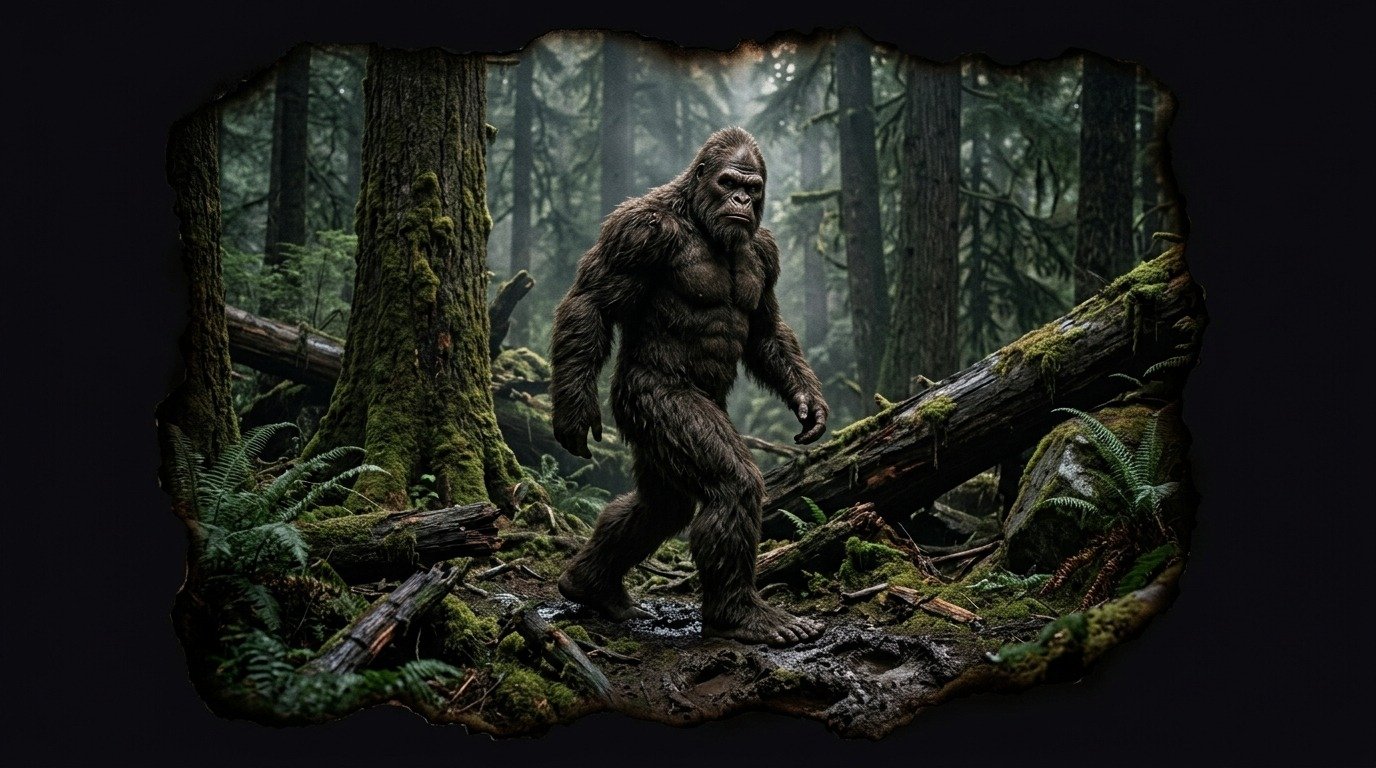
Sasquatch: The Silent Guardian of the Boreal Forests
Origin and Indigenous Roots
The figure that contemporary mass culture calls "Bigfoot" (Bigfoot) sinks its true roots into the cosmogonies and oral traditions of the Indigenous nations of the northwestern American continent. Long before the logging industry and sensationalism seekers mapped the temperate forests of British Columbia, Washington, and Oregon, the Coast Salish peoples already respected the presence of the *sásq'ets* (a term from the Halkomelem language that roughly translates to "wild man" or "hairy being"). For these cultures, the *sásq'ets* was neither a zoological anomaly nor a monster in the Western sense, but a sovereign and sacred people. The stories of the Klamath, Modoc, Hoopa, and Yurok peoples describe these entities as guardians of the forest boundaries, beings endowed with a deep connection to earth medicine and possessing abilities that defy three-dimensional physics, such as the capacity to become invisible at will or transmute into elements of the environment. In their ceremonial representations, Sasquatch masks exhibit pronounced anthropomorphic features, deep-set eyes, and prominent sagittal crests—elements that denote reverence toward an ancestral relative who chose to remain in the primal state of creation.
The Construction of the Modern Myth and Cryptozoology
The transition of the entity from Indigenous myth to a global cryptozoological phenomenon was consolidated in the mid-20th century. The founding milestone occurred in 1958 in Bluff Creek, California, when heavy machinery operator Jerry Crew discovered and made plaster casts of humanoid footprints forty-one centimeters (16 inches) in length. It was in this context that the press coined the term "Bigfoot," assimilating the creature into popular culture. The documentary turning point occurred on October 20, 1967, in the same locality of Bluff Creek, when Roger Patterson and Robert Gimlin filmed a brief sequence of 16 mm film. The footage shows a bipedal, massive figure covered in dark hair, later identified as a female dubbed "Patty." Biomechanical analyses of the film, conducted by anatomists and visual effects experts, remain a subject of debate: the presence of a gait with constant knee flexion (compliant gait), the location of the center of gravity, and the visibility of musculature beneath the fur suggest to proponents of its authenticity an unclassified hominid, endowed with a "midtarsal break" in the foot—an anatomical feature absent in modern humans but common in other primates.
Symbology and Psychology of the Wild Man
From an esoteric and analytical perspective, Sasquatch embodies the archetype of the "Wild Man" (*Homo sylvestris*), a constant in the collective unconscious of humanity. It represents the shadow of industrial civilization: that which remains untamed, pure, and free from the shackles of technological progress. In depth psychology, the search for Bigfoot is the search for our own lost primordial nature, an attempt at reconciliation with the mystery of the virgin forest. In contemporary esoteric currents, it is associated with vibrational frequencies different from those of humans, suggesting that these beings act as living nodes of Earth's energy (ley lines). Their systematic evasion of physical capture and the absence of conclusive skeletal remains have led to theories, within frontier mysticism circles, that Sasquatch is a liminal being, an inhabitant of the thresholds between worlds who uses dense forest systems as transition portals.
Evidence and Guidelines for Encounters
The phenomenology associated with Sasquatch is composed of a corpus of data that exceeds mere physical footprints: * **Unidentified Acoustics:** Recording of complex vocalizations known as "samurai chatter," high-frequency whistles, and rhythmic knocks on wood (*wood knocks*), apparently used as a language or method of territorial echolocation. * **Infrasound:** Persistent reports of paralysis, nausea, and sudden panic not attributable to physical causes in witnesses prior to a sighting, suggesting the use of low sound frequencies similar to those used by large cats to stun their prey. * **Physical Traces:** Footprints with detailed dermal ridges (footprints' fingerprints) and nests of interwoven branches at great heights that denote colossal physical strength. For the seeker who ventures into the depths of the boreal forests, the traditional protocol of the Indigenous nations dictates absolute respect. One must not seek confrontation or capture. The Sasquatch perceives intent; aggression or the urge for scientific possession closes the threshold of contact, causing its immediate retreat or, in extreme cases of territorial desecration, an induced disorientation that dooms the traveler to be lost forever in the green immensity.
Comments
Share information, an experience, or a source to help enrich this entry. They are automatically reviewed before being published.
Loading comments...