Yeti, the Abominable Snowman
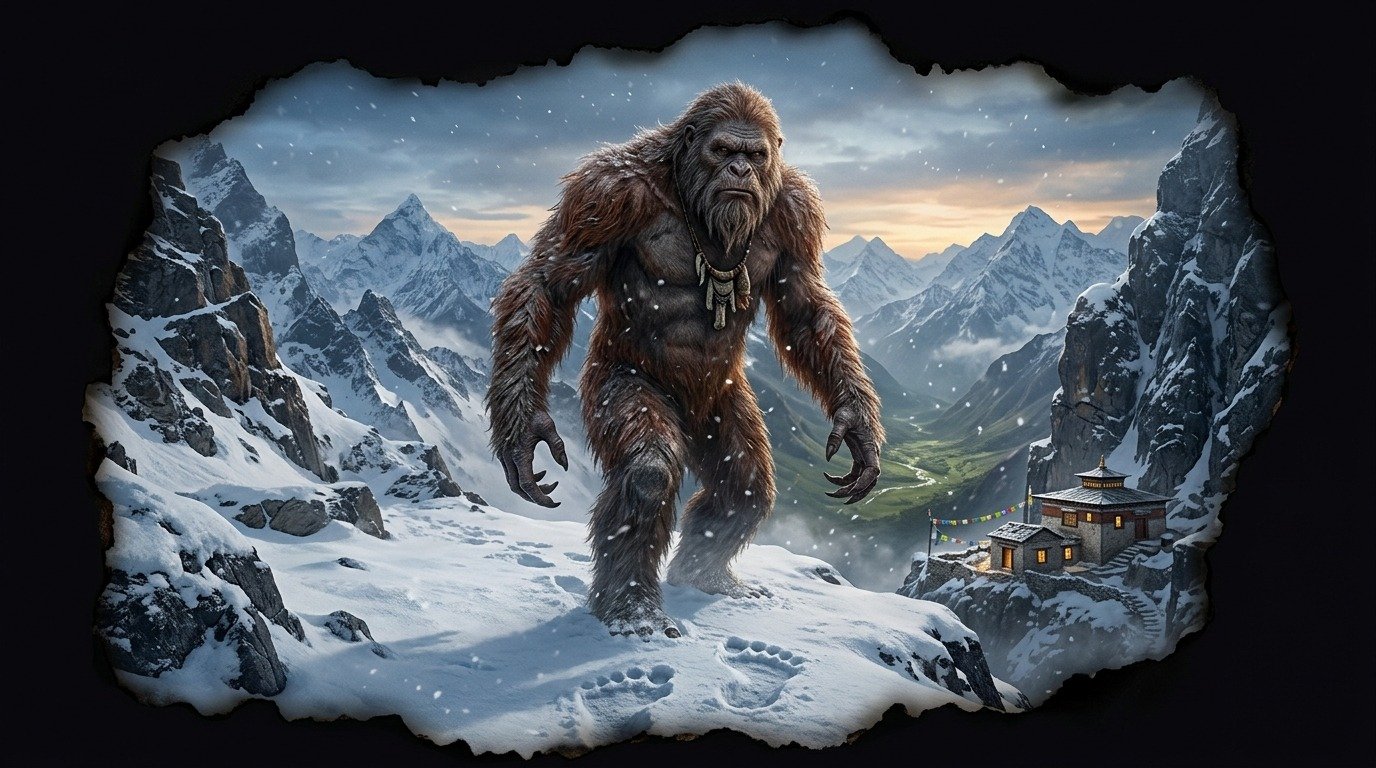
Yeti: The Spirit of the Himalayan Snowdrifts
Sherpa Mythology and Buddhist Roots
In the freezing altitudes of the Himalayan mountain range, the Yeti (from the Tibetan *yeh-teh*, which translates to "that thing over there" or "rocky area anthropomorph") is not a myth for entertainment, but an ecological and spiritual reality documented for centuries by Sherpa communities and the monks of Buddhist monasteries in Tibet, Nepal, and Bhutan. La tradition local distinguishes at least three variants of this entity: * **The Meh-Teh:** The most common, short in stature, covered in reddish or grayish hair, omnivorous, and aggressive in behavior if cornered. * **The Dzu-Teh:** A massive being, up to three meters (9.8 feet) tall, herbivorous, and an inhabitant of high-mountain forested valleys. * **The Teh-Lma:** A small, ape-like hominid that inhabits areas of lower vegetation. In Tibetan Buddhism and the pre-Buddhist Bön religion, the Yeti is considered a nature spirit, a "Mi-go" (wild man) that often acts as a guardian of the *Beyul*, the sacred and hidden valleys consecrated by Padmasambhava where Buddhist doctrine is preserved intact from the corruption of the outside world. In monasteries such as Khumjung, Pangboche, and Rongbuk, relics attributed to the Yeti have been kept for generations, such as conical scalps, hand bones with elongated phalanges, and manuscripts describing their ritual behavior on the peaks.
The Western Expedition and the Creation of the "Abominable"
The transformation of the Yeti into the "Abominable Snowman" is the result of a translation error and the sensationalism of the era of colonial exploration. In 1921, during the First British Mount Everest Reconnaissance Expedition led by Colonel Charles Howard-Bury, gigantic footprints were sighted at high altitude in the Lhakpa La pass. Local guides referred to them as belonging to the *Metoh-Kangmi* (which alludes to a "dirty-snow man-bear"). Journalist Henry Newman, upon receiving the telegraph cable, mistakenly translated *Metoh* as "abominable," fixing the epithet in the Western imagination. During the 1950s and 1960s, expeditions funded by tycoons like Tom Slick and featuring explorers like Sir Edmund Hillary actively sought physical evidence of the creature. Although biological samples were recovered and footprint trails showing an opposable big toe and a gait pattern adapted to steep slopes were photographed, mainstream science has attempted to reduce the phenomenon to misidentifications of the Himalayan brown bear (*Ursus arctos isabellinus*), the Tibetan blue bear (*Ursus arctos pruinosus*), or the snow langur. However, recent genetic analyses performed on hair samples from monastery relics show mitochondrial DNA sequences that partially match an ancestral evolutionary lineage of the Pleistocene polar bear, suggesting the existence of a carnivore or hybrid hominid not yet classified by modern taxonomy.
Esotericism of the White Threshold
From the perspective of mountain esotericism, the Yeti represents the guardian of the threshold of asceticism. Extreme cold, oxygen deprivation, and the vastness of the white landscape act as catalysts for altered states of consciousness. The Yeti is the physical personification of the rigor of the combined elements of air and earth; a being that thrives where human life is extinguished. In the practices of the Yoga of Psychic Heat (*Tummo*), hermits living in caves at altitudes of over five thousand meters (16,404 feet) report the presence of these entities as silent witnesses to their practices. The Yeti is a reminder that nature possesses its own ascetics, creatures whose very existence challenges human sovereignty over the highest points of the planet.
Sighting Records and Behavior
Documented encounters with the Yeti share a pattern of territorial and elusive behavior: * **Mixed Locomotion:** The ability to alternate between a fast quadrupedal gait to move over soft snow and an erect bipedal posture to scan the horizon from rocky cliffs. * **Metallic Vocalizations:** High-pitched screams and whistles that echo through the gorges before snowstorms, leading locals to believe the Yeti can predict the weather. * **Melting Footprints:** The characteristic deformation of its footprints under the action of the sun, which expands the original size of the print in the snow—a technical factor that researchers must meticulously calculate to avoid erroneous anatomical estimations. The survival protocol when encountering one in the Himalayas forbids looking directly into the Yeti's eyes, an action it interprets as a challenge for dominance. Sherpas advise running down the slope in a zigzag pattern; due to its physical build, with robust lower limbs adapted for upward traction, it is extremely difficult for the Yeti to pursue prey downhill without losing its balance.
Comments
Share information, an experience, or a source to help enrich this entry. They are automatically reviewed before being published.
Loading comments...