Tasmanian Tiger
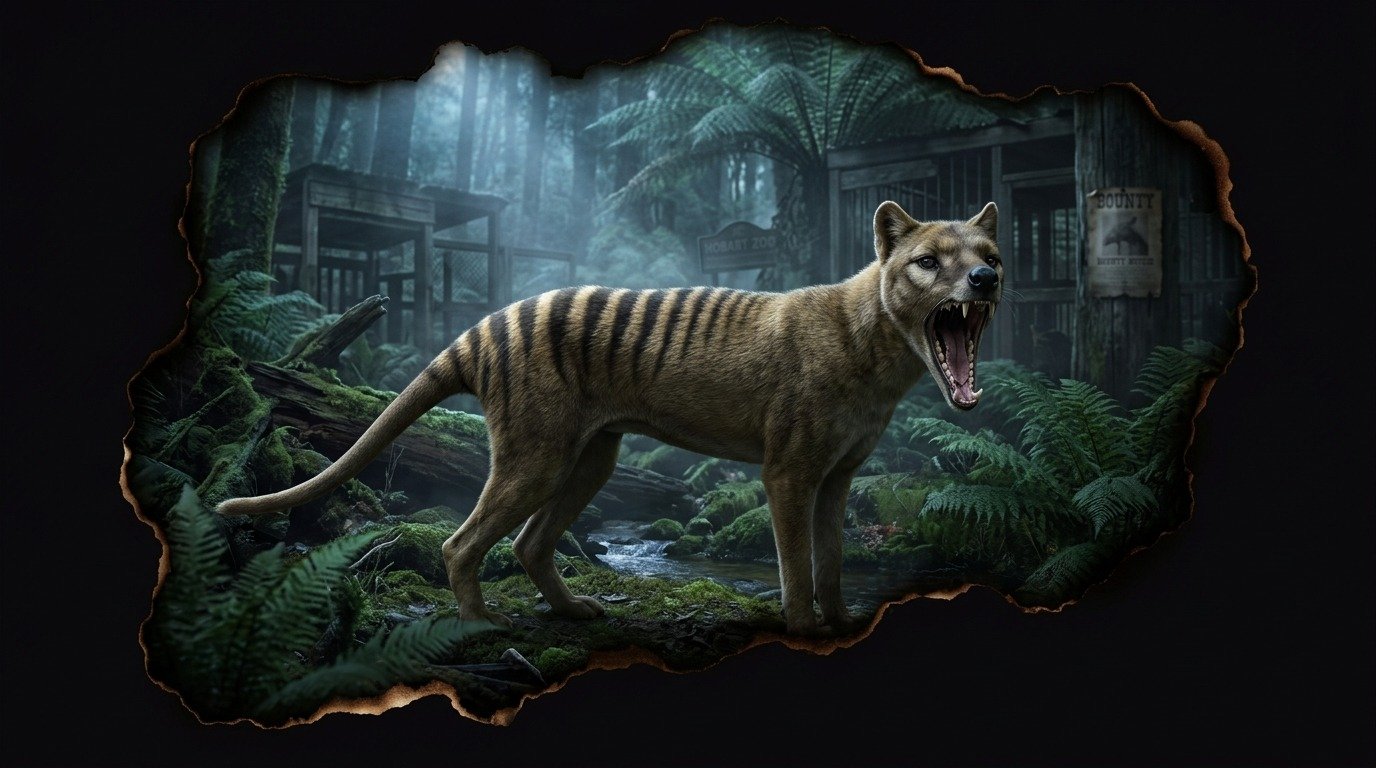
The Thylacine: The Striped Specter of the Island of Tasmania
The End of the Species and the Martyrdom of Benjamin
The thylacine (*Thylacinus cynocephalus*), popularly known as the "Tasmanian Tiger" or "Marsupial Wolf," represents the most tragic and emblematic borderline case on the boundary dividing official zoology from cryptozoology. This creature, the largest carnivorous marsupial of modern times, originally inhabited the Australian mainland and New Guinea, becoming confined in historical times to the island of Tasmania, where the absence of the dingo allowed it to survive as the ecosystem's apex predator. The arrival of European colonizers in Tasmania in the early 19th century marked the beginning of the end for the thylacine. Erroneously considered a lethal threat to sheep flocks (the true culprit was usually the feral dog), the Tasmanian government and large agricultural corporations like the Van Diemen’s Land Company established a systematic bounty system starting in 1830. Between 1888 and 1909, thousands of bounties were paid for thylacine carcasses, unleashing a massive and ruthless campaign of extermination. The collapse of the species was dizzying. Intensive hunting was compounded by the destruction of its forest habitat and a mange epidemic that decimated the remaining populations. The last known wild thylacine was shot by a farmer in 1930. The last captive specimen, posthumously named "Benjamin," died due to the negligence of his keepers on September 7, 1936, at the Hobart Zoo, after being left exposed to the elements during a night of extreme cold. Barely fifty days earlier, the Tasmanian government had enacted laws for the full protection of the species; a bureaucratic irony that arrived far too late.
Unique Morphology: Evolutionary Convergence
The thylacine is one of the most astonishing examples of evolutionary convergence in the history of life on Earth. Despite being a marsupial (more closely related to kangaroos and koalas than to placental mammals), it developed a physiognomy that almost perfectly mimicked that of a canid or a wolf of the Northern Hemisphere, because it occupied the same ecological niche. Its morphology, however, presented unique and baffling features: * **The stripes:** Fifteen to twenty dark bands that crossed its back and the base of its tail, earning it the name "Tiger." These stripes provided optimal camouflage in the dim light of temperate forests. * **The jaw:** It possessed an astonishing gape, capable of opening to an angle of 120 degrees, revealing teeth adapted for crushing bone, although its bite force was relatively weak, suggesting that it hunted small to medium-sized prey through exhaustion or ambush. * **The tail:** Rigid, thick at the base and tapering gradually toward the tip, merging with the body in a manner similar to that of a kangaroo. This rigidity prevented the animal from wagging it from side to side like dogs and forced it to have a clumsy and unusual gallop. * **The marsupial pouch:** Both the female and the male possessed a pouch. In the female, the opening of the pouch faced backward (toward the hind legs), an evolutionary adaptation to prevent the pouch from filling with dirt or brush while the animal ran through dense forests.
Cryptid by Omission: Sightings of the Gray Ghost
Since Benjamin's death in 1936, the thylacine was officially classified as extinct by the International Union for Conservation of Nature (IUCN) in 1986, after meeting the international standard of fifty years without verified scientific records. However, the moment science closed the file, the thylacine was reborn in the realm of cryptozoology, becoming the most sought-after and sighted cryptid on the planet. Over the last few decades, thousands of unconfirmed sightings have been recorded both in Tasmania and on the Australian mainland (where it is believed to have gone extinct thousands of years ago). Witnesses ranging from experienced park rangers and field researchers to tourists and local farmers describe brief encounters with a grayish, striped animal that moves with the stiff, hopping gait characteristic of the thylacine. Numerous scientific and amateur expeditions equipped with camera traps, highly sensitive microphones, and environmental DNA analysis kits have been organized in forested and inaccessible areas such as the Tarkine region in northwestern Tasmania. Although blurry photographs, low-resolution videos, and footprint casts bearing an uncanny resemblance to those of the thylacine have been obtained, none of this evidence has been considered definitive by the academic scientific community. For official zoology, the Tasmanian Tiger remains a ghost.
The Archetype of Guilt and Ecological Redemption
From a psychological and cultural perspective, the persistence of the search for the thylacine transcends mere zoological interest. The Tasmanian Tiger has become the ultimate symbol of humanity's ecological guilt. Its extermination was so well-documented, so deliberate, and so unjustified that the refusal to accept its disappearance acts as a psychological defense mechanism against the harsh reality of human-caused mass extinction. Believing that the thylacine still runs free in the deepest recesses of the Tasmanian wilderness is a way of keeping alive the hope that nature possesses a resilience superior to our destructive power. Likewise, the thylacine is the leading candidate in scientific genetic de-extinction projects through cloning from DNA preserved in museum specimens. In this sense, the creature represents the Holy Grail of modern biotechnology: the promise that science can undo its own mistakes and resurrect the gods that human greed sacrificed on the altar of progress.
Comments
Share information, an experience, or a source to help enrich this entry. They are automatically reviewed before being published.
Loading comments...