The Owlman of Mawnan
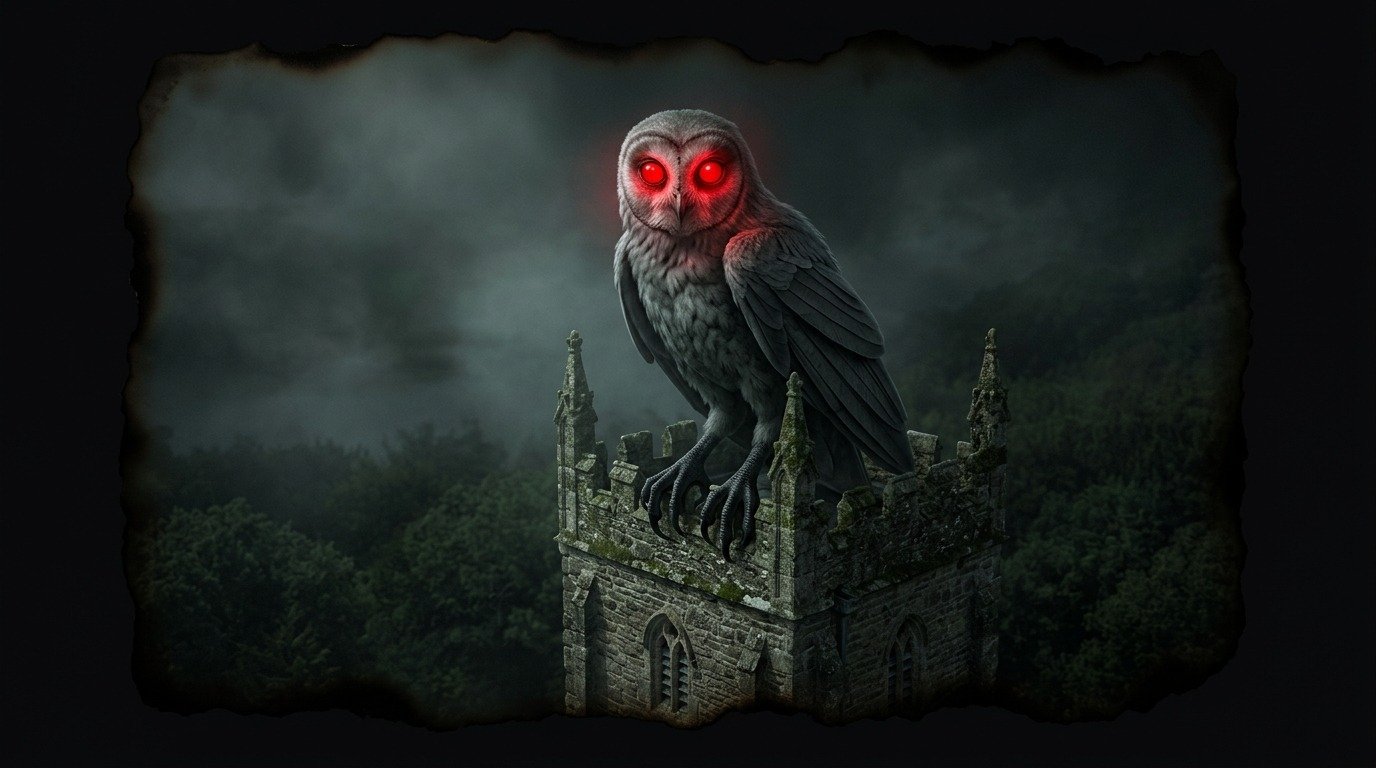
Owlman of Mawnan: The Winged Stalker of Cornwall
Origin and the Shadow of Mawnan Smith
The genesis of the "Owlman" is located in the far southwestern tip of England, in the parish of Mawnan, Cornwall. The foundational record of the myth dates back to April 17, 1976, when two young sisters, June and Vicky Melling, sighted a winged creature of human proportions hovering over the tower of Mawnan Church, a 13th-century temple built upon the remains of a fortified Iron Age hillfort. The young girls described an anthropomorphic being covered in grayish feathers, possessing bifid claws and huge red eyes that emitted a hypnotic glow.
The case gained notoriety thanks to the investigations of Anthony "Doc" Shiels, a controversial illusionist, writer, and seeker of the unusual of the era. Shiels, who coined the term "Owlman", documented subsequent sightings throughout 1976 and 1978, most of them concentrated in the wooded surroundings of the Helford River estuary and the aforementioned church. The testimonies, gathered from local teenagers, consistently described a silent being, capable of rising vertically without the noisy flapping of common birds of prey.
Folkloric Parallelisms and Cryptic Phenomenology
The Owlman is not an isolated phenomenon in cryptozoology and comparative folklore. It presents an astonishing symmetry with the *Mothman* (the Mothman) of Point Pleasant, West Virginia, sighted a decade earlier. Both entities share glowing red eyes, a winged wingspan, a clumsy gait on land, and the capacity for silent vertical flight, in addition to an alarming predilection for manifesting near geographical nexuses or high-energy installations (in Mawnan's case, the confluence of marine currents and geological faults).
In Cornish folklore, the region possesses a long tradition of nature spirits and chthonic creatures. The *piskies* and *spriggans* usually inhabit the county's prehistoric barrows. However, the Owlman stands apart from these mischievous fairies to embody a presence of a more ominous and totemic character. Skeptical researchers have suggested that the sightings could have been triggered by the misidentification of an Eurasian eagle-owl (*Bubo bubo*), a large species not native to the British Isles, but which occasionally escapes from captivity. Nonetheless, the psychological impact on the witnesses and the persistence of the legend suggest a deeper catalyst.
Anatomy and Documented Sightings
Original reports detail a creature approximately 1.5 to 1.8 meters (4.9 to 5.9 feet) tall. Its lower limbs end in three-toed black claws, reptilian or raptor-like in appearance. The wings fold behind its back in a manner similar to those of an insect or a bird, and its head lacks a visible neck, merging directly into the shoulders. The eyes, described as "red lanterns", dominate a flat face with vaguely feline or avian features.
After the wave of the late seventies, the Owlman seemed to sink into lethargy, only to resurface briefly in 1989 and 1995. In the latter year, a tourist from Staffordshire reported having seen a "nightmare vision" near Mawnan Church, describing a gray being with pointed ears and eyes that glowed with their own light. The persistence of these sightings in such a circumscribed geographical area points to a spatial fixity that paranormal researchers associate with ancient places of power.
Esoteric Analysis: The Guardian of the Threshold
From an esoteric perspective, Mawnan Church and its adjacent graveyard act as a liminal threshold. Being built upon a prehistoric pagan settlement, the structure channels what earth magic currents call "ley lines". The Owlman, within this framework, is not a biological entity subject to conventional taxonomy, but rather a thoughtform (*tulpa*) or a guardian of the threshold fed by the collective subconscious of the region.
The owl has historically been a psychopomp, the conductor of souls to the underworld in Greek and Celtic mythologies, as well as a symbol of dark wisdom and occult revelation. The physical manifestation of a human-owl chimera in an enclosure consecrated to the dead suggests a tear in the veil between the physical and astral planes. For the modern seeker, the Owlman represents the intrusion of the numinous and the wild into the neatness of rationalist modernity, a reminder that the old gods and their heralds still nest in the wooded strongholds of the world.
Comments
Share information, an experience, or a source to help enrich this entry. They are automatically reviewed before being published.
Loading comments...