Champ
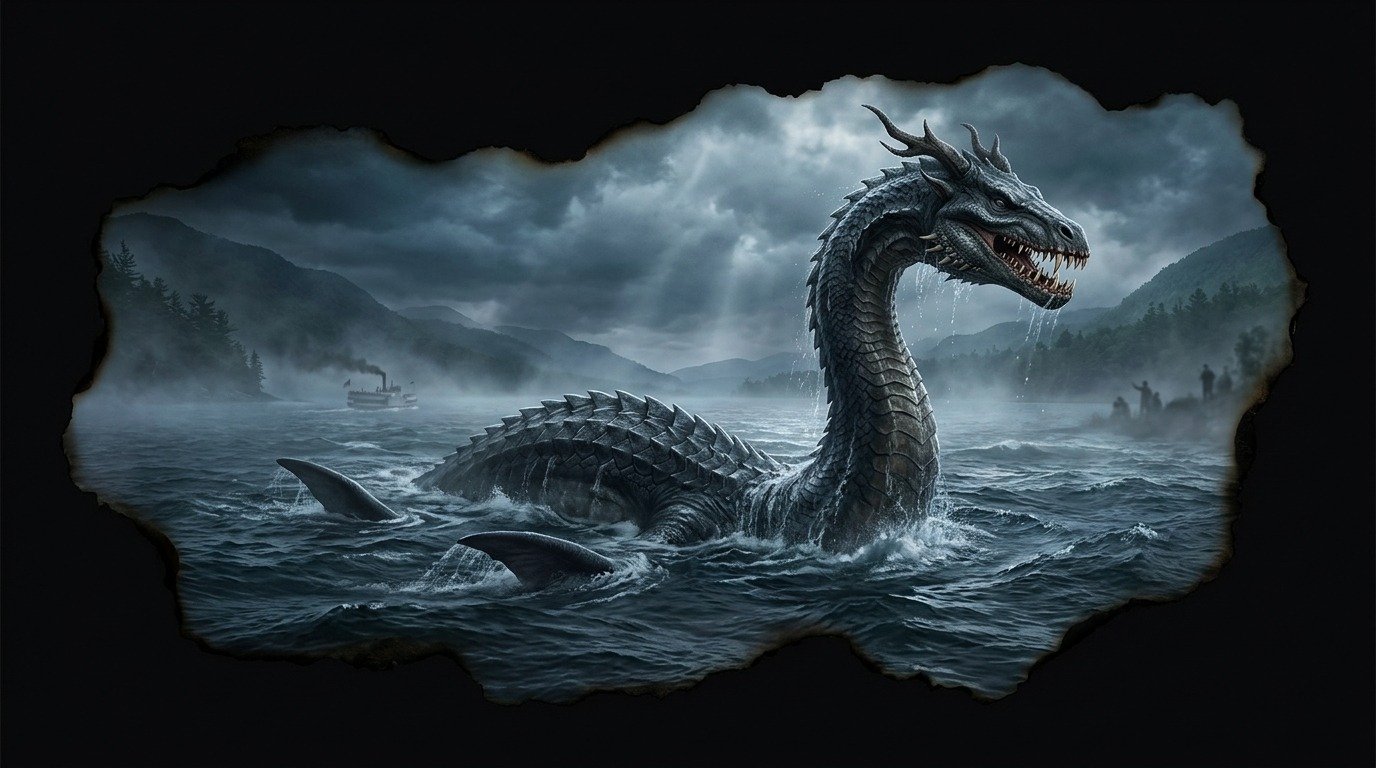
Champ: The Prehistoric Enigma of the Border Waters
The Abenaki and Iroquois Legacy
Lake Champlain, a narrow and deep basin of glacial origin that serves as a natural border between the states of New York, Vermont, and the Canadian province of Quebec, harbors in its folkloric memory one of the oldest lake legends in North America. The Abenaki and Iroquois Indigenous nations spoke of a large horned and scaly creature that inhabited the depths of these waters, which they called *Tatoskok* or *Chaousarou*. In their traditions, this entity was associated with the mysteries of the aquatic underworld and was attributed a power of transmutation and control over the lake's storms. The first written record by a European is attributed to the French explorer Samuel de Champlain in 1609, who described seeing a large fish, similar to a pike, with scales so hard that a dagger could not penetrate them, jaws armed with sharp teeth, and a head resembling that of a horse. Although modern historians maintain that Champlain likely described a sturgeon or a longnose gar (*Lepisosteus osseus*), popular culture took his testimony as the founding stone of the Champ myth.
The 19th-Century Boom and the Mansi Photograph
During the 19th century, sightings of Champ increased exponentially, coinciding with the growth of commercial and tourist traffic on Lake Champlain. In 1819, the *Plattsburgh Republican* newspaper reported an encounter with a "black snake" about 50 meters (164 feet) long that frightened local sailors. The phenomenon reached its peak of scientific and media credibility on July 5, 1977, when Sandra Mansi took one of the most famous and intriguing photographs in modern cryptozoology. The image shows what appears to be the long, arched neck of an animal emerging from the water, along with a supposed portion of its back. Although the photograph was subjected to exhaustive forensic analysis by optical and US Navy experts who failed to prove any fraud, the lack of precise data regarding the exact location and depth of the shot prevented a conclusive validation, leaving the image suspended between definitive proof and the optical illusion of a floating log.
Cryptozoological and Biological Hypotheses
The persistence of Champ sightings has led researchers and naturalists to propose explanations that go beyond folklore. The most popular hypothesis among cryptozoologists suggests the residual survival of a plesiosaur or a type of extinct marine reptile adapted to the freezing temperatures of the lake after the last ice age, when Lake Champlain was part of the Champlain Sea, a saltwater inlet of the Atlantic Ocean. However, the biological community argues that the low water temperature, the limited food supply available to sustain a breeding population of large reptiles, and the complete absence of skeletal remains invalidate this theory. More plausible explanations point to specimens of lake sturgeon (*Acipenser fulvescens*) that reach monumental sizes, schools of American eels swimming in undulating patterns, or atmospheric refractions created by thermal differences over the water's surface.
Archetype of the Boundary Between Two Lands
On a symbolic level, Champ represents the persistence of the untamed in an intensely colonized and mapped territory. Lake Champlain, with its deep, dark trenches and its history of naval battles and political borders, finds in Champ a symbol of ecological unity that transcends human boundaries. The creature functions as a totem of the fragility of the lake ecosystem: in 1982 and 1983, both the state of Vermont and the state of New York passed legal protection resolutions for Champ, banning any attempt to hunt, capture, or harass it. This legislative act is, in itself, an esoteric and political recognition of the value of mystery as a constitutive element of the cultural and ecological identity of the region.
Comments
Share information, an experience, or a source to help enrich this entry. They are automatically reviewed before being published.
Loading comments...