Kraken
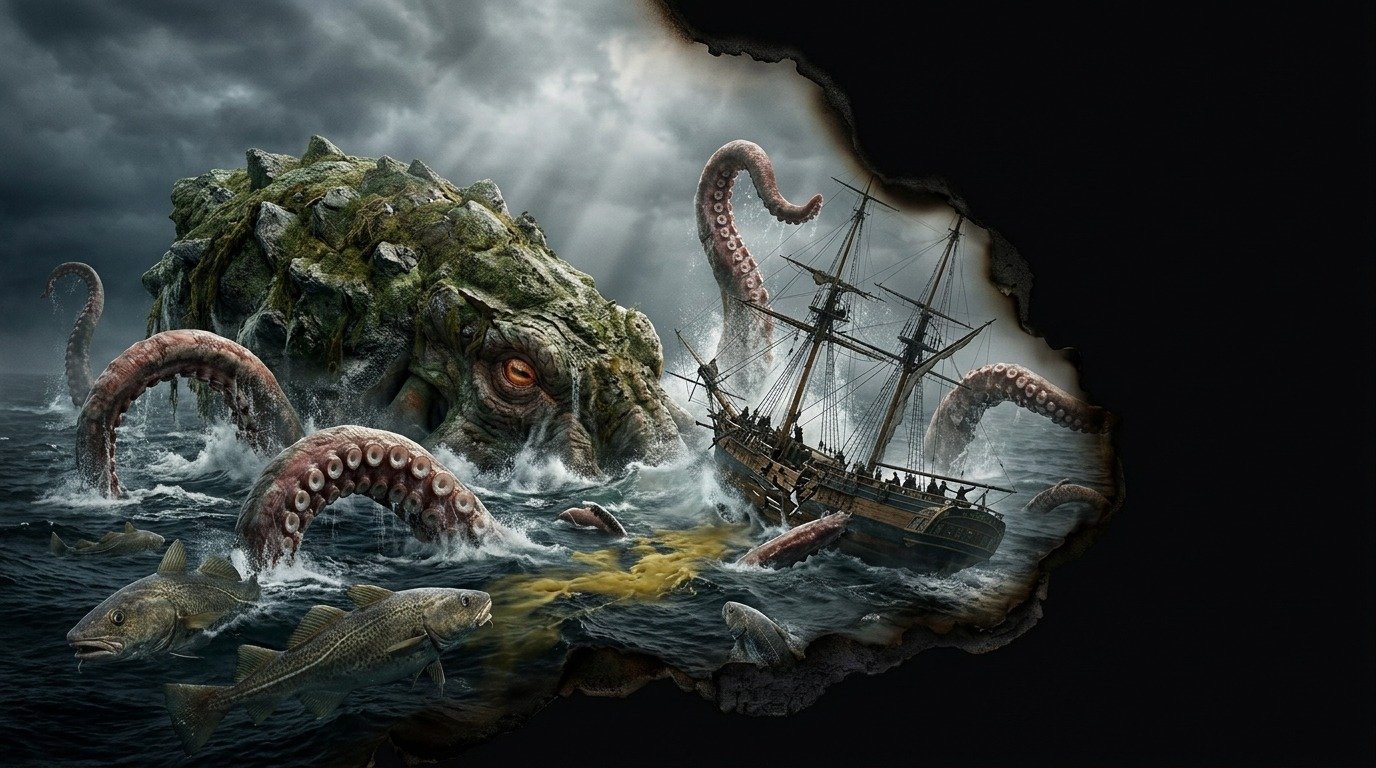
Kraken: The Leviathan of the Norse Abysses
The Hafgufa and the Norse Sagas
The *Kraken* has its roots in the nautical cosmology of the Scandinavian peoples, where the sea was not merely a route of communication, but an unfathomable abyss populated by primeval colossi. In its earliest forms, recorded in the Icelandic *Örvar-Oddr* saga (13th century), the entity is called *hafgufa* ("sea mist") and *lyngbakr* ("heather-back"). These texts describe the monster not as a cephalopod, but as a colossal mass of island-like proportions; a being so vast that sailors mistook its seaweed- and rock-covered back for dry land, disembarking upon it only to perish by drowning when the beast submerged.
The transformation of this island-leviathan into the giant squid or octopus of later tradition began to take shape in the chronicles of Norse scholars. In the 16th century, the Swedish archbishop Olaus Magnus described in his *Historia de gentibus septentrionalibus* marine monsters with fiery eyes and long arms capable of sinking high-tonnage vessels. However, it was Erik Pontoppidan, Bishop of Bergen, who in his monumental *Natural History of Norway* (1752-1753) consolidated the modern physiognomy of the Kraken. Pontoppidan detailed that the monster's primary danger lay not solely in its tentacles, but in the immense whirlpool (*maelstrom*) it generated by rapidly submerging, dragging down any vessel in the vicinity.
Naturalized Monstrosity: From Pontoppidan to Cryptozoology
The fishing folklore of Norway and Iceland held that the Kraken excreted a dense, scented substance that attracted fish in immense schools. Local fishermen, aware of the risk, used to say they "had fished over the Kraken" when they secured exceptionally abundant catches, consciously defying the possibility of the creature awakening and ascending to the surface.
Modern cryptozoology and classical marine biology (led in the 19th century by zoologist Japetus Steenstrup) succeeded in stripping the myth of its theological excesses to identify the historical Kraken with *Architeuthis dux* (the giant squid) and *Mesonychoteuthis hamiltoni* (the colossal squid). These creatures, which inhabit the mesopelagic and bathypelagic zones at depths exceeding one thousand meters (3,280 feet), possess eyes the size of human heads and tentacles equipped with suckers featuring serrated chitinous rings. The fierce struggle of these cephalopods with sperm whales, evidenced by the circular scars found on the cetaceans' skin, served as a real foundation to feed the nightmares of the Norsemen.
Abyssal Chaos and the Archetype of the Vortex
On the plane of universal archetypes, the Kraken is the personification of primordial chaos (*Tiamat*, *Leviathan*). It represents the destructive force of water in its wild and untamed state. While the ship represents civilization, human order, and the fragile technology that attempts to float upon the unconscious, the Kraken is the rising force of the depths that claims the tribute of flesh and wood.
Esoterically, the Kraken is related to the mysteries of dissolution. In alchemy, the return to the liquid state (*solutio*) is a necessary step for transmutation, but it carries the danger of total destruction if the ego is devoured by the abyss. The Kraken is the guardian of submerged secrets, the one who destroys those who venture into the sea of self-understanding without proper preparation, reminding us that occult knowledge demands, above all, respect for the forces that lie beyond the reach of the sunlight.
Comments
Share information, an experience, or a source to help enrich this entry. They are automatically reviewed before being published.
Loading comments...