Mermaids and Fish-Men
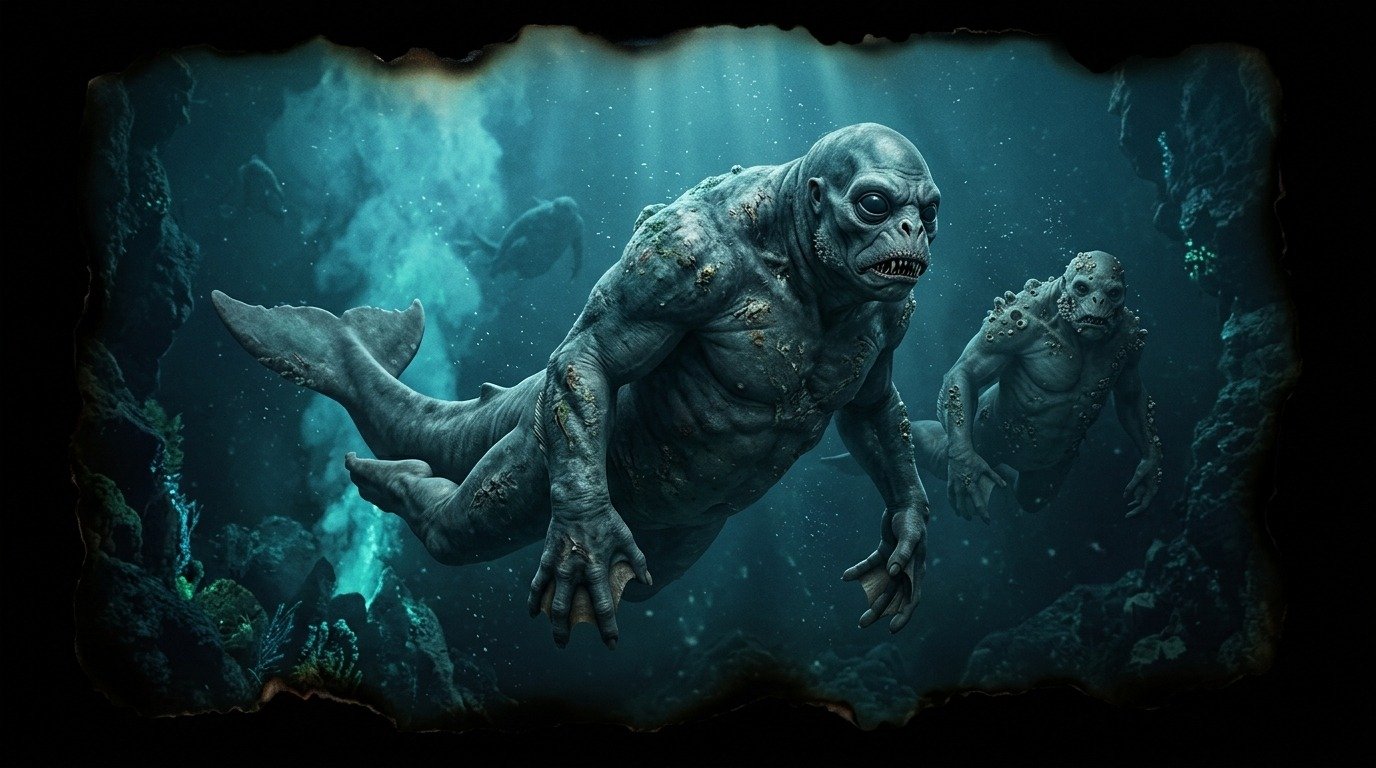
Mermaids and Fish-Men: The Hominids of the Deep Ocean Trench
The Aquatic Ape and the Cryptozoological Record
Far from the romantic idealization of Homeric naiads or medieval undines—spiritual and fae entities linked to water—the cryptozoological record documents the existence of a divergent evolutionary branch of hominids or marine mammals extremely adapted to the ocean depths: the so-called "fish-men" or biological mermaids. This perspective finds marginal theoretical support in the *Aquatic Ape Hypothesis*, proposed by biologists like Alister Hardy, which suggests that a group of human ancestors underwent a prolonged period of adaptation in coastal and underwater environments.
Historical sightings describe these creatures not as heraldic beauties with scaly fish tails, but as humanoid beings of grotesque and functional physiognomy. They present webbed hands and feet, extremely thick grayish or bluish skin (similar to that of cetaceans or seals to withstand low temperatures and pressure), oversized eyes adapted to the low light of the lower photic zone, and specialized teeth for consuming fish and cephalopods. Their lower extremities, instead of a bony fish fin, usually consist of legs fused or modified into a unique hydrodynamic structure that emulates the caudal fin of a manatee or a dolphin.
Historical Chronicles of the Capture of Fish-Men
The literature of the sixteenth to eighteenth centuries abounds with documented encounters with these entities, treated through the prism of the natural history of the era. A famous case is that of the "Fish-Man of Liérganes" (Francisco de la Vega Casar), documented in Spain in the seventeenth century by Father Benito Jerónimo Feijoo. Francisco, a young man who disappeared at sea, was captured years later in the Bay of Cádiz; his skin had turned scaly, he had a membrane of skin running from his throat to his stomach, and his fingers and toes were joined by elastic webs. His inability to communicate through human language and his purely aquatic behavior suggest a mutation or a severe biological regression.
Likewise, the navigation logs of explorers such as Henry Hudson (1608) and John Smith (1614) detail encounters with marine creatures of humanoid torso, coarse-featured faces, and purely animal behavior. In the East, the tradition of the *Ningyo* describes fish-like creatures with human heads and sharp claws, whose mummified bodies—often crude taxonomic fakes known as "Jenny Hanivers," crafted by joining monkey torsos with the tails of salmon or dried rays—were exhibited in temples and fairs as relics of the abyss. However, behind the trickery lies a consistent pattern of sightings of an uncataloged intelligent species that shuns contact with the surface.
Comparative Anatomy and the Abyss of Divergent Evolution
From an esoteric and symbolic point of view, fish-men represent biological involution and the return of the human being to the original maternal womb of the ocean. While terrestrial humanity opted for fire, tools, and articulate language, these creatures personify the branch that chose silence, pressure, and absolute symbiosis with the marine immensity.
Symbolically, they embody the most primitive and predatory aspect of water. They do not lure sailors with melodic songs of metaphysical content; their call is the muffled splashing of what stalks beneath the keel, the constant threat of suffocation. They are the dark mirror of the human being: a version adapted to survive where terrestrial man perishes in a matter of minutes, a reminder that on this planet's tree of life, humanity is not the only possible end, but merely one of the ways in which conscious matter has attempted to colonize the elements.
Comments
Share information, an experience, or a source to help enrich this entry. They are automatically reviewed before being published.
Loading comments...