Nahuelito
Nahuelito: The Colossus of the Patagonian Glacial Trench
Mapuche Roots: The "Cuero" and the "Sueiro"
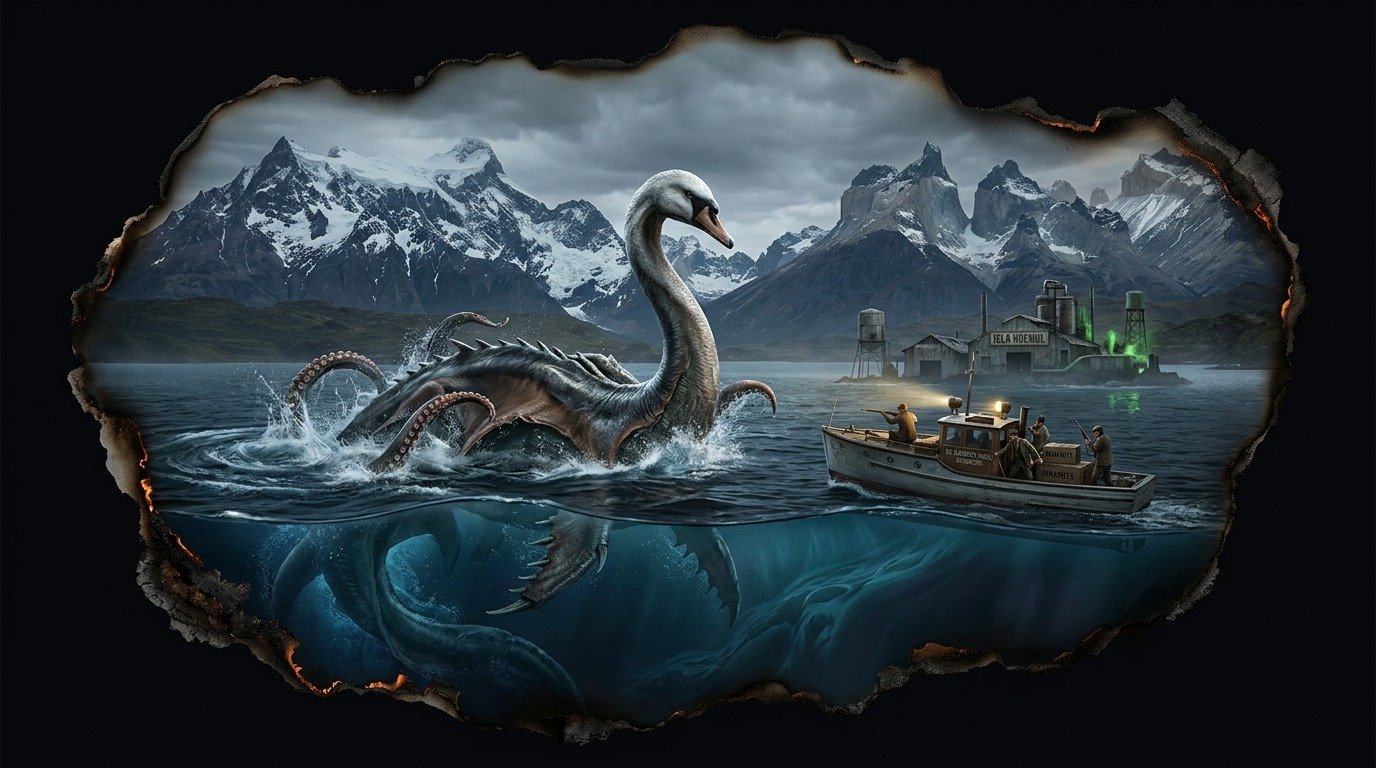
Lake Nahuel Huapi, a colossal body of water of glacial origin located at the foot of the Andes mountain range in Argentine Patagonia, harbors in its dark trenches a mythical phenomenology that predates the arrival of the white man by centuries. The mythology of the Mapuche people describes the presence of fearsome creatures in the Andean waters, the most prominent being *El Cuero* (also known as *Trelque Huecufe*). It is a creature with the appearance of an outstretched cowhide, its edges bristling with sharp claws and tentacles equipped with suction cups with which it sucks the blood of its human or animal prey as it drags them to the bottom of the lake. Another related entity is the *Sueiro*, a nocturnal aquatic beast with a bifid spine and powerful claws. These legends were not mere metaphors; they represented real terror in the face of the unfathomable depth of a lake whose trenches reach more than 460 meters (1,509 feet) and whose waters remain at freezing temperatures year-round, guaranteeing a rapid death from hypothermia to anyone who dares to defy its currents.
The Expedition of Clemente Onelli and the 20th Century
The transformation of the indigenous myth into the modern cryptozoological enigma known as "Nahuelito" formally occurred at the beginning of the decade of 1922. Dr. Clemente Onelli, director of the Buenos Aires Zoo, received a detailed report from the North American gold prospector Martin Sheffield, who claimed to have observed gigantic footprints and the track of an animal with a long neck and a swan-like head in a lagoon near Lake Nahuel Huapi. Onelli, influenced by Florentino Ameghino's evolutionary theories regarding the persistence of prehistoric fauna in Patagonia, organized an official expedition equipped with high-caliber rifles and dynamite to capture the alleged "Patagonian plesiosaur." The expedition, although unsuccessful, sparked an international media frenzy that attracted the attention of publications such as *Scientific American* and turned Nahuelito into a cultural and tourist icon of the San Carlos de Bariloche region.
Nature of the Glacial Trench
Scientific theories surrounding Nahuelito are divided among geological, biological, and industrial explanations. The glacial origin of the lake generates complex underwater currents and wind waves known as *seiches*, capable of creating the optical illusion of a dark back moving against the wind on the water's mirror-like surface. Another hypothesis of a conspiratorial and local nature attributes the sightings to failed experiments or mutations derived from the Huemul Project, a failed attempt to develop controlled nuclear fusion carried out by the Austrian physicist Ronald Richter on Huemul Island (located in the center of the lake) under the government of Juan Domingo Perón in the early 1950s. Cryptozoologically, there is speculation about the existence of a surviving specimen of a marine reptile or an unknown freshwater seal, although the low biological productivity (oligotrophy) of Lake Nahuel Huapi makes sustaining a creature of colossal dimensions extremely difficult.
The Mirror of Patagonian Solitude
On the level of depth psychology and territorial esotericism, Nahuelito embodies the hostile immensity, isolation, and sepulchral silence of the Patagonian plateau. The lake is a mirror of the snowy peaks and the lead-gray sky; its calm surface is a threshold separating mountainous civilization from the abyssal void. Nahuelito is not just a physical monster, but the personification of existential vertigo in the face of the unknown: the certainty that beneath the apparent serenity of mountain lakes lie ancient and invisible currents that escape cartography, human control, and the laws of modern biology.
Comments
Share information, an experience, or a source to help enrich this entry. They are automatically reviewed before being published.
Loading comments...