Mongolian Death Worm
Mongolian Death Worm: The Silent Scourge of the Gobi Sands
Origin and Anatomy of the Olgoi-Khorkhoi
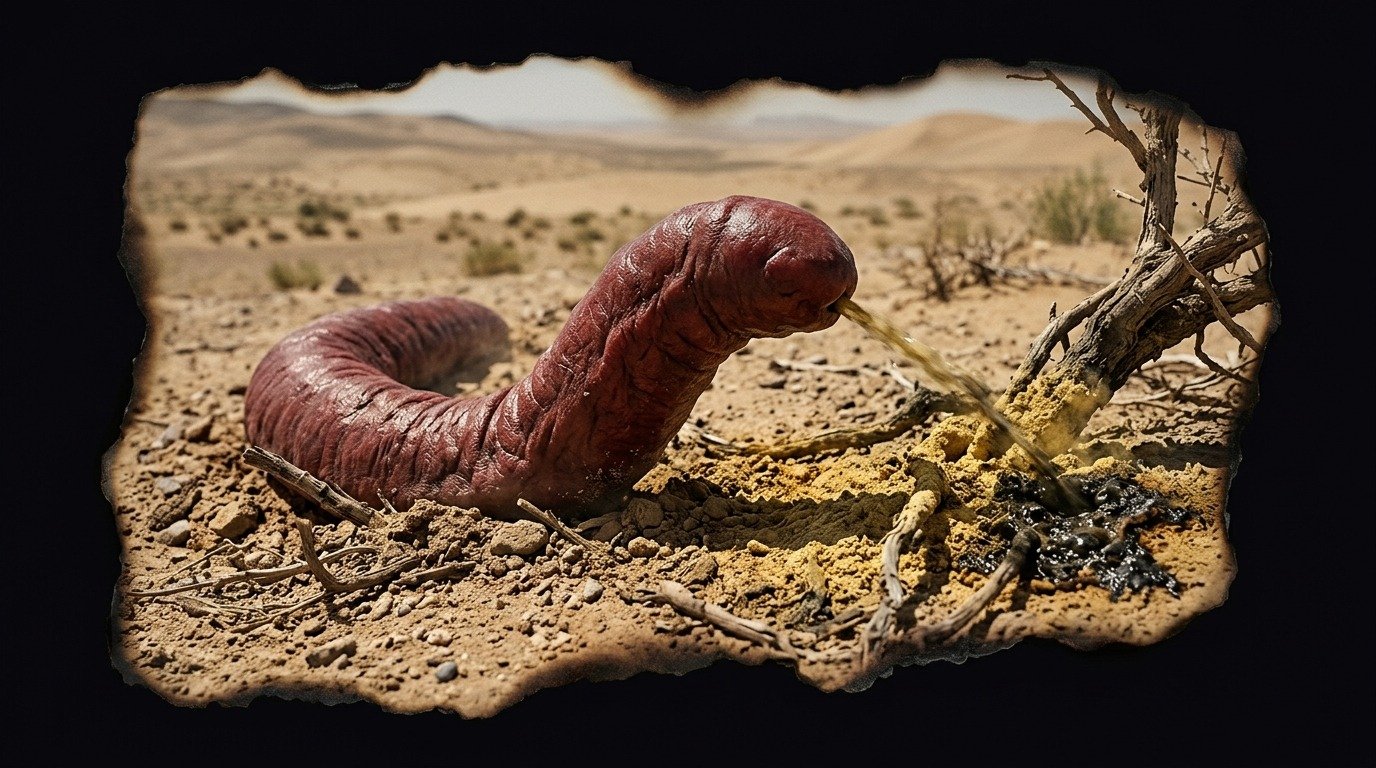
In the vast and hostile expanses of the Gobi Desert, Mongolian nomads have for generations transmitted the terror of the *Olgoi-Khorkhoi* (literally, "large intestine worm" or "sand worm"). The name is no mere metaphor: those who claim to have seen it describe it as an oblong creature, between sixty centimeters and one and a half meters (2 to 5 feet) in length, with a plump body devoid of defined limbs, eyes, or mouth, whose appearance disturbingly evokes the bloody intestine of a cow. Its coloration is a dark, matte red, often described as the shade of clotted blood.
The first formal Western reference to this entity is due to the American paleontologist Roy Chapman Andrews, who in his 1926 work, *On the Trail of Ancient Man*, documented testimonies gathered from the mouths of Mongolian authorities, including Prime Minister Damdinbazar. Although academic skepticism initially categorized the worm as a superstition of the steppes, local accounts insist on an unparalleled biological lethality: the *Olgoi-Khorkhoi* does not need to bite to kill; it is capable of spraying a highly corrosive acid that turns living tissue yellow and destroys it instantly, or triggering an electrical discharge or subtle energy capable of striking down a camel or a man several meters (yards) away.
Regional Variants and Biological Theories
The worm's habitat is limited to the most arid regions of the southern Gobi, particularly in dense areas of saxaul plants (*Haloxylon ammodendron*), under whose roots it usually burrows during the coldest months, emerging only during the hottest periods, between June and July, or when rain dampens the sand.
Cryptozoology and herpetological biology have attempted to rationalize the worm's existence through various hypotheses. One of the most plausible proposes that the *Olgoi-Khorkhoi* is an evolutionary relative of amphisbaenians (legless reptiles commonly known as "worm lizards"), extremely adapted to subterranean life in desert environments. Another school of thought suggests an unknown species of spitting cobra (*Naja*), capable of spraying cytotoxic venom over a great distance, or a member of the sand boa family (*Eryx tataricus*), whose general morphology matches the blunt and thick appearance described by nomads, although it completely lacks the electrical or acidic capabilities attributed to the cryptid.
Esoteric Symbology and the Void of the Gobi
From the perspective of esoteric analysis and comparative folklore, the Death Worm personifies the horror of the void and the pure hostility of the desert. The Gobi is not just a physical territory; in Eastern mysticism (sometimes associated with the Theosophical legends of Shambhala and forbidden deserts), it is a space of initiatory trial where nature strips human beings of any illusion of control.
The *Olgoi-Khorkhoi* is the shadowy guardian of this sterile threshold. It represents the sudden, invisible, and faceless death that stalks beneath the surface of consciousness. Its lack of visible external sensory organs symbolizes a purely instinctive existence, a blind force of the earth that reacts with destructive violence to human intrusion. In mental alchemy, the worm is the *nigredo* in its most primitive state: decomposing organic matter that refuses to be plowed or transformed, a reminder that the wasteland possesses its own antibodies against desecration.
Comments
Share information, an experience, or a source to help enrich this entry. They are automatically reviewed before being published.
Loading comments...