Shambhala
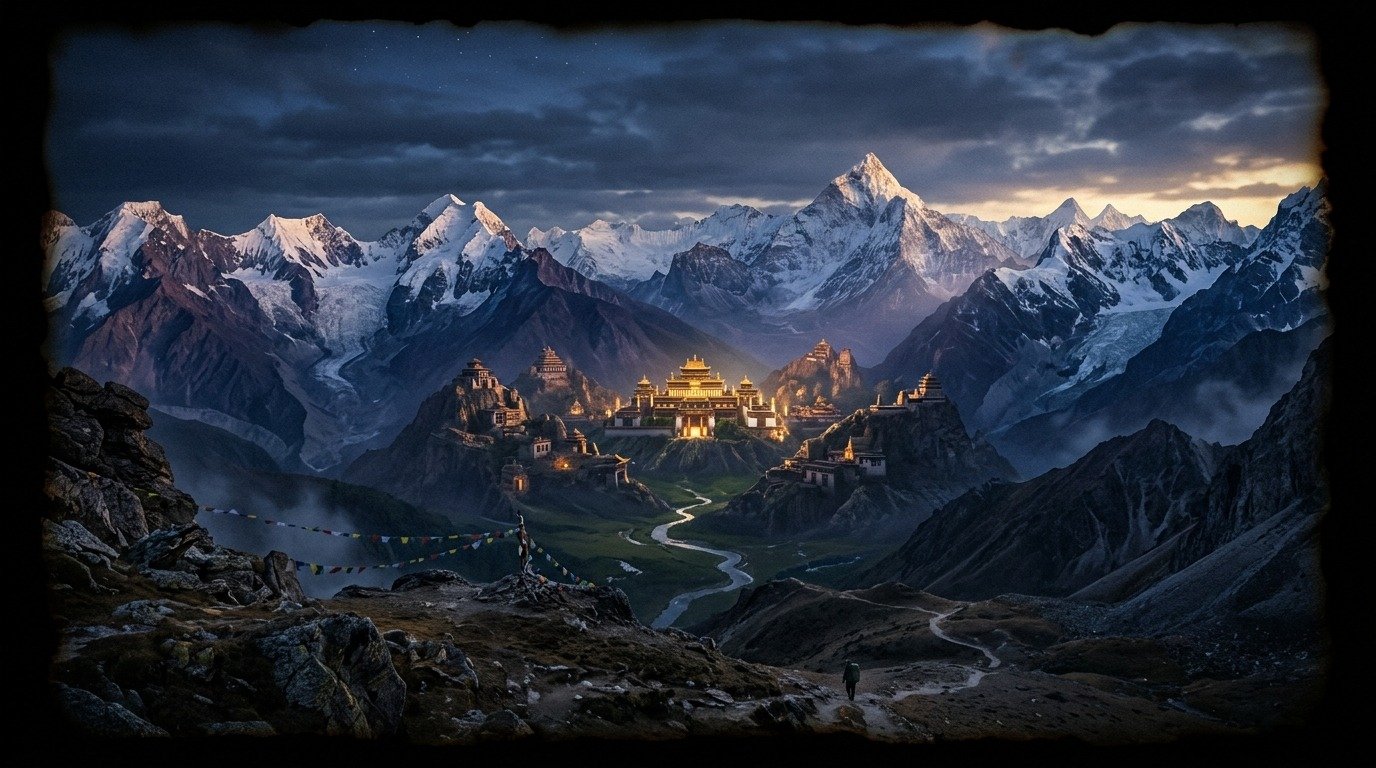
Shambhala: The Pure Land Where Time Stands Still
In August 1927, the Russian painter and mystic Nicholas Roerich was leading a caravan through the steppes of Mongolia, heading toward Tibet. While observing the clear sky through his binoculars, he saw an oval object of colossal size shining under the sun. The craft was moving at high speed from north to south, abruptly changing direction before disappearing behind the snow-capped peaks. The Tibetan guides immediately fell to their knees, praying fervently. They assured the painter that the object was neither a bird nor a human machine, but the sign that they were at the outer borders of Shambhala, the hidden kingdom of the Buddhists.
The Lotus of the Snows
The history of Shambhala is recorded in the most sacred texts of Tibetan Buddhism, particularly in the *Kalachakra Tantra*. It is not a simple popular myth, but a sacred geography precisely described by ancient sages. The kingdom is situated in the heart of Central Asia, protected by a double ring of mountains covered in perpetual glaciers that block the way to any uninvited traveler. Its shape is that of an eight-petaled lotus, where each section is ruled by kings who guard the highest spiritual teachings of the universe. At the center of this lotus rises Kalapa, the capital of the kingdom, a palace built of sandalwood, emeralds, and diamonds, where the King of Shambhala rules over a population of beings who have achieved spiritual enlightenment. In this place, there is no sickness, crime, or scarcity; time passes in a different way than in our outer world.
The Prophecy of the Last Battle
The importance of Shambhala in Eastern cosmology goes beyond its peaceful isolation. The kingdom is the protagonist of an apocalyptic prophecy. The sacred texts warn that the outer world will progressively fall into an era of darkness, materialism, and destructive wars. When the moral degeneration of humanity reaches its peak and a tyrannical king attempts to conquer the entire planet, believing there is nothing left to subdue, the mist that conceals the mountains of Shambhala will dissipate. The twenty-fifth king of the kingdom, Rudra Chakrin, will emerge from the mountain fortress leading a celestial army. In a final battle to be fought on the plains of the Earth, the forces of light will destroy the armies of greed and establish a new Golden Age that will last for thousands of years.
The Quest for the Secrets
This promise of purity and spiritual power attracted explorers from all over the world. A persistent legend claims that the SS expedition to Tibet in 1938–1939, driven by Heinrich Himmler's *Ahnenerbe*, sought the entrance to Shambhala to seize its power. Documents show that the team dedicated itself to measuring skulls, filming, and collecting samples; but the myth of the Nazis at the gates of the hidden kingdom never died. Today, Buddhist pilgrims and spiritual seekers continue to travel to the most remote regions of the Himalayas in search of the *Beyul*, the sacred hidden valleys that serve as portals to Shambhala. Those who venture into these sacred regions report experiences of intense mental clarity and a distortion of the perception of time. Professional climbers speak of specific areas where compasses become useless and the air seems charged with a vibration that generates a state of spontaneous meditation or profound spatial disorientation, forcing them to turn back before crossing invisible thresholds.
The Map of the Spirit
Modern geography and satellites have mapped every corner of the Himalayan mountain range and the Gobi Desert without finding any trace of a hidden kingdom among the mountains. For contemporary Buddhist masters, this lack of physical evidence does not contradict the existence of Shambhala. They explain that the kingdom is not a physical place that can be recorded with ordinary cameras or satellites. Shambhala is a "pure land," a dimensionally superior plane of existence. Only those who have purified their karma and achieved a high level of spiritual development can see its borders and cross the veil of mist that protects it. Shambhala remains the unattainable fortress of human hope, a spiritual jewel guarded by the eternal cold of the Himalayas, waiting for the precise moment when humanity is ready to remember its true path.
Comments
Share information, an experience, or a source to help enrich this entry. They are automatically reviewed before being published.
Loading comments...