City of the Caesars
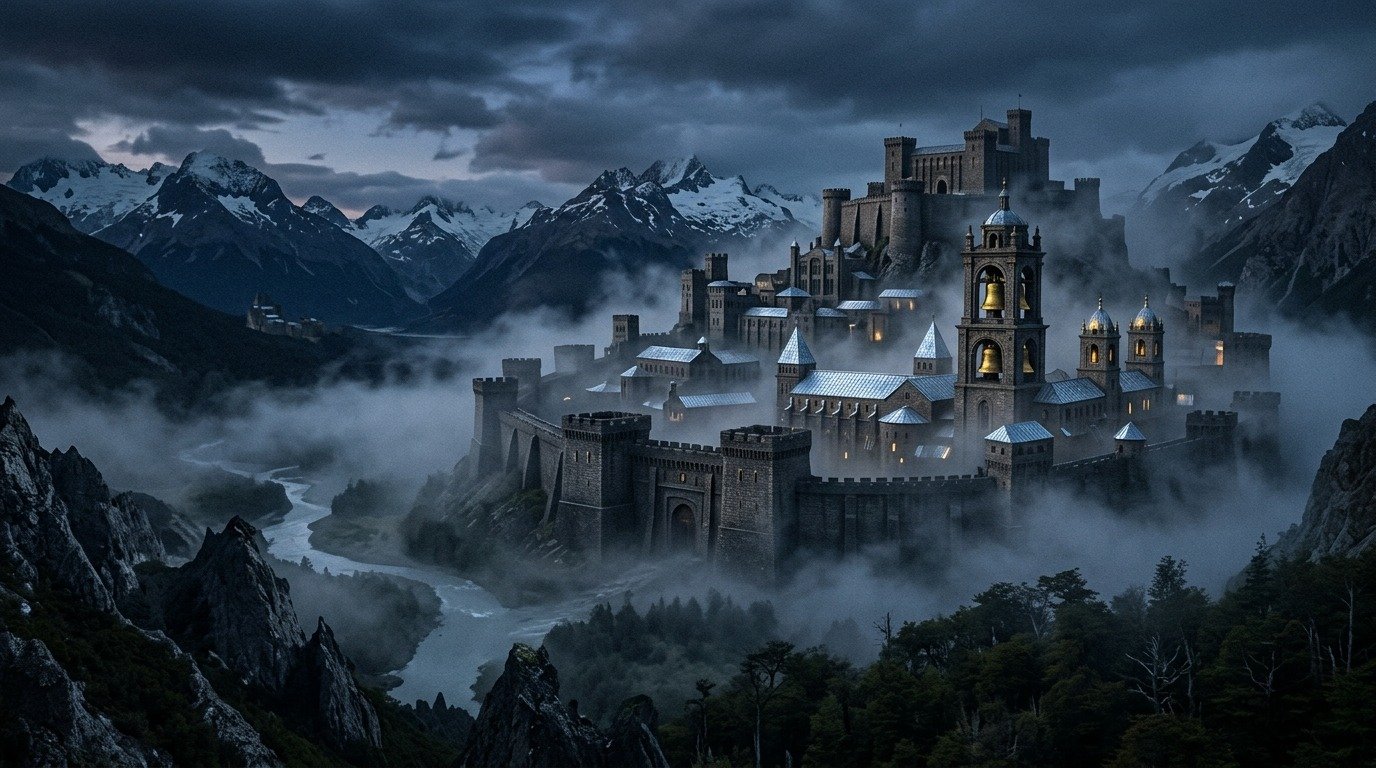
City of the Caesars: The Golden Fortress Hidden Beneath the Patagonian Mist
The Return of the Fourteen Men
In the autumn of 1528, fourteen exhausted men, their armor rusted by the jungle dew and their clothes in tatters, entered the fort of Sancti Spiritu on the banks of the Paraná River. Commanding the expedition was Captain Francisco César. They had set out months earlier toward the west, venturing into an unknown and hostile territory. They brought back no casualties, but they did bring something far more dangerous: a story. César claimed before Sebastian Cabot himself that they had crossed a mountain range and found a civilization where men wore clothes woven with gold thread, houses had silver roofs, and the precious metal was so common that it was used for farming tools. That very night, among the campfires, the legend of the City of the Caesars was born.
The Lost Trail in the Immensity of the South
The captain's tale ignited the greed of the Spanish Crown. Over the next two centuries, the search for this mythical city—also called Trapalanda, Lin Lin, or the Enchanted City—dragged dozens of expeditions to a certain death in the wastelands of Patagonia. The history of the myth was fueled by real tragedies. In 1540, one of the ships from the fleet of the Bishop of Plasencia was shipwrecked in the Strait of Magellan. The survivors, abandoned on a freezing, windswept coast, marched northward seeking refuge. They never returned, but rumors claimed that these shipwreck survivors had settled in a mountain valley that was difficult to access. There, according to letters circulating in Santiago de Chile and Buenos Aires, they joined the natives to found a fortified city, surrounded by carved stone walls and deep moats, inaccessible to the rest of the world. Governors like Hernandarias and missionaries like the Jesuit Nicolás Mascardi spent fortunes and lives searching for the settlement. Official maps of the era began to mark the location of the floating city among the lakes and volcanoes of the Andes mountain range, shifting it further and further south as explorers failed to find it. Patagonia became a gigantic labyrinth of stone and cold that devoured anyone who dared to seek the shipwreck survivors' gold.
The Kingdom of the Invisible Bell
The legend of the City of the Caesars describes it as a bubble of European splendor suspended in the prehistory of South America. Its buildings have roofs of pure silver, and the churches boast solid gold bells whose tolling can be heard leagues away. Its inhabitants, a mixture of conquistadors, English shipwreck survivors, and peaceful natives, enjoy supernatural longevity; there, no one falls ill, no one ages, and the orchards produce gigantic fruits year-round, despite the Andean frosts. However, the city's true power lies in its magical defense. The accounts of the few natives who claimed to have seen it assert that the city is protected by a dense and perpetual mist that hides it from foreign eyes. If a greedy traveler approaches its vicinity, the mist becomes so thick that it prevents them from seeing their own hands, disorienting them until they plunge off cliffs or become lost forever in the coihue forests. The city only becomes visible to those who search for it without ambition, but anyone who manages to enter it loses all memory of the way back and remains trapped in its precious metal paradise forever.
The Echo Among the Glaciers
Today, the territory where the mythical city was located is part of the national parks of Argentine and Chilean Patagonia, near the imposing Mount Tronador and Lake Nahuel Huapi. The dense Andean forest remains a territory that is difficult to access in many of its areas, and park rangers and solitary mountaineers who traverse the deepest zones of the mountain range often report strange phenomena. The most common account among hikers who stray from marked trails speaks of a metallic, clear, and rhythmic sound that echoes in the deep valleys during days of absolute calm. It is not the wind through the branches nor the creaking of the glaciers: it sounds exactly like the distant tolling of a great bronze bell. There are mountaineers who tell of having seen, at sunset, the reflection of golden lights on a stone wall where there was nothing but ice and rock, and that when they tried to approach, a sudden blizzard forced them back, erasing all traces of the path.
The Roots of the Hallucination
The historical explanation behind the myth is as human as it is desperate. Most historians believe that Captain Francisco César and his men never reached Patagonia in 1528; their incursion likely took them toward the sierras of Córdoba or San Luis. There, the natives told them of the immense wealth of an empire located much further north: the Inca Empire. César confused the cardinal directions or exaggerated the tale to win the favor of his superiors. On the other hand, the shipwreck survivors of the Bishop of Plasencia did exist, but instead of founding a city of silver, they died of starvation or integrated completely into the Tehuelche and Mapuche tribes, adapting to their nomadic lifestyle to survive the inclement weather. The City of the Caesars was, in reality, a projection of the greed and nostalgia of the Spanish colonizers, who needed to believe that in the coldest and most desolate confines of the Earth, an oasis of wealth and European civilization awaited them. The Patagonian mist continues to descend the slopes of the mountain range every afternoon, thick and white, erasing the contours of the trees and the water. For anyone walking alone through those forests in the cold of dusk, it is easy to understand why so many men believed that, behind that wall of vapor, rose the walls of a silver city that the world would never manage to find.
Comments
Share information, an experience, or a source to help enrich this entry. They are automatically reviewed before being published.
Loading comments...