El Dorado
El Dorado: The Gold Rush That Devoured a Jungle and a Thousand Lives
One morning in February 1541, a massive column of men set out from Quito toward the east under the command of Gonzalo Pizarro. There were two hundred and twenty Spaniards in heavy armor, four thousand chained indigenous people, and hundreds of bloodthirsty hunting dogs. They all pressed forward, driven by a persistent rumor that the natives repeated with a mixture of fear and cunning: beyond the Andes, in the jungles where the sun rises, there existed a province so rich that its lord covered his body with gold dust every morning to bathe in a sacred lagoon at sunset. El Dorado was not a place; it was a man of precious metal.
The Lagoon of the Offering
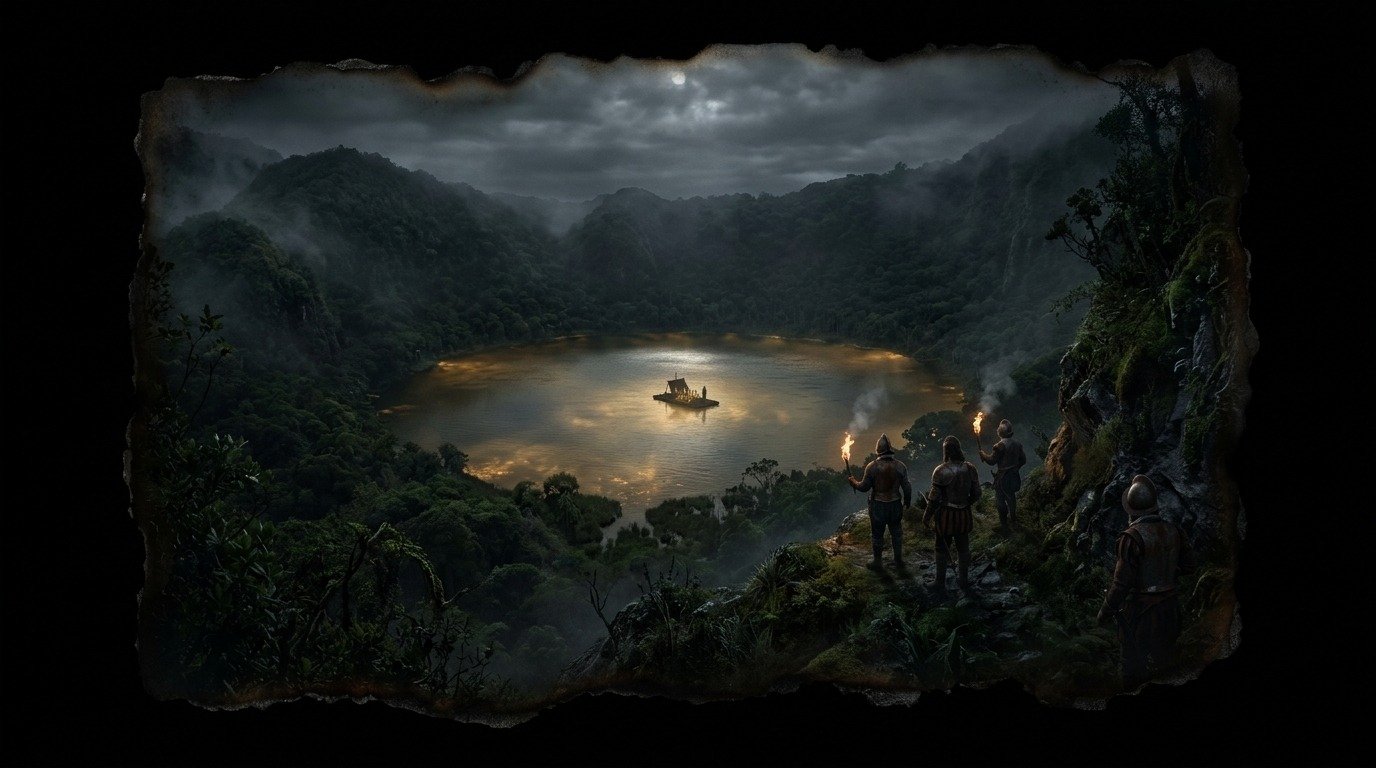
The real origin of the myth lay in Lake Guatavita, a perfectly circular body of water located nearly three thousand meters (9,842 feet) above sea level in the Eastern Cordillera of Colombia. There, the Muisca people celebrated the consecration of the new cacique of Guatavita.
The ritual was of absolute solemnity. The heir was stripped naked, anointed with a sticky resin, and completely covered in fine gold dust, transforming into a living statue that gleamed under the Andean sun. The new cacique would board a reed raft loaded with gold vessels, emeralds, and votive figures called *tunjos*. Accompanied by four priests, he would sail to the center of the lagoon. Upon reaching the deepest point, the music of the clay flutes and drums would cease. The new lord would throw the riches into the water as an offering to the goddess of the lagoon and then dive in himself, emerging clean while the gold settled to the muddy bottom.
The Madness of the Jungle
When the Spanish conquistadors subjugated the Muisca and plundered their temples, the ceremony was no longer practiced, but European greed transformed the ritual of the golden man into an entire city built of the precious metal. The search for El Dorado became a life-crushing machine.
Pizarro's expedition disintegrated in the Amazon rainforest due to hunger, fevers, and attacks by the natives. Francisco de Orellana separated from the main group and ended up discovering the Amazon River by accident, but found no trace of the golden city. Others tried with desperate violence. Lope de Aguirre traveled the rivers of South America, sowing terror and death among his own men, driven mad by the promise of a kingdom of golden temples that always seemed to lie just around the next bend of the river.
Even the refined Sir Walter Raleigh guided his English ships up the Orinoco River on two occasions to find Manoa, the mythical city of El Dorado that cartographers of the time were already drawing next to a non-existent lagoon called Parime. Raleigh returned empty-handed and ended up beheaded in London by order of the king, largely due to the conflicts his golden obsession provoked with the Spanish Empire.
The Echo in the Mud of Guatavita
For centuries, the obsession shifted to engineering. The first systematic attempt to drain Lake Guatavita occurred in 1580, when Bogotá merchant Antonio de Sepúlveda forced thousands of indigenous people to dig a channel in the rim of the crater. He managed to lower the water level by twenty meters (65 feet) and recovered some gold pieces and emeralds before the earthen walls collapsed, burying the workers and halting the excavation.
Today, Lake Guatavita is a protected natural sanctuary, surrounded by thick, silent vegetation that seems to absorb the sound of visitors. Those who walk along the rim of its crater claim that the air feels dense and cold, and that the wind coming down from the mountain sounds like the murmur of a crowd watching from the depths of the green waters.
What History Rescued
The material confirmation of the legend arrived in 1969. Some farmers found an extraordinary archaeological piece in a cave in Pasca, a municipality near Bogotá: a gold raft nearly twenty centimeters (7.8 inches) long, which depicted with astonishing precision the ceremony of the cacique with his priests and rowers.
This raft, now housed in the Gold Museum of Bogotá, proved that the story of the lagoon was real. However, the Spaniards never understood that for the natives, gold had no commercial value, but rather a purely ritual and spiritual meaning.
El Dorado was never a metropolis of glittering palaces hidden in the Amazon basin. It was a sacred bridge between men and their gods, a golden gleam that sank forever to the bottom of an Andean lagoon before the greed of Europe devoured the entire jungle in its pursuit.
Comments
Share information, an experience, or a source to help enrich this entry. They are automatically reviewed before being published.
Loading comments...