Lemuria
Lemuria: The Sunken Continent That Science Needed to Invent
In 1864, the English zoologist Philip Sclater stared in dismay at a map of the Indian Ocean in his London office. On his desk lay dozens of lemur skulls and skins. He could not solve a physical enigma: these animals were abundant on the island of Madagascar and in distant India, but there was not a single trace of them on the coasts of Africa or in the Middle East, the territories separating the two locations. To solve the mystery, Sclater took a pen, drew a line connecting southern Asia with eastern Africa, and christened this gigantic submerged landmass Lemuria.
The Birth of an Underwater Giant
Sclater's proposal did not take long to gain traction in the scientific community of the time. In a world that did not yet know the theory of continental drift, the existence of sunken land bridges was the only logical explanation for the distribution of species. The famous German biologist Ernst Haeckel used Lemuria to fill the most uncomfortable gap of his era: the origin of humanity. Haeckel claimed that Lemuria was the true cradle of humankind, the place where the "missing link" took its first steps before the ocean swallowed the evidence.
The leap from armchair science to absolute mysticism occurred at the hands of Helena Blavatsky, the founder of Theosophy. In her monumental 1888 work, *The Secret Doctrine*, Blavatsky revealed that Lemuria was not just a bridge for lemurs, but the home of humanity's Third Root Race.
The Three-Eyed Giants
Theosophical cosmogony describes Lemurians as colossal beings, nearly four meters (13 feet) tall, with yellowish or bronze-toned skin. They lacked a brain as we know it today; their communication was purely telepathic. Their most disturbing anatomical feature was a third eye located at the back of the head, an organ of spiritual perception that over millennia retracted to become what we call today the pineal gland.
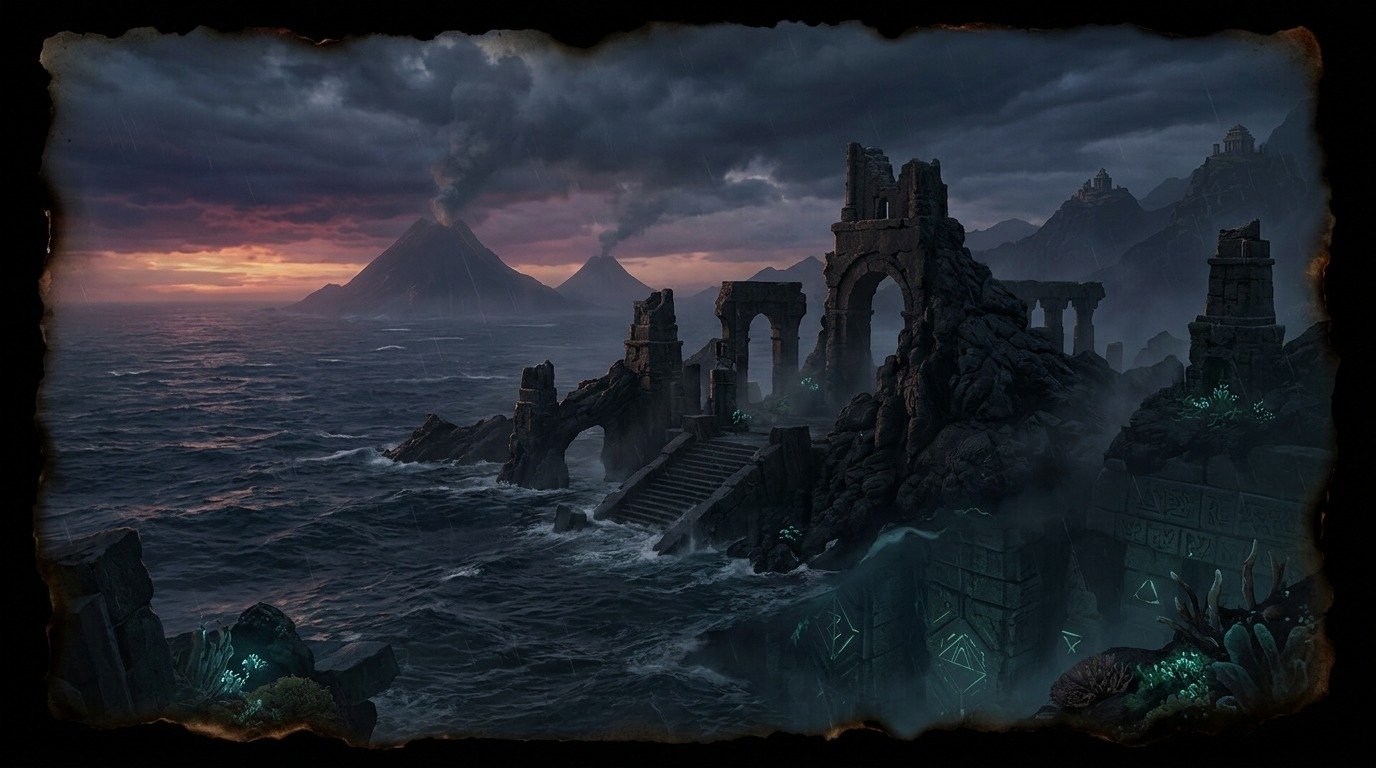
The Lemurians coexisted with dinosaurs and built the first great stone cities using solidified lava and clay. However, their civilization fell into moral decay. Mystical legend narrates that the forces of nature reacted to their corruption: hundreds of thousands of years ago, a series of massive volcanic eruptions cracked the ground of Lemuria. The continent fragmented, and the Indian Ocean swallowed its temples, leaving only small exposed mountain peaks that we know today as Madagascar, the Mascarene Islands, and Ceylon.
The Survivors of Mount Shasta
The story of Lemuria did not end at the bottom of the ocean. In the first decades of the 20th century, the myth moved to California, specifically to the imposing Mount Shasta. Followers of the occult claim that, just before the final catastrophe, a group of Lemurian high priests escaped eastward and took refuge in the depths of this dormant volcano.
Hikers who traverse the slopes of Mount Shasta report encounters with unusually tall figures, dressed in glowing white robes, who appear out of nowhere in the mist and disappear without leaving footprints in the snow. There is talk of an underground city called Telos, hidden beneath the mountain, from which the last Lemurians guard the knowledge of ancient Earth. Witnesses claim to hear deep vibrations emerging from the ground during clear nights and to see strangely colored lights entering and leaving the volcano's summit at speeds incompatible with any human technology.
What the Earth Hides
Modern geology solved Philip Sclater's enigma without the need for giants or phantom continents. The theory of plate tectonics, consolidated in the mid-20th century, proved that India and Madagascar were once joined as part of the supercontinent Gondwana, and then slowly drifted apart over millions of years.
However, science gave skeptics a surprise in 2013. A group of researchers found fragments of a prehistoric microcontinent beneath the waters of Mauritius in the Indian Ocean. Scientists named this landmass Mauritia. Although real, it fragmented and sank tens of millions of years ago, long before humans existed.
The mist of the Indian Ocean continues to hide the secrets of the deep. Those who sail its silent waters know that, beneath the darkest currents, rest the foundations of a world that science needed to invent and that myth refuses to forget.
Comments
Share information, an experience, or a source to help enrich this entry. They are automatically reviewed before being published.
Loading comments...