Jiangshi
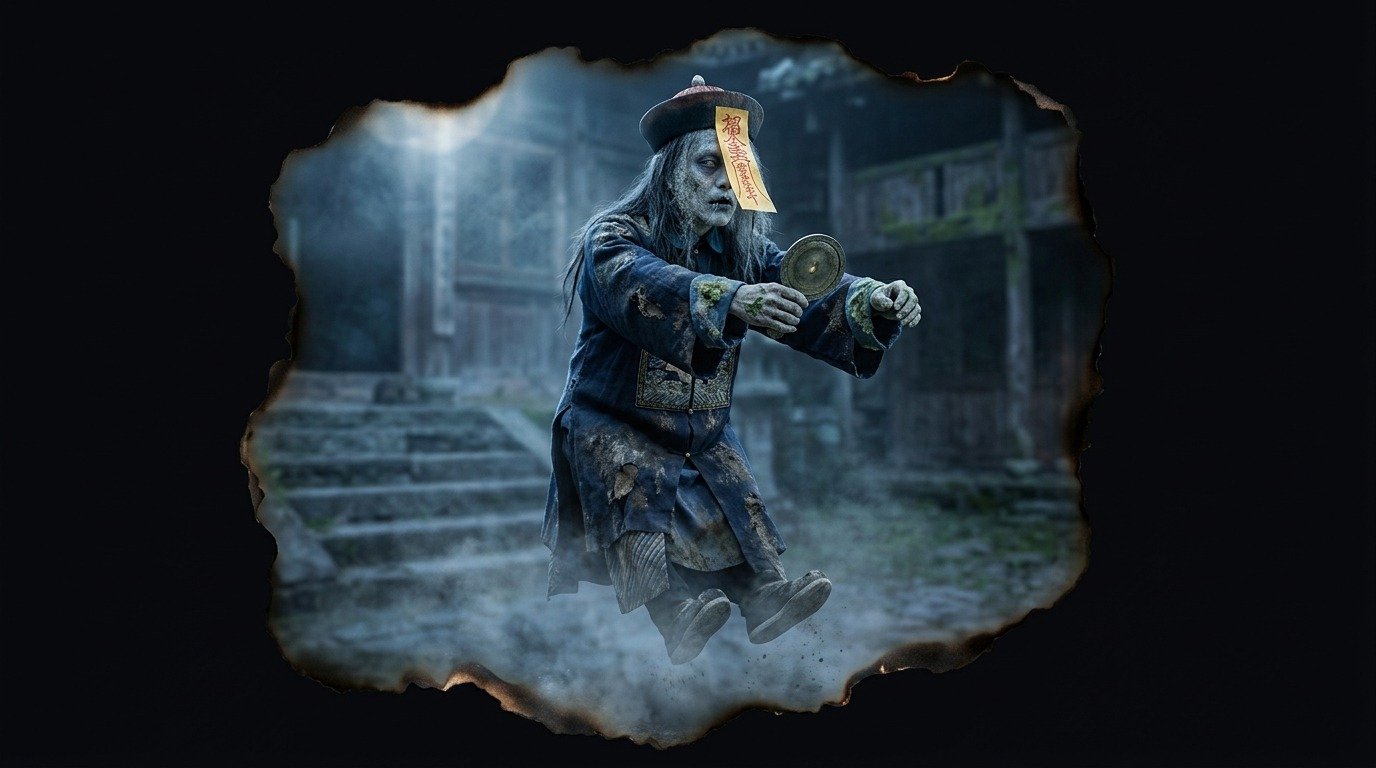
Jiangshi: The Stiff Corpse of Taoist Tradition
Origin and Legend
The Jiangshi (Chinese: 僵屍 or 殭屍, literally "stiff corpse") is an entity from Chinese folklore whose existence combines elements of ancestor worship, Taoist alchemy, and traditional funerary practices. The most detailed written sources on these creatures date back to the Ming and Qing dynasties, notably the treatise 阅微草堂笔记 (Yuewei Caotang Biji or Notes of the Yuewei Hermitage) written by the scholar Ji Yun (1724–1805), and the 子不語 (Zi Bu Yu or What the Master Did Not Speak Of) by Yuan Mei (1716–1797).
According to these chronicles, a human being transforms into a Jiangshi when their Po (the corporeal or earthly soul) refuses to leave the body after death, due to an improper burial, a violent death, a lightning strike, or the interference of Yin energy accumulated in the soil of the grave. Unlike the vampires of Western folklore, the Jiangshi's rigor mortis never disappears; for this reason, the creature cannot bend its joints or walk normally, moving instead by rhythmic hopping with its arms outstretched.
Historical and Regional Evolution
The origin of the Jiangshi is closely linked to the historical practice of Xiangxi Ganshi (the driving or transporting of corpses in Xiangxi). In the mountainous areas of Hunan Province, low-income families would hire Taoist priests (Suhuai) to transport the bodies of deceased workers far from home back to their native villages:
The "Transport of Corpses": The priests would line up the bodies and tie them vertically to two long bamboo poles resting on the shoulders of two porters. As they walked, the poles would flex, creating the optical illusion from a distance that the dead were moving by hopping. Over time, popular superstition transformed this logistical practice into the belief that Taoists resurrected the corpses using talismans so they could walk on their own.
Qing Dynasty Categorizations: Yuan Mei classified the Jiangshi into several phases of ontological development. A recent corpse first becomes a Baihai (white corpse), covered in light hair; if it consumes enough vital energy (Qi), it evolves into a Heihai (black corpse), then a Chigui (red demon), and finally a Feitou-man or Hou (a winged being capable of flying and transforming into a dragon).
Esoteric and Symbolic Significance
In the Chinese worldview, the human condition is sustained by the balance between the Hun (spiritual soul/Yang) and the Po (earthly soul/Yin). Upon death, the Hun ascends to the heavens or spiritual realms, while the Po descends to the earth with the body.
The Jiangshi represents the absolute triumph of matter over consciousness: the aberrant presence of a Po trapped in dead flesh without the illuminating guidance of the Hun. It is the pure accumulation of stagnant Yin energy. Symbolically, it embodies the corruption of filial piety (Xiao): a deceased person who has not received proper rest or ritual becomes a parasite that returns to devour the vital energy (Qi) and blood of their own descendants.
Manifestation and Neutralization Practice
The Jiangshi is detected by its extremely pale skin or skin covered in a fine white or greenish mold/hair, its foul breath saturated with cadaverous air (Zangqi), and its inability to breathe (it detects its victims by tracking the inhalation and exhalation of human breath).
The Taoist tradition (Maoshan) consolidated a rigorous protocol of exorcism and containment based on Yang-dominant alchemical and symbolic principles:
Huangfu (Yellow Talismans): Strips of yellow paper written with cinnabar ink containing mandates of celestial imperatives. By affixing a talisman to the Jiangshi's forehead, the circulation of the trapped Po is paralyzed.
Bagua Bronze Mirrors: They reflect light and pure Yang nature, dissipating the Yin condensation of the corpse.
Uncooked Glutinous Rice (Nuomi): Used for its properties to draw out the corpse's venom and neutralize dark mystical energy.
Carpenter's Red Ink Lines: Blessed with mantras and steeped in black rooster blood, stretched around the coffin or the creature to create an impassable physical and hyperphysical barrier.
Comments
Share information, an experience, or a source to help enrich this entry. They are automatically reviewed before being published.
Loading comments...