Dhampir
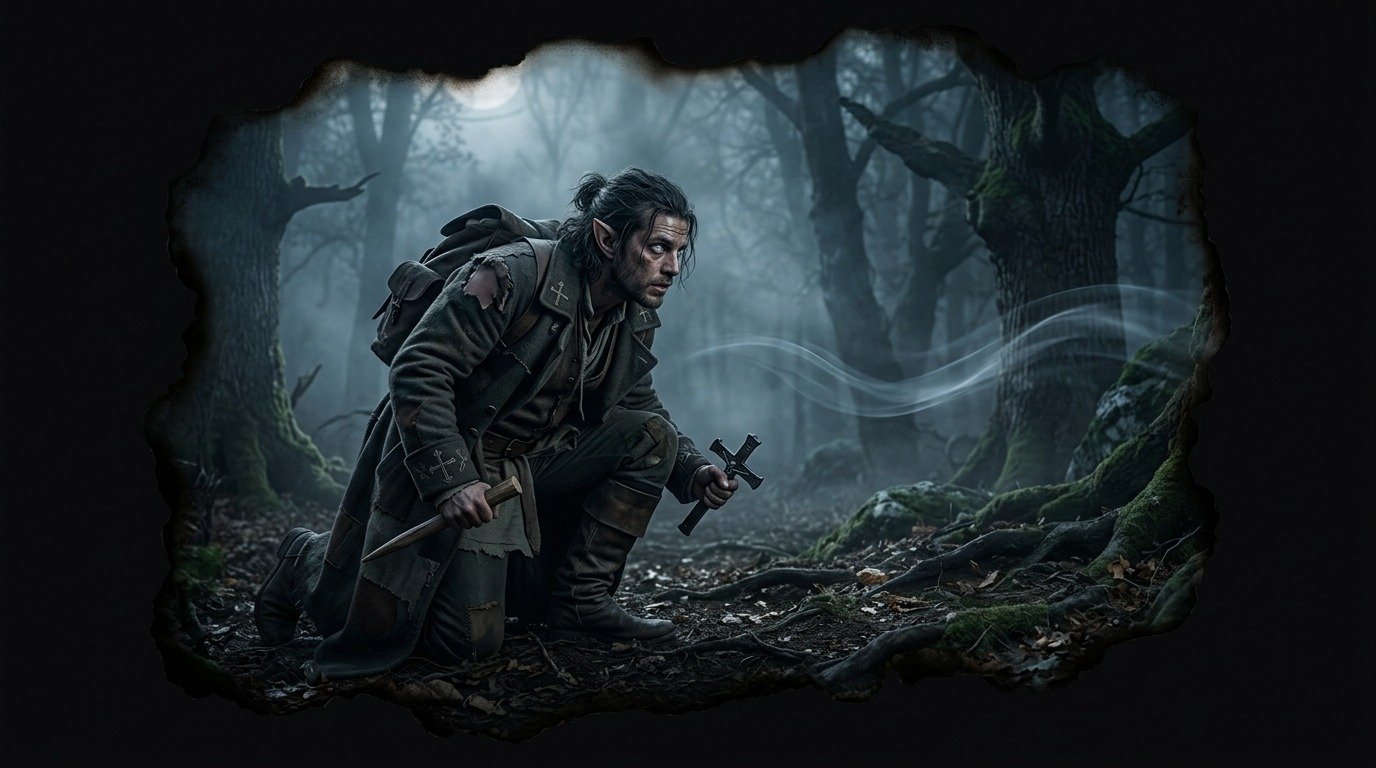
Dhampir: The Scion of Two Worlds and the Hunter of the Night's Lineage
Origin and Legend
In the folklore mythology of the Balkans—with a prominent presence in Albania, Serbia, Bulgaria, North Macedonia, and Romani (*rom*) culture—the crucial figure of the *Dhampir* emerges (with regional variations such as *Dhampir*, *Dampyr*, *Dampiro*, or in Slovenian *Kresnik* in certain hunting contexts). The term comes directly from Albanian: composed of *dhëmb* (tooth) and *pîr* (to drink or suck), literally translating as "he who drinks through teeth."
The Dhampir is the hybrid entity par excellence: the child conceived from the union between a vampire (*Grave-dweller* or *Vampir*) and a mortal human woman. In Balkan folklore, unlike the modern cinematic myth, it was firmly believed that male vampires retained an aberrant reproductive capacity. Upon returning from their graves to their former homes, vampires often sought the sexual companionship of their own widows, drawn by the somatic memory of earthly desire.
From this sacrilegious and liminal act, the Dhampir was born. Being born a Dhampir was not perceived as a noble blessing, but rather as a tragic birthmark, an intermediate position between the world of the living and the abyss of the dead. However, due to his divided heritage, the Dhampir possessed the one quality that humanity desperately needed: the innate ability to **see, track, and destroy invisible vampires**.
Historical and Regional Evolution
Throughout the 18th, 19th, and early 20th centuries, the Dhampir was not a literary invention, but a **real sociological and occupational figure** in rural Balkan life. There were real individuals who advertised themselves and charged professional fees as *Dhampirs* or *Vampiradzhis* (vampire hunters).
The profession of Dhampir was both respected and feared. When a village in Serbia or Macedonia suspected it was being victimized by a vampire that withered livestock or brought disease, the council of elders would hire the services of a wandering Dhampir.
The regional variations of the hybrid hunter figure showcase the richness of the myth: - **Albania (*Dhampir*):** He was believed to possess the ability to see the vampire even when it became completely invisible to the rest of mortals. His body lacked distinct shadows, and it was said that his bones were soft or nonexistent (a concept shared in several Balkan areas where the Dhampir was believed to have a gelatinous or flexible physical constitution). - **Serbia and Bosnia (*Vampirović* / *Glog*):** The son of the vampire was often called *Vampirović* (son of the vampire). He was believed to have extremely large ears and a dark birthmark shaped like a claw or a cross on his back. - **Romani Folklore (*Murrain*):** In nomadic Romani communities, the Dhampir possessed the unique ability to detect the "lines of invisibility" that impure spirits left in their wake.
Esoteric and Symbolic Significance
In high magic, theurgy, and Left-Hand Path esotericism, the Dhampir is the ultimate archetype of the **Liminal Being and the Hermetic Mediator**. He is the embodiment of the principle of the *Alchemy of Opposites*: the union of vampiric Sulfur (the dark, hungry, and immortal spirit) with human Salt (earthly, fragile, and mortal matter).
Symbolically, the Dhampir represents the **Initiate who has integrated his Shadow without being consumed by it**. Unlike the ordinary human, who falls prey to terror before the vampiric force, and the vampire, who has lost his humanity to become a cosmic parasite, the Dhampir possesses the power of the monster but retains empathy and connection to the earthly plane.
Kabbalistically, the Dhampir is located on the path of *Tiphereth* projecting toward *Yesod* (the bridge between the spiritual Sun and the psychic/astral Moon). He is the consciousness that can descend into the depths of the Qliphothic realms (the infernal realms or the abyss) and return intact, using the very weapons of darkness to restore balance in Creation.
In depth psychology, the Dhampir is the **Archetype of the Wounded Healer** (*Chiron*): he who carries the toxin of inherited trauma in his own blood, but uses that very biological and psychic immunity to heal the community that looks upon him with suspicion.
Manifestation, Testimonies, and Practice
The work of a Dhampir was not a cloak-and-dagger spectacle, but a somatic, ritual, and shamanic process highly documented in the judicial and ethnological records of the Carpathians and the Balkans.
**Documented Hunting Procedures (18th-19th Centuries):**
When a Dhampir arrived in an affected village, he carried out a strict protocol that combined psychic trance with ritual combat:
1. **The Detection Trance:** The Dhampir entered an altered state of consciousness, often removing his shirt or part of his clothing to feel the "cold air currents" emanating from the invisible vampire. The hunter would look through a hole made in his own hat or use a red-dyed handkerchief. 2. **The Invisible Combat:** The Dhampir would begin to fight in the seemingly empty air, running through the village streets, growling, making thrusts with a stag-horn-handled dagger, or firing pistols loaded with cast iron. The villagers watched in dread as the Dhampir fell to the ground, sweated profusely, and struggled against an invisible force. 3. **The Subduing of the Entity:** The combat culminated when the Dhampir cornered the spirit or the invisible corpse against a wall or in the barn. After delivering the final blow (often using a blackthorn stake or *Glog* wood—hawthorn), the Dhampir declared that the entity had been destroyed, occasionally showing a viscous, gelatinous, and reddish substance on the ground that he claimed was the "condensed blood" or the dissolved mass of the vampire (*jelada*).
**Traditional Protection Protocols and Control Methods:**
For the community, the Dhampir was an indispensable but dangerous tool. Due to his impure blood, it was feared that the Dhampir himself could become an extremely powerful vampire upon death. Therefore, strict protocols were applied:
- **Occupational Inheritance:** It was believed that the Dhampir's power could only be transmitted from father to male son. If the lineage was broken, the region's protection was lost. - **Special Funeral Rituals for the Dhampir:** When a Dhampir died of natural causes, the community performed a burial of high apotropaic security: his heart was preemptively pierced with a silver needle and boiling oil was poured into his ears to ensure that his half-vampiric soul found definitive rest and did not return as an immortal tyrant.
Comments
Share information, an experience, or a source to help enrich this entry. They are automatically reviewed before being published.
Loading comments...