Asema
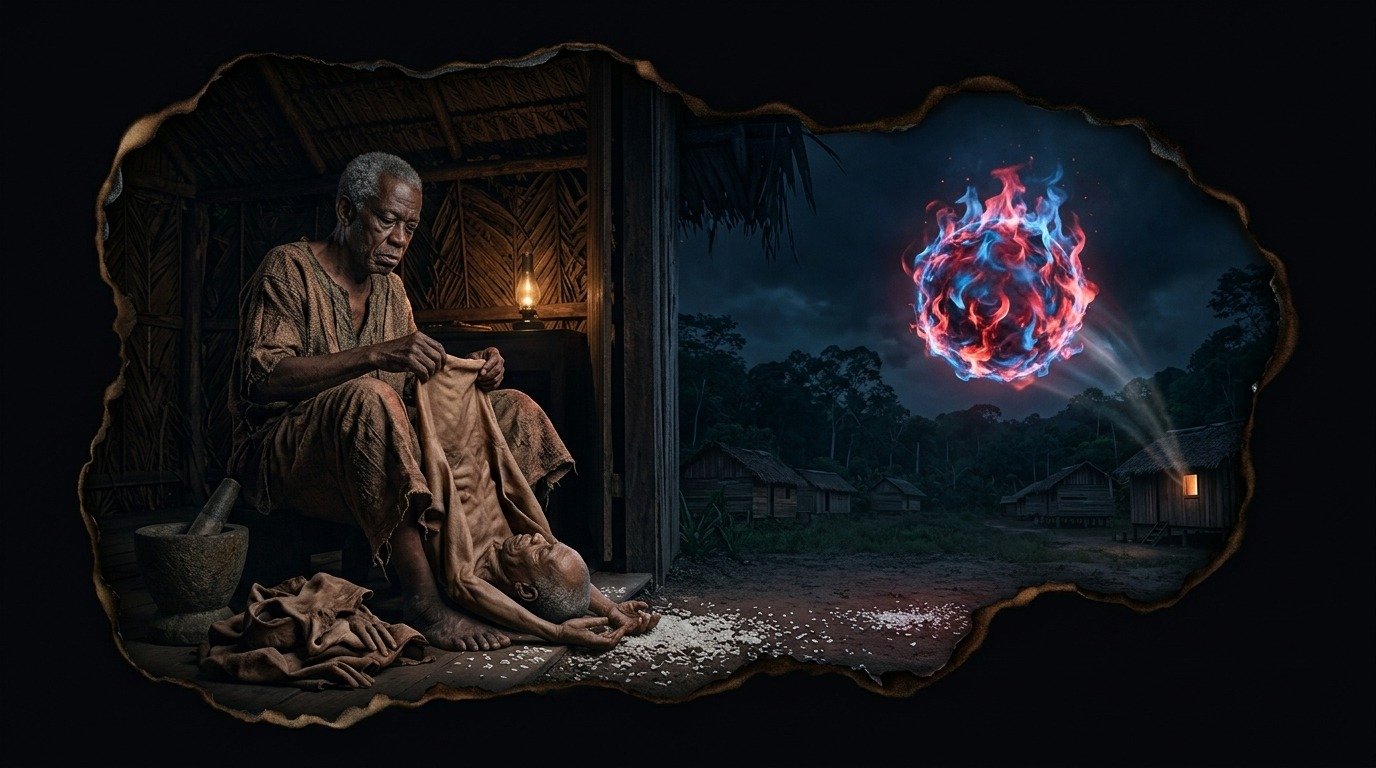
Asema: The Elder Vampire of the Guianas
Origin and Legend
The *asema* is a hematophagous entity whose origin is rooted in the oral tradition of the *Maroons* of Suriname and French Guiana, communities descended from enslaved Africans who preserved and reshaped West African worldviews (especially those of the Akan and Fon peoples) in the dense Amazonian ecosystem. In the structure of local folklore, the asema belongs to the category of *azeman* or *witch-vampires*, beings that inhabit the earthly plane under an apparently harmless human guise: usually elderly, solitary, and reclusive people. During the day, the asema lives among the population without raising direct suspicion. However, when night falls, the entity retreats to the shadows of its home to perform a ritual anatomical shedding: using a plant ointment or incantation, it completely sheds its human skin, which it carefully folds and hides under a mortar or a grinding stone. Deprived of its epidermis, the asema transforms into a bluish or reddish ball or globe of fire that flies through the night sky in search of fresh blood, preferring that of young children and weakened individuals.
Historical Evolution and Regional Variants
The myth of the asema represents a clear transculturation of the *adze* of the Ewe people and the *obayifo* of the Ashanti people, brought to the Guianas through the transatlantic slave trade. In the environment of the tropical rainforest and the settlements along the Suriname River, the figure of the practitioner of night witchcraft (*obeah* or *voodoo*) merged with collective fears of wasting diseases, such as malaria or tuberculosis, which caused severe anemia and the sudden death of infants. Throughout the 19th and 20th centuries, the term *asema* began to be used interchangeably in neighboring regions. In Trinidad and Tobago, it adopts traits of the *soucouyant*, while in Brazil it is linked to variants of the female *lobisomem*. Despite the modernization of Paramaribo and other Surinamese cities, belief in the asema persists in rural areas of the interior, where the presence of anomalous night lights (*ignes fatui* or will-o'-the-wisps) continues to be attributed to the hunting of the flayed vampire.
Symbolic Meaning and Social Function
From an anthropological and sociological perspective, the asema embodies the projection of community distrust toward social isolation and unintegrated old age. In tribal and Maroon societies, group cohesion was vital for survival; any individual who withdrew, showed greed, or shunned reciprocity was suspected of draining the "life force" (*kra*) of the community in favor of their personal longevity. Symbolically, the act of shedding the skin represents the duality of human nature: the social mask that conceals an underlying spiritual voracity. The flying fire is the primary manifestation of the unrestrained desire that consumes the individual from within until the degradation of their earthly vessel is complete.
Protective Practices and Testimonials
Surinamese tradition has codified a precise corpus of countermeasures against the asema, based primarily on the principle of obsessive-compulsive disorder or arithmomania, a recurring pattern in defense against flying vampires of African origin. * **Deterrence strategies:** It is customary to scatter grains of raw rice, sesame seeds, or coarse salt around bedroom doors and windows. Upon arriving in the form of a flame, the asema is forced by a mystical compulsion to count every single grain before dawn. If the sun rises before it finishes, the sunlight destroys its substance or prevents it from returning to its skin. * **Skin neutralization:** The definitive method to destroy the entity does not consist of attacking it in its luminous form, but rather in locating the hidden human skin while it floats through the air. If the inner side of the epidermis is sprinkled with fine salt, hot pepper (*adjuma*), or lime juice, when the asema attempts to put it back on at dawn, the corrosive substance will cause unbearable pain that will prevent it from wearing it, causing it to burn in the first rays of the sun. * **Use of garlic and methylene blue:** Families coat openings with garlic or paint crosses on doors with indigo (*doti azul*), ritual barriers that repel the entity's energetic frequency.
Comments
Share information, an experience, or a source to help enrich this entry. They are automatically reviewed before being published.
Loading comments...