Estrie
Estrie: The Bird Demon of Medieval Jewish Tradition
Origin and Legend
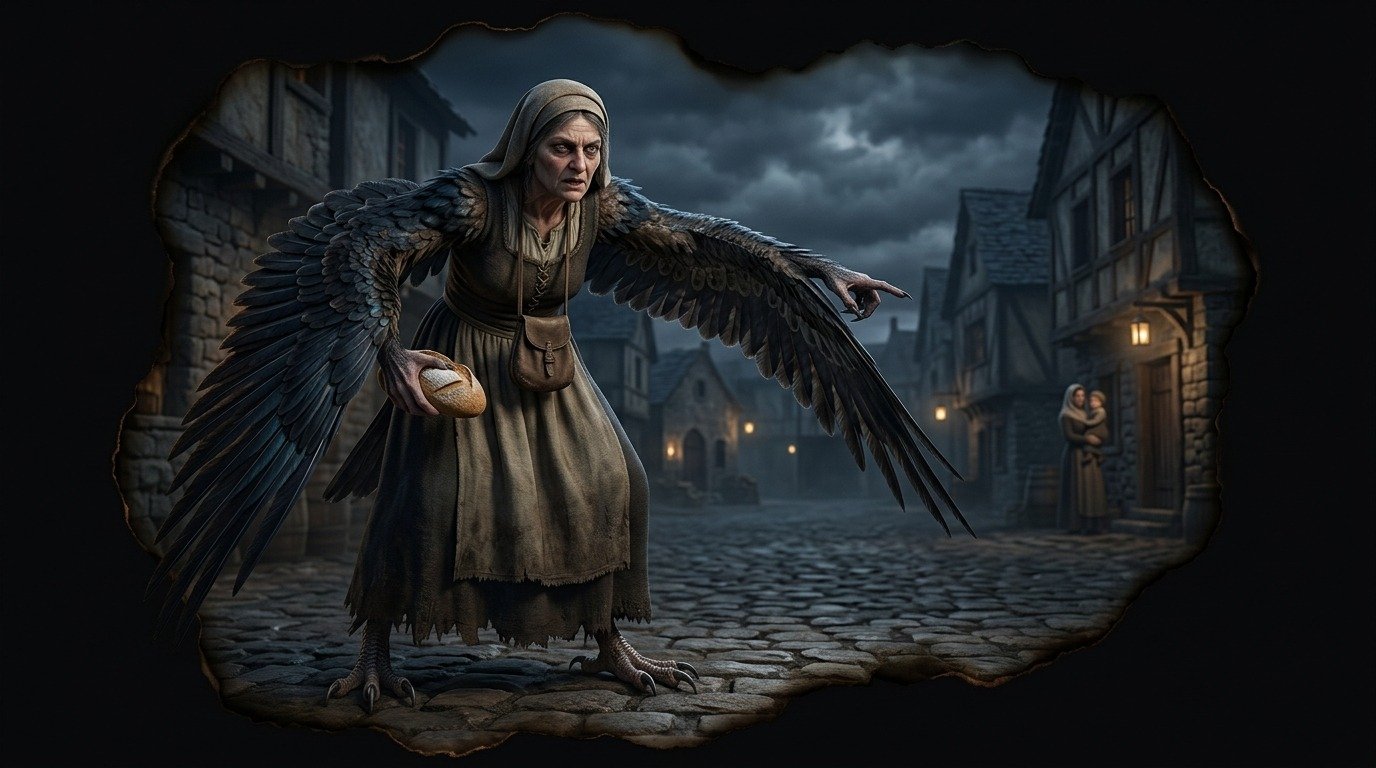
The *estrie* (from Hebrew: אסתרייאה, derived in turn from the Latin *strix*, "screech owl" or "night witch") is a prominent and terrifying figure in the demonology of Ashkenazi Judaism of Central and Eastern Europe during the Middle Ages. Its most detailed and serious records do not come from secular legends, but from rabbinic and legal texts of immense authority, most notably the *Sefer Hasidim* ("The Book of the Pious"), written in the 12th and 13th centuries by Rabbi Judah the Pious (*Yehuda he-Hasid*) of Regensburg. The estrie is defined as a hybrid creature: a living human woman who possesses a demonic nature, either latent or acquired through the dark arts. She possesses the ability to shapeshift at will, predominantly transforming into a nocturnal bird (usually an owl or a crow), although she can also take the form of domestic animals such as cats or dogs. In this animal form, she flies through Jewish villages (*shtetls*) at night to feed on the blood and life energy of the community members, showing a predatory preference for young children, women in childbirth, and the gravely ill.
Historical Evolution and Rabbinic Context
Unlike the vampires of the surrounding Slavic folklore, who were usually unburied or unbaptized corpses, the Ashkenazi estrie is an entity highly integrated into daily social life during the day. She lived among the community as a Jewish woman, attended the synagogue, and formally complied with the precepts of the Torah to avoid being discovered. The *Sefer Hasidim* treats the estrie with a disconcerting legal and medical pragmatism. For the Ashkenazi sages of the 12th century, the estrie was not a mere metaphor, but a real biological and spiritual danger. According to rabbinic texts: * To sustain her capacity for metamorphosis and her supernatural faculties, the estrie *needs* to consume human blood periodically. * If an estrie is wounded or struck while in her bird form, the physical damage is immediately reflected in her human body. * To heal from a wound received in her animal form, the estrie must consume bread and salt lent or gifted by the very person who wounded her, which generated complex halakhic (Jewish law) dilemmas regarding whether feeding a suspect constituted a sin or an obligation of charity.
Esoteric and Kabbalistic Significance
Within Jewish mysticism and later Kabbalah, the estrie is directly linked to the emanations of the *Sitra Achra* (the "Other Side" or the realm of spiritual impurity) and shares an archetype with the figure of *Lilith*, the mythical first wife of Adam who rejected subordination and became the mother of demons (*shedim*). From the standpoint of rabbinic esotericism: * The estrie represents the danger of the infiltration of impurity (*Tumat Met*) into the heart of the pious home (*Bayit Ne'eman*). * It reflects the communal anxiety in the face of the extremely high infant mortality of the Middle Ages, attributing the unexplained deaths of newborns to the voracity of these female entities that attacked the sanctity of childbirth. * It symbolizes the power of the vital fluid (blood) which, according to Leviticus (*Vayikrah* 17:11), contains the life (*nefesh*) of all flesh; consuming blood is seizing the victim's soul to prolong an impure existence.
Testimonies from the Sefer Hasidim and Methods of Protection
The *Sefer Hasidim* documents specific cases and establishes definitive protocols to counteract, diagnose, and destroy an estrie: * **The Synagogue Incident:** In one of the accounts of the *Sefer Hasidim* (§ 1465), it is narrated how an estrie took the form of a cat and tried to attack a Jewish man at night. The man struck her hard with a stick. The next day, a respectable woman of the community fell gravely ill with matching bruise marks. The woman desperately begged the man to give her a piece of bread and salt to save her life. The sage of the city warned the man to give her absolutely nothing, because if he did, the estrie would regain her strength to continue murdering children; upon being denied the food, the woman died a few days later. * **Ritual of Burial and Destruction:** Dealing with the corpse of a confirmed estrie required extreme measures to prevent her from rising as a wandering spirit. The rabbinic law of the text instructs that, when burying an estrie, her mouth must be opened and completely filled with earth or ash before sealing the coffin. In other documented cases within Franco-German communities, her head was severed or a wooden stake was driven into her heart directly inside the grave, ensuring that the demonic force could not reuse the physical vessel. * **Protection Amulets:** To protect women in labor and newborns before circumcision (*Brit Milah*), the Ashkenazim hung amulets in the four corners of the room marked with the names of the angels *Sanvi, Sansanvi, and Semangelof*, along with the words written in Hebrew: *"Lilith and Estrie, out of here"*.
Comments
Share information, an experience, or a source to help enrich this entry. They are automatically reviewed before being published.
Loading comments...