Manananggal
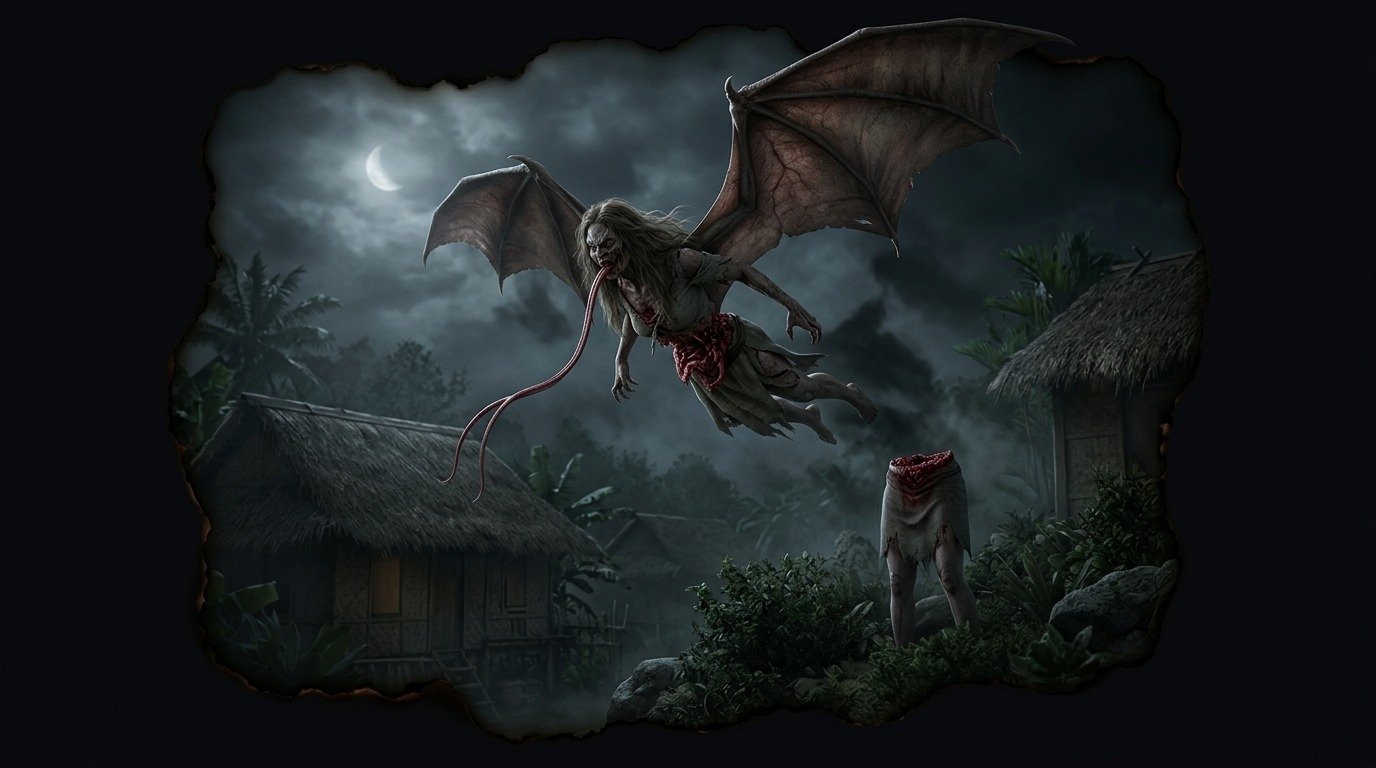
Manananggal: The Severed Vampire of the Visayas
Origin and Legend
The Manananggal (derived from the Tagalog term *tanggal*, "to separate" or "to remove", meaning "the one who separates") is the most iconic mythical creature in Philippine folklore, originating primarily from the Visayan Islands. Although often confused in Western popular literature with the Malay *Penanggalan* due to its severed anatomy, the Manananggal possesses a completely distinct morphology and origin.
Extensively documented by Spanish chroniclers and historians during the colonial period (such as the Franciscan friar Juan de Plasencia in his 1589 *Customs of the Tagalogs*), the Manananggal is described as a hideous-looking female being who possesses the ability to completely sever her body at the waist. Upon separating, massive membranous wings similar to those of a gigantic bat (*pukpuk*) sprout from her back, leaving her lower extremities motionless and standing upright on the ground while the upper half flies in search of prey.
Historical and Regional Evolution
The narrative surrounding the Manananggal was instrumentalized and significantly altered over the centuries:
Colonial Demonization: Before the arrival of the Spanish, Philippine society granted a central spiritual role to the *Babaylan* (priestesses and healers). The colonial administration and religious orders reconfigured healing knowledge and female shamanic practices under the stigma of witchcraft, merging local deities of night and death (*Aswang*) with the terrifying figure of the Manananggal to undermine the social authority of the healers.
Transmission by Demonic Seed: In late Philippine oral tradition, the condition of being a Manananggal is not solely an act of black magic, but a spiritual infection. It is believed that a mythical black worm or chick dwells inside the witch's throat or heart. When the Manananggal dies, she must pass this creature to a relative through direct oral contact; if she cannot find a successor, she cannot leave the earthly plane, suffering prolonged agony.
Esoteric and Symbolic Significance
The Manananggal represents the Archetype of Existential Fragmentation and Mystical Abortion. Unlike other nocturnal beings that seek wholeness through the consumption of blood, the Manananggal operates by dividing her own physical form into two opposite poles: the lower half (earthly, inert, anchored to the ground) and the upper half (volatile, predatory, destructive).
Her preferred target is the womb of pregnant women. Using a bifurcated, threadlike, and hollow tongue, she pierces thatched roofs while her victims sleep to suck the blood of the fetus or the embryo itself. She is the personification of the abrupt interruption of the continuity of life and the terror of infertility, a collective shadow in societies where the preservation of the community lineage is the fundamental axis of survival.
Manifestation and Neutralization Practice
The flight of the Manananggal is heralded by the sound of heavy flapping and a sharp, repetitive whistling (*tik-tik* or *wak-wak*). Paradoxically, in Philippine folklore, it is believed that the fainter and more distant the sound of the *tik-tik* is heard, the closer the entity is to the house.
Traditional methods to combat the Manananggal exploit the absolute vulnerability of her abandoned lower half:
The Use of Salt and Ashes: If the lower half of the creature's body is located (usually hidden among dense vegetation or behind bushes), the practitioner or hunter must sprinkle fine salt, wood ash, crushed garlic, or hot spices onto the exposed wound of the severed waist.
Impossibility of Reintegration: The salt or garlic chemically and magically prevents the upper half from rejoining the bodily base. Upon the arrival of the first rays of the sun (*Araw*), the unprotected upper half cannot withstand direct sunlight and spontaneously incinerates, causing the permanent death of the witch.
Domestic Protection: The presence of stingray daggers (*buntot ng pagi*), holy vinegar, garlic hung from the rafters, and blessed rosaries acts as a repellent shield to prevent the creature from landing on the structure of the home.
Comments
Share information, an experience, or a source to help enrich this entry. They are automatically reviewed before being published.
Loading comments...