Penanggalan
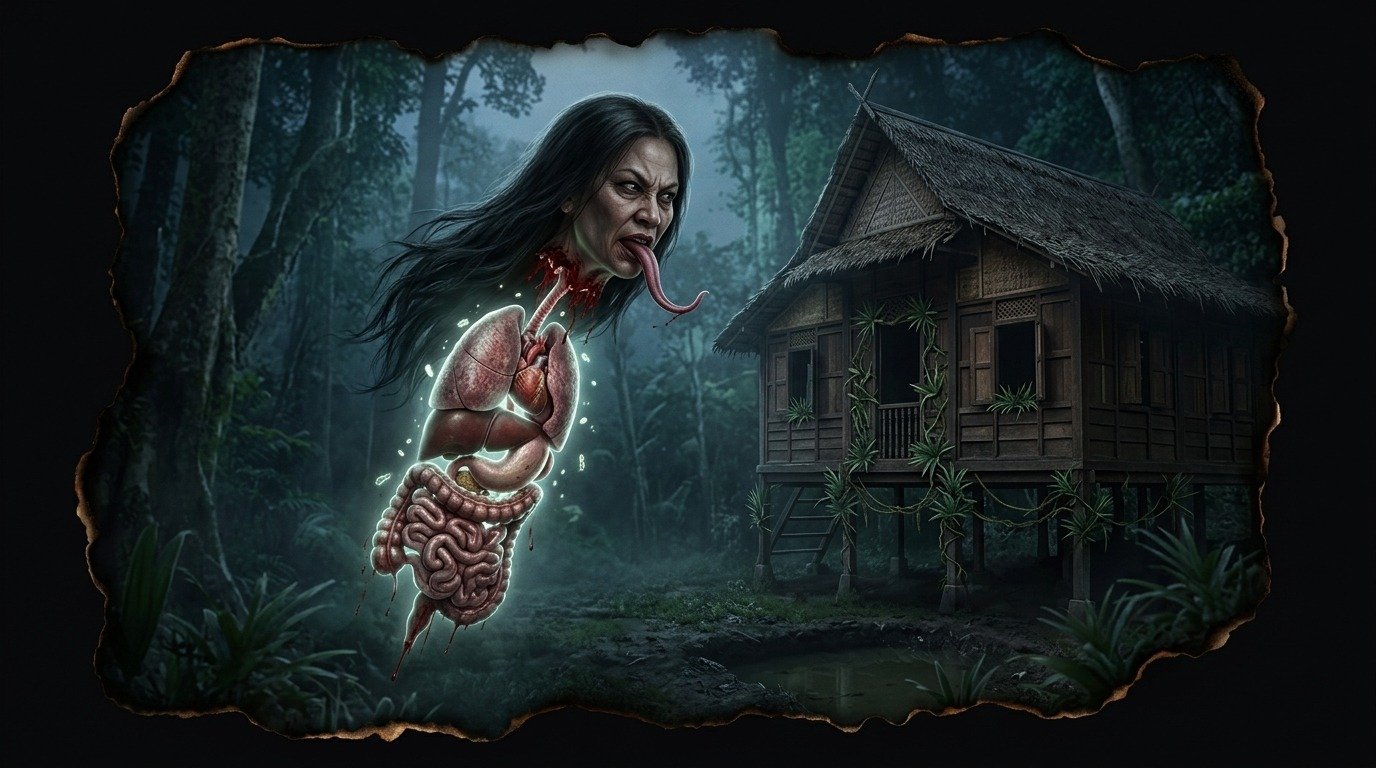
Penanggalan: The Floating and Disemboweled Head of Insulindia
Origin and Legend
The Penanggalan (or Penanggal, also known in Thailand as Krasue, in Cambodia as Ahp, and in Vietnam as Ma Cà Rồng) is one of the most terrifying nocturnal entities of Southeast Asian folkloric traditions, widespread mainly in Malaysia, Brunei, and Indonesia. Its name comes from the Malay word tanggal, which means "to remove", "to detach", or "to take off". Unlike pure spectral entities, the Penanggalan is a living woman who practices dark arts (Ilmu Hitam). Legend holds that the primordial origin of this condition lies in a forbidden pact with demonic entities or in the breaking of a ritual taboo during the execution of beauty or immortality enchantments (such as the Susuk). According to traditional Malay narrative, the first Penanggalan was performing a penance, sitting inside a large vinegar pit, when she was startled by a man; from the shock, she turned her head with such violence that her neck tore, separating the head from the rest of the torso and pulling up with it the entire digestive system and viscera.
Historical and Regional Evolution
The figure of the Penanggalan has maintained a remarkable stability in the collective memory of the Insulindia region, deeply linked to traditional obstetrics and the fears associated with maternal and infant mortality: Dual Nature (Day and Night): During the day, the witch lives as a normal woman within the community, though often withdrawn, with red marks around her neck or with a characteristic sour breath. At night, she detaches her head from her physical body through the application of scented oils and dark invocations, leaving the headless torso vacant in her bed. Indochinese Krasue Variation: In Thailand and Cambodia, the Krasue is not always the product of a voluntary pact, but rather a karmic curse transmitted through contact with the bodily fluids (saliva or blood) of a dying Krasue to an unsuspecting victim.
Esoteric and Symbolic Significance
The Penanggalan is the archetype of the Inversion of Motherhood. While the complete female body is the receptacle of gestation and nourishment, the Penanggalan strips the head (the mind, the will, the senses) from the harmonious bodily base, dragging along only the organs of digestion and waste (stomach, intestines, heart). It represents the uncontrolled appetite that devours the strength of the future generation: her exclusive nourishment is the blood of women in childbirth (darah nifas) and the life force of newborns. On a psychological and anthropological level, she personifies repressed longing, envy toward the fertility of others, and the transgression of natural limits through egotic magic that devours the life she could not create.
Manifestation and Practice of Protection
The Penanggalan flies in the night, illuminated by a ghostly glow emanating from her own exposed organs, which drip corrosive bile and emit a buzzing sound similar to that of a swarm of insects. To feed, she perches on the roofs of houses where a woman in labor resides, inserting her long, extensible tongue through the cracks in the bamboo floor to suck the life from the mother or the newborn. The traditional protection protocols documented in Malay folklore are physical and symmetrical to the anatomical nature of the creature: Jeruju Leaves (Acanthus): Thorny-leaved plants are placed around windows, doors, and beneath the stilts of the house. The Penanggalan's exposed intestines easily get caught on the thorns, leaving her trapped and helpless before the light of the rising sun. Intervention of the Empty Body: If a person finds the witch's headless torso during the night, it is advised to change the position of the body (turning it face down) or to fill the neck cavity with ash or pieces of glass. Upon the head's return at dawn, it will be unable to reconnect properly or will die while attempting to fit back on upside down. Vinegar Bathing: The creature must periodically soak her entrails in a container of vinegar to reduce their size and hypertrophy before reinserting herself into her human body. The lingering smell of vinegar is the key diagnostic method for identifying the practitioner during the day.
Comments
Share information, an experience, or a source to help enrich this entry. They are automatically reviewed before being published.
Loading comments...