Nachzehrer
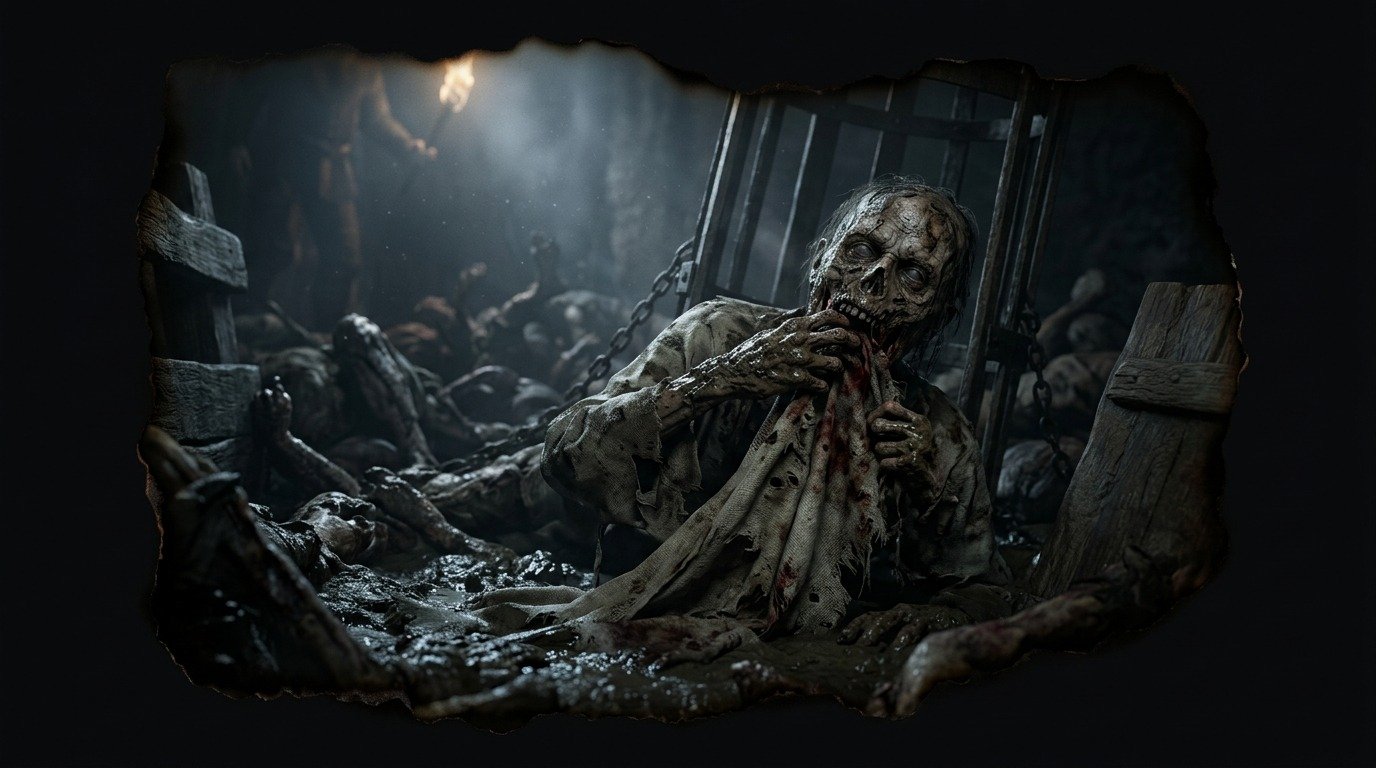
Nachzehrer: The Shroud Devourer and the Germanic Epidemic Scourge
Origin and Legend
In the northern and central regions of Germany, as well as in areas of Bavaria, Silesia, and the Baltic basin, the figure of the vampire takes on a uniquely morbid and necrophagous manifestation: the *Nachzehrer* (whose literal translation from Middle High German is composed of *nach*—after—and *zehren*—to consume, devour, or waste away—meaning "one who devours from after [death]"). Unlike vampiric entities that actively leave their graves to hunt through villages, the *Nachzehrer* is a fundamentally subterranean creature, immobilized in its own grave. Its modus operandi does not require direct physical contact in the streets; instead, it exerts a sympathetic fascination or contagious magic from deep within the earth. Legend dictates that the *Nachzehrer* begins its activity by devouring itself: it starts by chewing its own fingers, its grave clothes, and the sheet or shroud (*Totenhemd*) in which it was wrapped. As the *Nachzehrer* consumes its own skin and shroud in the grave, a phenomenon of vital force absorption at a distance occurs. Its closest relatives, and later the village neighbors, begin to waste away, losing blood and strength as if they were connected by an invisible and malignant umbilical cord to the buried corpse.
Historical and Regional Evolution
The myth of the *Nachzehrer* is inextricably linked to the history of the great devastating pandemics in the Holy Roman Empire, predominantly during the Black Death of the 14th century and the bubonic plague and typhus epidemics of the 16th and 17th centuries. Germanic medical and theological literature of the era coined specific terms for this phenomenon, such as the *Schmatzenden Toten* (the "chewing dead" or cadaverous ones making sucking noises in their graves). In 1679, the Protestant theologian and scholar Philip Jakob Hartmann published one of the most influential treatises on the subject, titled *De Nobilis Sanguisuga* (On Noble Leeches), followed in 1728 by the famous study by scholar Michael Ranft, *De Masticatione Mortuorum in Tumulis* (On the Mastication of the Dead in Their Graves). These works documented how, when opening mass graves during the peaks of epidemics, gravediggers heard muffled chewing noises (*Schmatzen*) coming from the earth. The German regional variants diversified the creature: - **The *Neuntöter* (The Nine-Killer):** A northern German variant credited with the ability to kill nine people from its family before completely dissolving. It only regained the ability to kill if the plague continued. - **The *Blutseuger* (Blood-Sucker):** Common in border areas with Slavic lands, which combined the characteristics of the *Nachzehrer* with the direct physical attack of the *Upír*. The profile of the person at risk of becoming a *Nachzehrer* was highly specific in Germanic society: the **first person to die in a community from an epidemic disease**. It was believed that the soul of this "patient zero," resentful of being the first to depart, bound subsequent dead to the grave through a destructive impulse. Also at risk were suicides and those from whom the handkerchief holding the jaw in place had not been removed when buried.
Esoteric and Symbolic Meaning
On the plane of esoteric interpretation and alchemical occultism, the *Nachzehrer* is the personification of **Putrefactio Inversa and Subconscious Psychic Cannibalism**. While in the alchemical Great Work the phase of *Nigredo* or putrefaction is a necessary step for the liberation of the spirit and the purification of matter, the *Nachzehrer* represents a stagnant and corrupted *Nigredo*, a phase where decomposed matter folds back in on itself, refusing to release frozen energy. Symbolically, the *Nachzehrer* embodies the **domino effect of unassimilated trauma and fear of the plague**. It is the vampirism of guilt: the first victim of a tragedy (the first to die of plague) becomes the black hole that sucks in the survivors due to contagious dread. The chewing of the shroud represents the ultimate oral regression and the autophagy of the spirit trapped in the rotting biological mass. In the tradition of late Germanic occultism, the *Nachzehrer* is also the manifestation of the "Magic Force of Binding" (*Anbinden*), where the flesh of the dead acts as a telluric receptor that drains vitality (*Ond* or *Prana*) from their bloodline through the magnetic resonance of shared blood.
Manifestation, Testimonies, and Practice
The presence of a *Nachzehrer* did not manifest through elegant night visions or spectral apparitions, but through very concrete somatic and acoustic symptoms: - An audible smacking or wet chewing sound near recent graves at dusk. - The sudden and progressive death of the deceased's family members, who reported suffering from lethal weakness and a feeling of oppression in the throat. - The persistence of the plague in the street or sector where the alleged *Nachzehrer* had been buried. **Archaeological Evidence and Grave Records:** Modern archaeology has validated the extent of apotropaic (anti-vampiric) practices against the *Nachzehrer* in Central Europe. In 2006, during excavations of a mass grave of plague victims from 1576 on the island of Lazzaretto Nuovo in the Venetian Lagoon, archaeologists led by Matteo Borrini discovered the skull of an elderly woman with a **massive brick forcibly wedged inside her oral cavity**. Forensic and historical analyses confirmed that this was a burial executed under the Germanic-Italian belief of the time regarding "shroud eaters" (*Nachzehrer*). The gravediggers, upon reopening the mass grave to deposit new corpses, observed that the woman's face was covered in decomposition fluids that had dissolved the shroud fabric at the level of her mouth. Believing the woman was a *Nachzehrer* feeding on her shroud to spread the plague, they inserted the brick to mechanically seal her jaws and break her teeth. **Traditional Protection Protocols:** To prevent a deceased person from transforming into a *Nachzehrer*, Germanic tradition demanded drastic preventive measures during shrouding: 1. **Mechanical Immobilization of the Jaw:** A large stone, a block of blessed earth, or a brick was placed inside the mouth of the newly deceased before closing the coffin. 2. **The Silver Coin (*Totengroschen*):** A hard silver coin was placed under the deceased's tongue. It was believed that the noble metal "paid" the dead's hunger or neutralized the electromagnetic charge of the cadaveric fixation, preventing them from chewing their clothes. 3. **Destruction of Binding Objects:** It was strictly mandatory to burn all handkerchiefs, bandages, or bindings that had been in contact with the chin or limbs of the deceased. If the deceased's name was embroidered on the shroud, it had to be cut out, as it was believed that the *Nachzehrer* read its own name in the darkness of the grave to keep its egoic identity active. 4. **Decapitation and Pinning:** If the epidemic had already broken out, the villagers would open the grave, cut off the suspect's head with a gravedigger's shovel and place the head out of reach of the arms, or pin the corpse's mouth to the bottom of the grave with a large iron nail (*Sargnagel*).
Comments
Share information, an experience, or a source to help enrich this entry. They are automatically reviewed before being published.
Loading comments...