Nosferatu
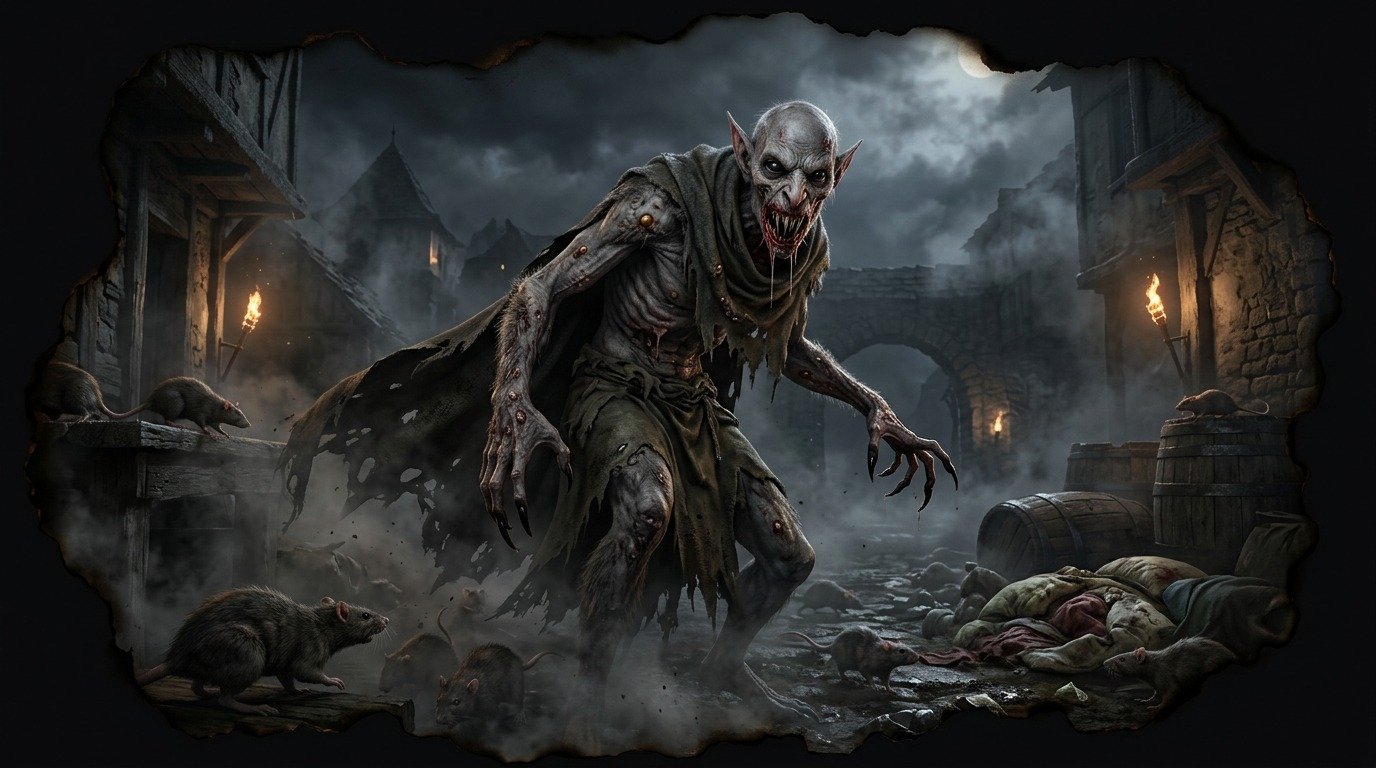
Nosferatu: The Pestilent Plague and the Philological Distortion of Romanian Folklore
Origin and Legend
The term *Nosferatu* occupies an absolutely unique and paradoxical place in Western demonology. While in the global popular imagination it represents the quintessential embodiment of the vampire—a cadaverous creature with pointed ears, elongated claws, and a rat-like face, immortalized by F.W. Murnau's 1922 cinematic masterpiece—a rigorous anthropological and historical research analysis reveals a fascinating phenomenon: the term *Nosferatu* does not exist as a valid native word in the traditional Romanian language.
The genesis of *Nosferatu* as a folkloric concept is due to a philological transcription error and subsequent Victorian romanticization. The first documented mention of the word appears in 1885 in an article by the Austrian author Emily Gerard titled *Transylvanian Superstitions*, published in *Blackwood's Magazine*, and later included in her book *The Land Beyond the Forest* (1888). Gerard wrote: > "More dreaded than the *Strigoi* is the *Nosferatu*, the undead vampire that every child born of an illegitimate marriage becomes, or anyone who has been the victim of a vampire." This work was the direct source from which the Irish writer Bram Stoker extracted the term to include it in his novel *Dracula* (1897), establishing it worldwide as a synonym for "undead."
However, linguists and ethnologists of the stature of Wilhelm Schmidt, Tudor Pamfile, and Sergiu Al-George have exhaustively demonstrated that Gerard misheard or mistranscribed a local Romanian term. The three most solid academic philological hypotheses regarding the actual origin of the word are: 1. **Nesuferit:** A genuine Romanian term meaning "the insufferable," "the objectionable," or "the detestable." It is a linguistic taboo used by peasants to avoid directly naming the Devil or a *Strigoi*. 2. **Necurat:** Literally meaning "the impure" or "the unclean," a common designation in Romanian folklore for evil spirits. 3. **Nostiforus / Nosophoros:** A corruption of the classical Greek *νοσοφόρος* (*nosophoros*), which translates as "the disease-bearer" or "the bringer of pestilence."
Thus, *Nosferatu* is the result of the intersection between authentic folklore about pestilence and a colonial/Western recording error, becoming a "second-degree myth": a word created by travel literature but fueled by the terrifying reality of the Transylvanian fear of necrophilic contagion.
Historical and Regional Evolution
Despite its controversial philological origin, the creature Gerard and Stoker were trying to refer to with the term *Nosferatu* corresponds to one of the darkest facets of the *Strigoi* or the *Vârcolac* in the rural folklore of the Carpathian arc.
In 19th-century Transylvania, the region was under the administration of the Austro-Hungarian Empire. Germanic and Austrian officers, observers, and ethnographers collected tales with a mixture of exotic fascination and rationalist contempt. For the rural Moldavian, Saxon, and Romanian populations of Transylvania, the entity was not a seductive figure, but a **living vector of pestilence**.
The evolution of the creature split into two parallel branches starting in the 20th century: - **The Authentic Folkloric Branch (*Nesuferitul*):** It represented the being that engendered venereal diseases, cholera epidemics, and congenital malformations. It was the embodiment of blood impurity (*sânge stricat*) and taboo sexual acts (incest, adultery, procreation outside of sacred marriage). - **The Mythic-Cinematic Branch (*Nosferatu*):** Initiated by Murnau's film (*Nosferatu, eine Symphonie des Grauens*), where the character of Count Orlok (played by Max Schreck) definitively merged the vampire with the image of the **rat and the bubonic plague**. In this version, the Nosferatu does not seek merely to feed, but brings with it plagues of rodents, sulfur vapor, and the mass death of entire cities through which it passes.
Esoteric and Symbolic Significance
In modern occultism and contemporary demonology, *Nosferatu* has acquired a symbolic status distinct from the aristocratic vampire or the mere Slavic corpse. It is the archetype of the **Somatic Shadow and the Degeneration of Matter**.
Symbolically, the Nosferatu represents the most abject facet of immortality: an immortality that does not grant eternal youth or beauty, but rather the **perpetuation of decrepitude and living rot**. It is flesh that refuses to die but cannot flourish, remaining trapped in a state of continuous decomposition.
Kabbalistically, it is associated with the Qliphothic sphere of *Belial* (The Worthless / The Wasteland) and the manifestation of *Arch Choronzon* in the microcosmic realm. It is the psychic virus that destroys the beauty of the soul, reducing the individual to a mere blind appetite devoid of spirit.
In analytical psychology, the Nosferatu represents the **return of the pathologically repressed**: invisible illnesses, infectious guilt, and the moral ugliness that a refined society attempts to hide but which continues to devour its foundations from the shadows of sewers and crypts.
Manifestation, Testimonies, and Practice
In the context of field anthropology in the Carpathians and 19th-century historical records, manifestations of this entity were almost invariably associated with symptoms of physical ruin and collective dementia in communities.
**Manifestation and Recorded Testimonies:**
Emily Gerard documented during her stay in Hermannstadt (present-day Sibiu, Romania) how local villagers described the attack of this force. The creature did not appear as a recognizable person, but rather as a dense, pestilent air (*văzduh necurat*) or as a grotesque, emaciated face that stalked the stables and the bedrooms of newborns.
Testimonies collected in rural Transylvanian areas in the late 19th century indicated that when the *Nesuferit* targeted a community: - Crops rotted in a matter of days by means of a sticky substance on the leaves. - Healthy young people suffered from galloping anemia and nocturnal hallucinations in which they felt a heavy, ice-cold presence lying down beside them. - Children were born with extreme physical anomalies or with the presence of abundant hair on their backs and pre-erupted teeth.
**Traditional Protection and Neutralization Protocols:**
Due to the deeply infectious nature attributed to this entity, protection measures were notably more aggressive than those used against common ghosts: 1. **Fumigation with Sulfur and Juniper:** To cleanse a home infected by the presence of the *Nosferatu/Nesuferit*, hard resins, elemental sulfur (*pucioasă*), and dry juniper branches were burned. The dense smoke had to completely fill the house to expel the demonic miasma. 2. **The Ritual of Sacred Fire and Vinaigrette:** Exhumed remains suspected of this condition were not simply impaled with stakes; they were meticulously washed with boiling water mixed with white vinegar and crushed garlic, to be subsequently burned completely. The ashes were not buried in the cemetery, but were thrown into fast-flowing rivers so that the moving water would disperse the load of impurity (*necurățenie*). 3. **The Shield of Salt and Vinegar:** A continuous line of coarse salt mixed with ash from Epiphany night was placed on the threshold of all inhabited structures.
Comments
Share information, an experience, or a source to help enrich this entry. They are automatically reviewed before being published.
Loading comments...