The End of the Mayan World
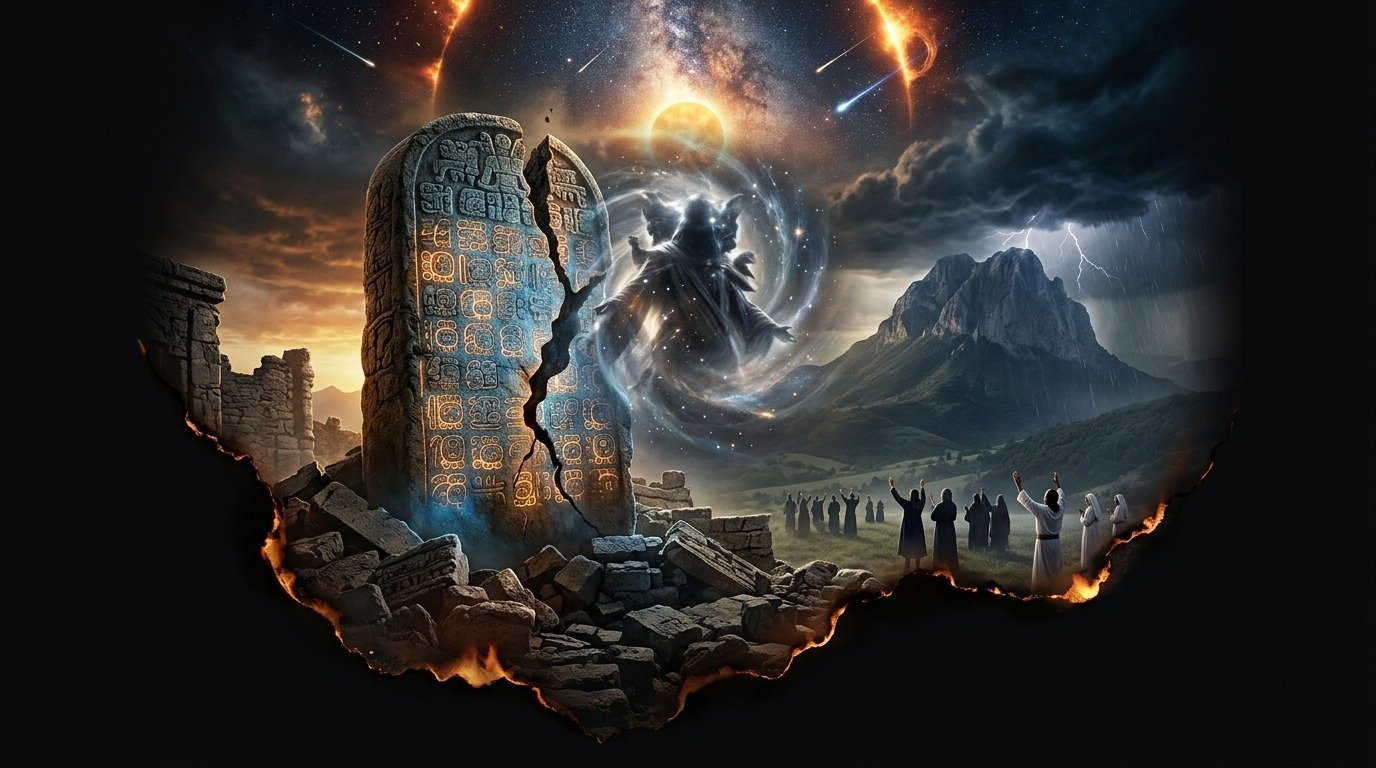
The End of the Mayan World: The Dawn That Held the Planet's Breath
On December 21, 2012, Mount Bugarach, a solitary peak in the south of France, woke up besieged by security forces. Local authorities had blocked all access to prevent thousands of people, convinced that the mountain housed an alien base that would open during the apocalypse to save a chosen few, from rushing up the slopes in a desperate rescue attempt. Meanwhile, in the temples of Chichén Itzá and Palenque, crowds dressed in white raised their arms toward the sun, waiting for the sky to open or the earth to swallow the present. On television screens across the planet, digital clocks counted down. The great cycle of the Mayan Long Count was coming to an end, and the entire world held its breath.
The Closing of the Great Cycle
The prophecy that kept humanity on edge at the dawn of the 21st century did not speak of an invasion or a plague, but of cosmic mathematics written in stone. The ancient Mayan scribes conceived of time as a serpent biting its tail, a succession of gigantic cycles called *baktuns*, periods of approximately 394 years in duration. To record dates across millennia, they designed the Long Count system, whose starting point was set on August 11, 3114 BCE.
According to the Popol Vuh, the gods made several attempts before creating present-day humanity: first, men of clay, who dissolved in water; then, men of wood, wiped out by a deluge of resin and attacks by animals; and finally, men of maize, the humans of today. For the Long Count, the current era began in that year 3114 BCE, and its great cycle lasted thirteen baktuns: a total of 5,125 years. Upon completion of this period, the cosmic count would return to zero. For modern Western interpreters, this calendar reset meant only one thing: the violent destruction of the Earth to make way for a new cosmic dawn.
The Prophecy Carved in Tortuguero
The origin of this planetary fear lies in a single archaeological piece: Monument 6 of Tortuguero, a site in the Mexican state of Tabasco. In the 1950s, during the construction of a highway that destroyed much of the site, workers unearthed a T-shaped limestone slab covered in hieroglyphic inscriptions.
Despite the damage suffered by the rock, epigraphers managed to translate the message carved by the scribes of the ruler B'ahlam Ajaw in the 7th century. The text describes political events of his reign, but in the final section, it projects into the future, pointing directly to the completion date of the thirteenth baktun. The relief announces that, on that day, *Bolon Yokte K'u*, a deity associated with war, the underworld, and moments of transition and chaos, will descend from the sky. The inscription is abruptly interrupted due to a fracture in the stone just after announcing that the god will appear in his ceremonial robes, leaving the outcome of the divine visit shrouded in mystery.
The Great New Age Hysteria
For centuries, the end of the Mayan Long Count was a fact known only to archaeologists and historians. However, in the final decades of the 20th century, the *New Age* movement and countercultural movements rescued the date and mixed it with an amalgam of esoteric beliefs. It was theorized that the Mayan date would coincide with a perfect galactic alignment between the Sun and the equator of the Milky Way, an astronomical event that would cause the reversal of Earth's magnetic poles, massive earthquakes, and the collapse of the planet's gravitational field.
The idea that an ancient civilization possessed precise astronomical knowledge that modern science was only beginning to understand fueled collective paranoia. The internet multiplied the reach of the prophecy. The entertainment industry exploited the panic with disaster movies showing entire continents sinking beneath the ocean. In several countries, the construction of private underground bunkers and the mass sale of survival food rations were reported. In China, some citizens spent their life savings building steel spheres capable of withstanding the impact of tsunamis. The prophecy became the first globalized and viralized end of the world in real time.
The Dawn of the Next Day
December 21, 2012, arrived. The sun crossed the sky, completed its daily cycle, and set without gravity being altered, without collisions with rogue planets, and without the gates of the underworld opening. Social media went from panic to mockery within a few hours, and the emergency hotlines that had been set up in several countries to calm anxious citizens fell silent.
In the Mayan communities of the Yucatán Peninsula and the highlands of Guatemala, the day passed with traditional ceremonies of gratitude and purification rites. For contemporary Mayan priests, the Western hysteria never made sense. They explained that the end of a Long Count cycle did not mean the death of the planet, but rather a date of spiritual renewal, the equivalent of the turn of the millennium in the Western calendar. For Mayan astronomy, time has no definitive end. The calendar did not stop that day; the fourteenth baktun simply began, ushering in a new era that will last another four hundred years before starting over.
Time That Does Not Stop
Today, the fragments of Monument 6 of Tortuguero remain protected in museums, their stone glyphs worn down by the centuries. Its prophecy, which once made millions of people tremble under the shadow of the apocalypse, was recorded as the most famous misunderstanding of the digital age and as a testament to the eternal human need to seek a final point on the horizon of time.
Comments
Share information, an experience, or a source to help enrich this entry. They are automatically reviewed before being published.
Loading comments...