Halley's Comet Panic
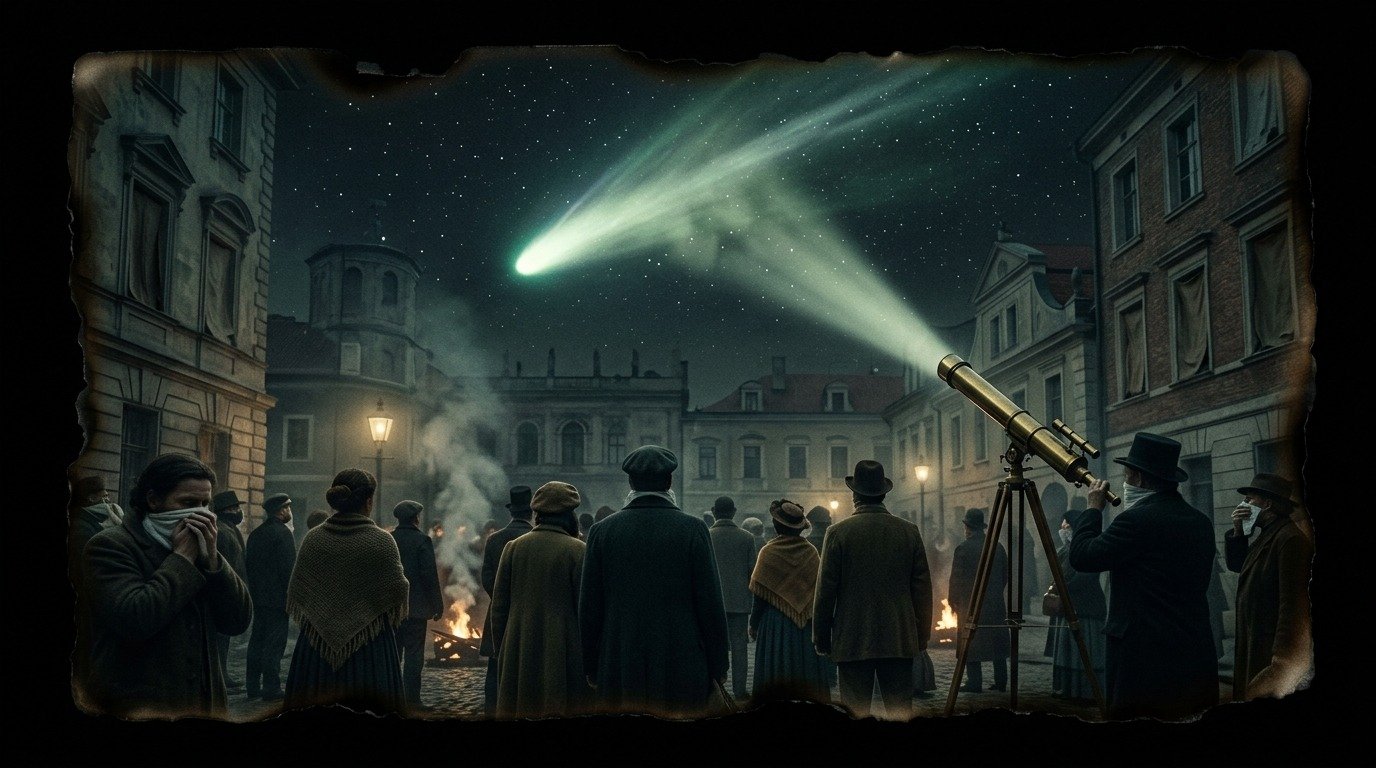
Halley's Comet Panic: The Lethal Gas That Threatened Earth in 1910
In May 1910, the approach of Halley's Comet to Earth unleashed an unprecedented wave of global panic due to warnings from prominent astronomers who pointed out that the planet would cross directly through the celestial body's tail. The alarm was sounded when French astronomer Camille Flammarion declared to the press that the comet's tail contained cyanogen, a highly toxic gas capable of suffocating all of humanity and extinguishing life on the face of the Earth.
The fear of an invisible collective death caused people on every continent to seal the cracks of their doors and windows, acquire gas masks, and buy pills supposedly designed to neutralize the space poison. On the night of May 18, 1910, the exact moment of the planetary crossing, millions of people stayed awake waiting for the end of the world, only to discover the next day that the Earth's atmosphere had acted as an impenetrable shield and that the gas had left no trace whatsoever.
The Scientific Discovery That Unleashed Terror
Halley's Comet visits the inner solar system every seventy-six years, but its 1910 pass was the first to be recorded using spectroscopic analysis technology. Early that year, astronomers at the Yerkes Observatory in Wisconsin used this technique to break down the light reflected by the comet and discovered the presence of cyanogen in its chemical tail, a gas composed of carbon and nitrogen that is part of the cyanide family.
The news, which should have remained within the academic sphere, reached the general public through sensationalist media. Camille Flammarion, a respected astronomer but prone to spectacular theories, declared to the newspaper *The New York Times* that the poisonous gas could permeate the Earth's atmosphere, snuffing out life on the planet in a matter of minutes, or cause a widespread combustion of oxygen upon coming into contact with the air.
Mass Hysteria and the End-of-the-World Business
Despite the fact that the vast majority of the scientific community tried to calm the population by explaining that the density of the comet's tail was millions of times less than that of Earth's air, collective hysteria spread like wildfire. The possibility of a silent, invisible apocalypse paralyzed entire cities.
In the United States and Europe, shrewd merchants capitalized on the fear to market miracle products. Thousands of "comet pills" made from sugar and aspirin were sold, as well as oxygen inhalers and bottles of "bottled pure air." In rural areas of various countries, people covered chimneys with wet sheets and put their farm animals in closed basements. In Chicago, luxury hotels organized gala parties in underground bunkers so their wealthy clients could toast while waiting for the chemical impact. In Rome, the Vatican reported a massive influx of the faithful crowding temples to confess before the passage of the celestial body.
The Poison-Free Dawn
The night of May 18, 1910, passed in deathly silence in major capitals and desperate prayers in rural areas. Astronomers kept their telescopes aimed at the clear sky, watching as the Earth indeed plunged into Halley's tenuous, kilometers-long (miles-long) tail of dust and gas.
May 19 dawned with absolute normalcy. No deaths from suffocation were recorded, the air remained breathable, and cyanogen levels in the atmosphere were undetectable even to the most precise measuring instruments of the time. The comet continued its journey back toward the outer reaches of the solar system, leaving behind thousands of unopened bottles of air, useless pills discarded in the streets, and the historical lesson of how scientific progress, misinterpreted by sensationalism, can generate a terror as deep as ancient religious prophecies.
Comments
Share information, an experience, or a source to help enrich this entry. They are automatically reviewed before being published.
Loading comments...