Great Disappointment of 1844
Great Disappointment of 1844: The Night the Sky Remained Empty
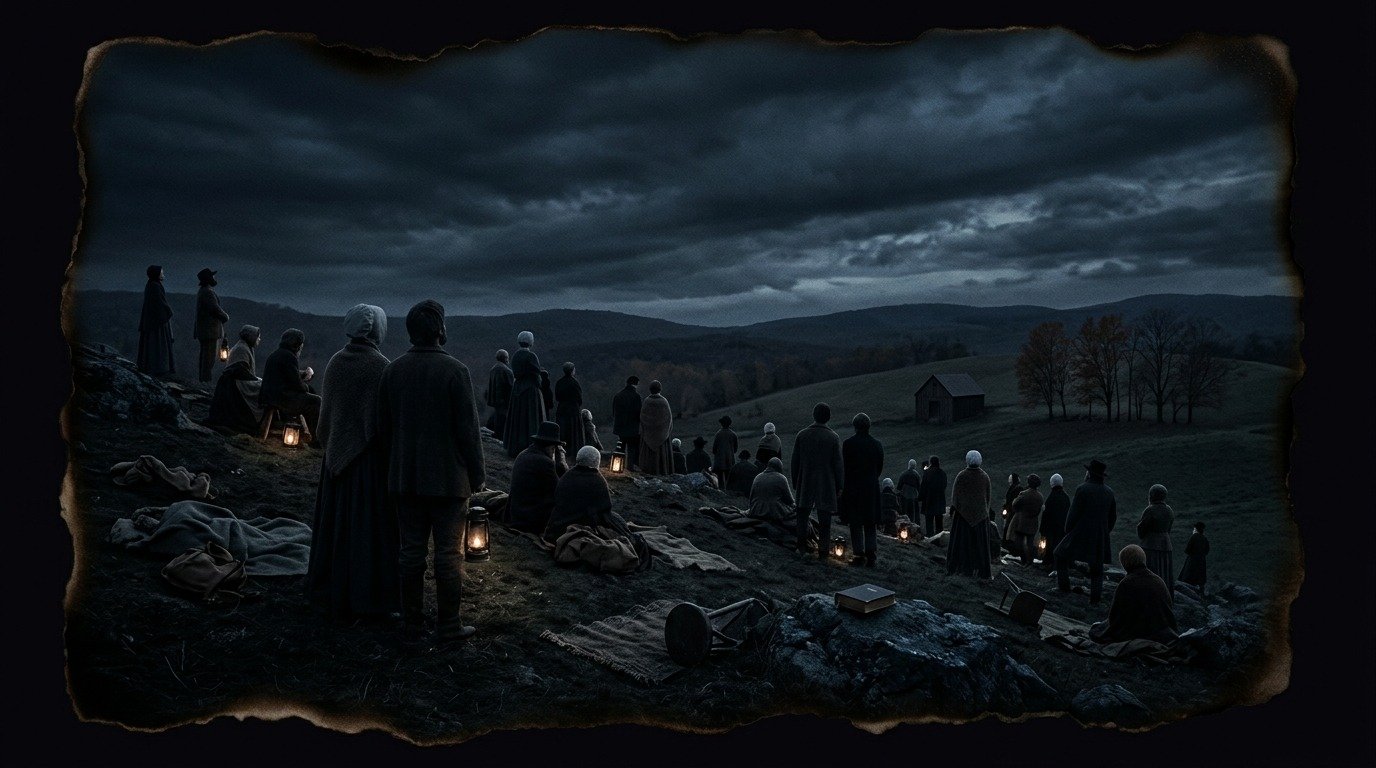
On October 22, 1844, more than one hundred thousand followers of the Adventist movement in the northeastern United States abandoned their homes and gathered on hills, in fields, and in churches to await the second coming of Jesus Christ. Convinced by the mathematical calculations of preacher William Miller, the faithful dressed in simple clothes and waited with hymns and prayers for the moment when the heavens would open to usher in the end of the world. The sun set, midnight passed, and October 23 dawned without any supernatural event occurring. This event, which went down in history as the Great Disappointment, left a multitude of people plunged into humiliation, financial ruin, and a deep spiritual crisis, permanently transforming the religious landscape of North America.
The Mathematical Equation of Salvation
The architect of this massive mobilization was William Miller, a farmer from New York State and a veteran of the War of 1812 who dedicated years of his life to the meticulous study of the Bible. His starting point was the Book of Daniel, specifically the eighth verse of the fourteenth chapter, which mentions a period of two thousand three hundred evenings and mornings, after which the sanctuary would be cleansed. Miller applied the "day-year" principle of interpretation to biblical prophecy. He determined that the starting point of this cycle was the year 457 BC, the date when the Persian king Artaxerxes issued the decree for the rebuilding of Jerusalem. By subtracting that figure from the two thousand three hundred years, Miller concluded that the cleansing of the Earth by fire and the return of Christ would occur between March 21, 1843, and March 21, 1844. Through publications, pamphlets, and massive camp meetings, the message spread rapidly across the American East Coast. When the first deadline of March 1844 passed without incident, one of Miller's followers, Samuel S. Snow, recalculated the prophecy based on the Jewish calendar for the Day of Atonement, definitively and irrevocably setting the final date for October 22, 1844.
The Appointed Day and the Desolation of Waiting
The certainty of the "Millerites" was so absolute that thousands of them stopped planting their fields, closed their businesses for good, sold their worldly possessions to pay off debts, and distributed their remaining money to the needy. They believed that holding onto material goods demonstrated a complete lack of faith in the divine word. Throughout October 22, the tension remained at its peak. Entire families gathered on the high hills of Mount Benedict in Massachusetts, and in barns across New York and Pennsylvania, gazing at the sky in search of the cloud that would announce the return of the Messiah. As the night hours wore on, the autumn cold began to take its toll on those assembled, but faith kept them steadfast until the clock struck midnight. The arrival of the early morning of October 23 brought disillusionment. One of the movement's leaders, Hiram Edson, later wrote that the grief they felt was so intense that they wept until the dawn showed them the reality of their situation: the world went on, and they had to return on foot to their empty homes, exposed to the merciless mockery of their neighbors and with no livelihood to face the approaching winter.
The Ashes of the Movement and a New Path
The disintegration of the Millerite movement was immediate. Many followers abandoned the faith entirely, plunged into skepticism, while others tried to find the error in Miller's mathematical calculations. The preacher himself publicly acknowledged his mistake, apologizing for having set a specific date, and died a few years later, sidelined from the new leadership. However, the Great Disappointment did not destroy belief in the prophecy, but rather forced it to mutate. A remaining group of followers, including Hiram Edson and James and Ellen G. White, concluded that the date of October 22, 1844, was correct, but that the expected event had been misinterpreted. They argued that on that day, Christ did not descend to Earth, but instead entered the most holy place of the heavenly sanctuary to begin an investigative judgment before His final physical return. From this theological reinterpretation, the Seventh-day Adventist Church was born, a global denomination that still keeps the expectation of the end times alive, while strictly avoiding the setting of new dates on the calendar.
Comments
Share information, an experience, or a source to help enrich this entry. They are automatically reviewed before being published.
Loading comments...