Newton's Prophecy
Newton's Prophecy: The Mathematical Calculation of the Apocalypse for the Year 2060
Isaac Newton, the physicist who formulated the laws of gravity and revolutionized the scientific understanding of the universe, calculated that the end of the current world will occur in the year 2060. This prediction, which remained hidden from the public for nearly three centuries, was discovered in his private theological manuscripts, where the scientist applied mathematical rigor and historical analysis to the prophetic texts of the Holy Scriptures to decipher the timeline of the divine plan for Earth.
Newton did not believe that the year 2060 would bring the physical destruction of the planet, but rather the culmination of a specific historical cycle defined by the collapse of corrupt religious institutions, the return of the Jewish people to Jerusalem, and the establishment of a new era of peace under a divine reign. The discovery of these papers at the end of the 20th century revealed an unknown facet of one of the most rational minds in history, whose obsession with theology far exceeded his dedication to physics.
The Alchemist Who Sought God's Code
For Isaac Newton, nature and the Bible were two works written by the same creator, and both had to be governed by exact and decipherable mathematical laws. For decades, in the absolute secrecy of his study at Cambridge University, the scientist dedicated more time to alchemy and the interpretation of biblical prophecies than to the writing of his famous principles of physics.
His calculation of the end times was based on an exhaustive analysis of the Book of Daniel and the Book of Revelation. Newton focused on revealing the meaning of the time periods mentioned in these texts, paying special attention to the symbolic figure of "a time, times, and half a time," which theologians interpret as one thousand two hundred and sixty prophetic days, equivalent to one thousand two hundred and sixty Earth years.
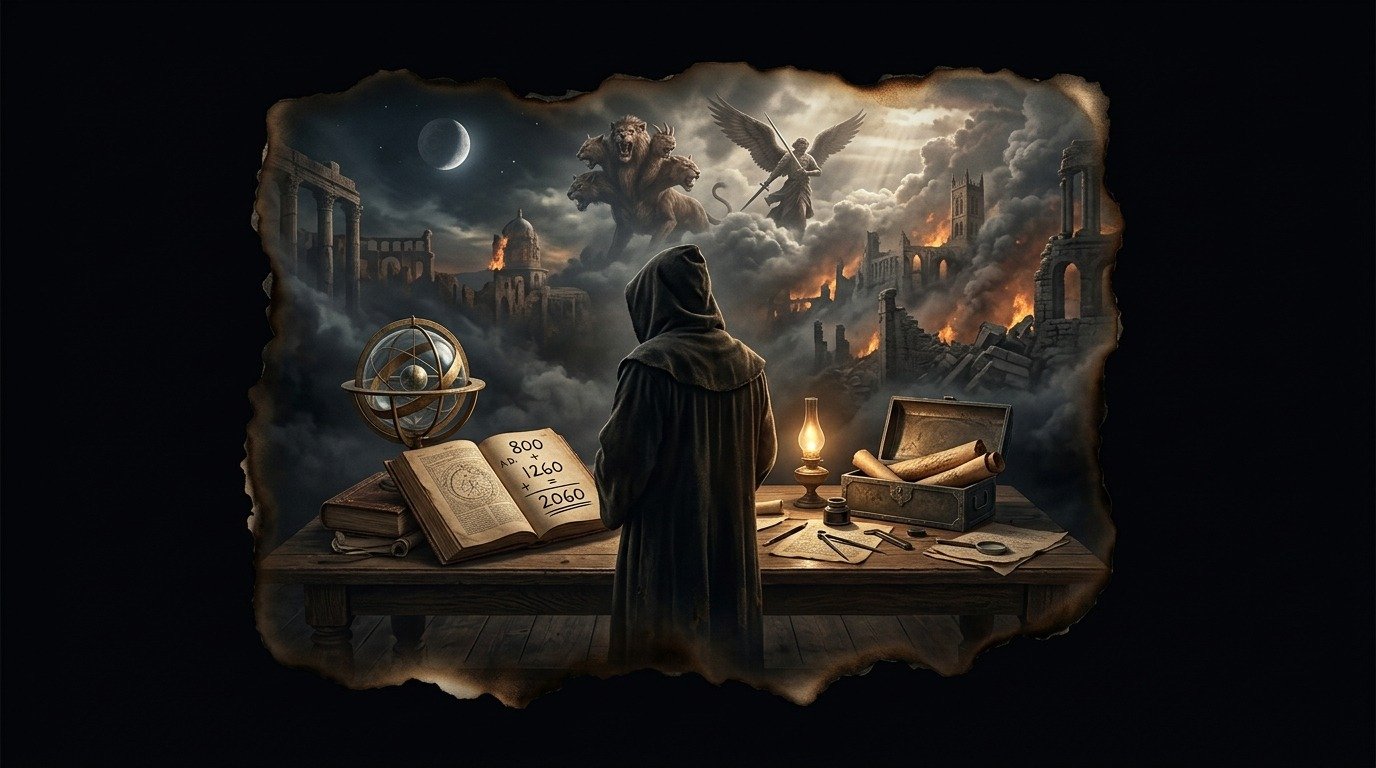
In a manuscript dated around 1704, Newton established that the beginning of this period of one thousand two hundred and sixty years coincided with the year 800 of our era, the moment of the coronation of Charlemagne and the rise of the temporal power of the Church of Rome, an institution that the physicist considered a corrupting force of Christ's original doctrine. By adding one thousand two hundred and sixty years to the year 800, the mathematical result precisely yielded the year 2060.
The Secret Kept in the Chest
Newton kept these theological writings under lock and key and never allowed their publication during his lifetime. In 17th and 18th-century England, professing ideas that questioned the doctrine of the Trinity or openly criticized the official Church was considered a serious offense that could ruin his academic and social career. His heirs kept these documents hidden after his death in 1727, fearing that the scientific reputation of the genius of physics would be tarnished by his mystical and alchemical obsessions.
The manuscripts remained in a metal chest until they were sold at a public auction at Sotheby's gallery in London in 1936. Most of the theological texts were acquired by the economist John Maynard Keynes, who, upon studying them, declared that Newton had not been the first of the age of reason, but the last of the magicians. Subsequently, these folios were donated to the National Library of Israel in Jerusalem, where they were finally digitized and exhibited to the public in the year 2007.
The Countdown of the Genius of Gravity
Unlike other seers who sought to instill terror in the masses, Newton specifically wrote in his letters that his calculations were intended to refute false prophets who set immediate dates for the end of the world, thereby preventing religion from falling into discredit before society when those predictions failed.
As the year 2060 approaches on our temporal horizon, Newton's calculation has gained singular relevance in circles that study prophecies and the history of science. The original manuscript, written in the clear and firm handwriting of the English scientist, shows the arithmetic operations he performed alongside his marginal notes. The prophecy remains there as a silent reminder that the man who calculated the trajectory of the planets also attempted to determine the exact moment when time would stop.
Comments
Share information, an experience, or a source to help enrich this entry. They are automatically reviewed before being published.
Loading comments...