Valefor
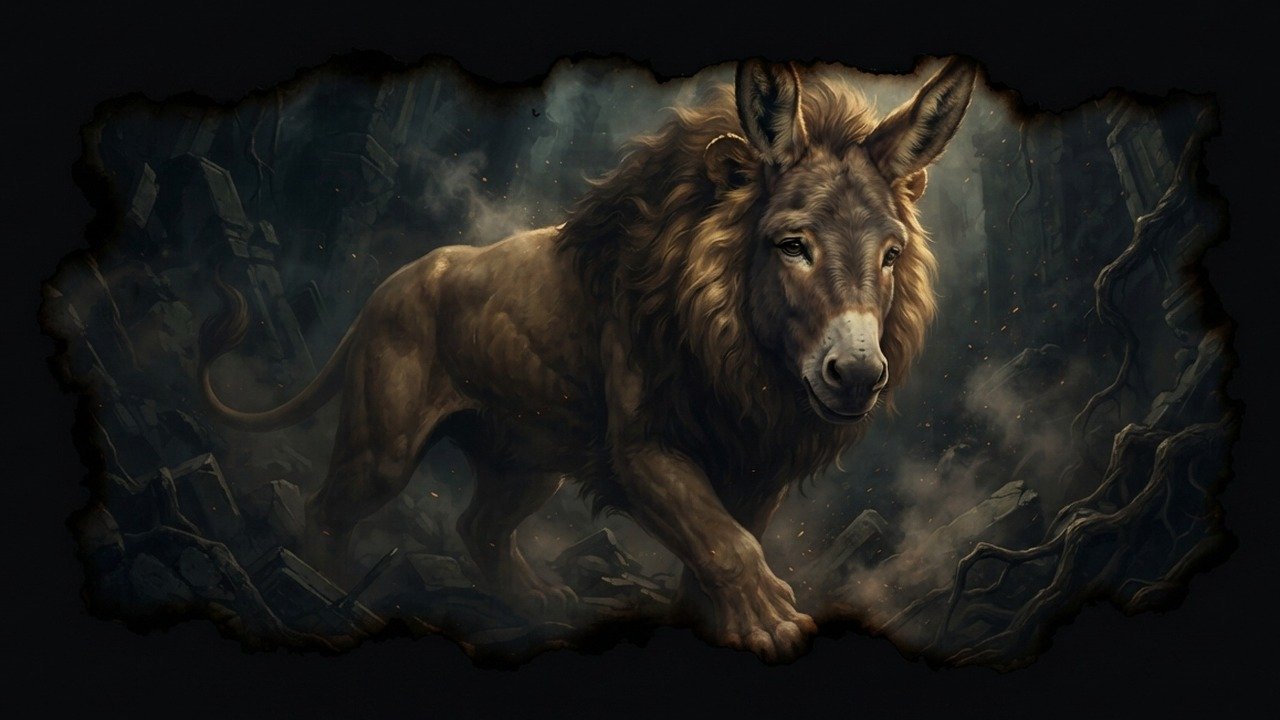
The Legacy of Valefor: The Duke of Shadows, Cunning, and the Web of Illusion
Origin and Legend: The Thief of the Wind and the Night
To understand the original matrix of Valefor—also recorded in medieval grimoires as Malphas, Valefar, or Malaphar—it is necessary to go back to the pre-Abrahamic era of the Mediterranean Levant and Mesopotamia. In the ancient world, theft, cunning, and deceit did not belong solely to the plane of moral villainy, but to the sphere of clever divinities, spirit guides of desert paths, and messengers of the wind.
Valefor traces its roots to the Mesopotamian archetype of nomadic desert spirits and storm heralds, intertwining with the mythology of birds of prey that watch from on high to snatch what lies defenseless. He was not a demon of slaughter or fire, but a power linked to speed, invisibility, and the art of plunder. When the medieval Ars Goetia organized the catalog of dark powers, it placed Valefor as a powerful Duke of Hell, commander of ten legions of spirits. Solomonic traditions did nothing but dress a primal force of survival in feudal garb: the instinct of the hunter who uses subtlety, infiltration, and the veiled pact instead of brute force.
Historical Evolution: From Desert Bandit to Patron of Larceny
With the consolidation of the inquisitorial vision in Europe, the perception of Valefor underwent a drastic simplification. Demonologists of the sixteenth and seventeenth centuries, such as Johann Weyer in his Pseudomonarchia Daemonum, reduced him to the stigma of "the spirit who tempts men to steal." Adepts were warned that, although Valefor promised quick wealth and unparalleled cunning to his familiars or charges, his ultimate goal was to lead the practitioner to the gallows or to ruin through betrayal and haste.
However, for marginal practitioners, shadow astrologers, and Left-Hand Path alchemists, Duke Valefor possessed a much more refined meaning. He ceased to be seen as a mere instigator of street crime and was transformed into the archetype of secret strategy, the evasion of chains imposed by authority, and mastery over Illusion (Maya). His figure represented the wisdom of breaking the locks of ordinary perception, the ability to move unseen in hostile territories, and mastery of the invisible web where material influences move.
Esoteric Meaning: The Rapacious Mind and the Alchemy of Illusion
In the architecture of modern occultism and the Qliphothic Kabbalah, Valefor operates at the intersection between the shadow of Mercury and the spheres of earthly cunning, embodying the principle of intelligent transgression.
**The Archetype of the Trickster and the Promethean Thief:** In depth psychology, Valefor is the Trickster (the sacred trickster or deceiver). He represents that part of the psyche that refuses to play by the rules of the dominant system, finding shortcuts, cracks in the structure, and backdoors. He is the impulse that "steals" the knowledge guarded by tyrants to deliver it to the mind that dares to seek it.
**The Guardian of the Material Threshold:** He symbolizes the understanding that the physical world is a web of illusions and arbitrary values. Valefor teaches that wealth and possessions are fluid, changing hands according to the operator's degree of cunning, will, and speed.
**The Familiar of Mental Agility:** He represents swift intuition, the ability to read the weakness of others in seconds, and the faculty to camouflage true intention behind an innocent mask.
Practice and Manifestation: The Presence, the Bond, and Sovereignty
Valefor's energy is neither heavy nor solemn; it is electric, restless, subtle, and intensely penetrating.
**The Manifestation of His Energy:** Ancient texts agree that he manifests as a lion with an ass's head or with a human face, although in operations of high magic his form usually drifts toward that of a large anthropomorphic feline or a winged hunter with the gaze of a bird of prey. His presence is perceived as a sudden freezing breeze, an increase in heart rate, and an unmistakable sense of hypervigilance, as if the shadows in the room were coming to life.
**Action on the Individual:** When Valefor acts on the practitioner's mind, he awakens a cold and calculating mental sharpness. He strips the individual of naivety, teaching them to identify the deceit of others and to move between the threads of diplomacy and secrecy. He facilitates psychic invisibility—the art of going unnoticed in dangerous environments—and the ability to snatch opportunities before others even notice their existence.
**The Danger of Abuse and Addiction:** The classic trap of Valefor's energy lies in recklessness and greed. Anyone who allows themselves to be carried away by his lowest side falls into arrogance, desperation for easy money, betrayal of their own allies, and constant paranoia of being discovered. Valefor's energy tempts the negligent to cross boundaries without calculating the consequences, leading them to their own social or physical destruction.
**Approach, Protection, and Respect:** To work with Duke Valefor from a position of sovereignty, the magician must maintain an iron grip on their own impulses. He is not approached as a servant to commit petty acts, but as a master of strategy and perception. The only true protection against the elusive nature of this force is absolute self-control and honesty with oneself: the practitioner must be the master of their cunning, not the slave of their greed. Whoever masters their own mind can use Valefor's mantle to walk among wolves without being devoured.
Comments
Share information, an experience, or a source to help enrich this entry. They are automatically reviewed before being published.
Loading comments...