Prophecy of Saint Malachy
The List of the Popes: The Enigma of the Church's Last Days
In the year 1595, the Benedictine monk Arnold de Wyon published a book in Venice titled *Lignum Vitae*, in whose pages he included a document that would shake the Catholic Church for centuries. It was a list of 112 brief Latin mottoes attributed to Saint Malachy, a 12th-century Irish archbishop, which described one by one the identity of all future popes, from Celestine II in 1143 to the final collapse of Rome. The prophecy culminates with the arrival of a definitive pontiff, referred to as "Peter the Roman," under whose rule the Apocalypse will be unleashed.
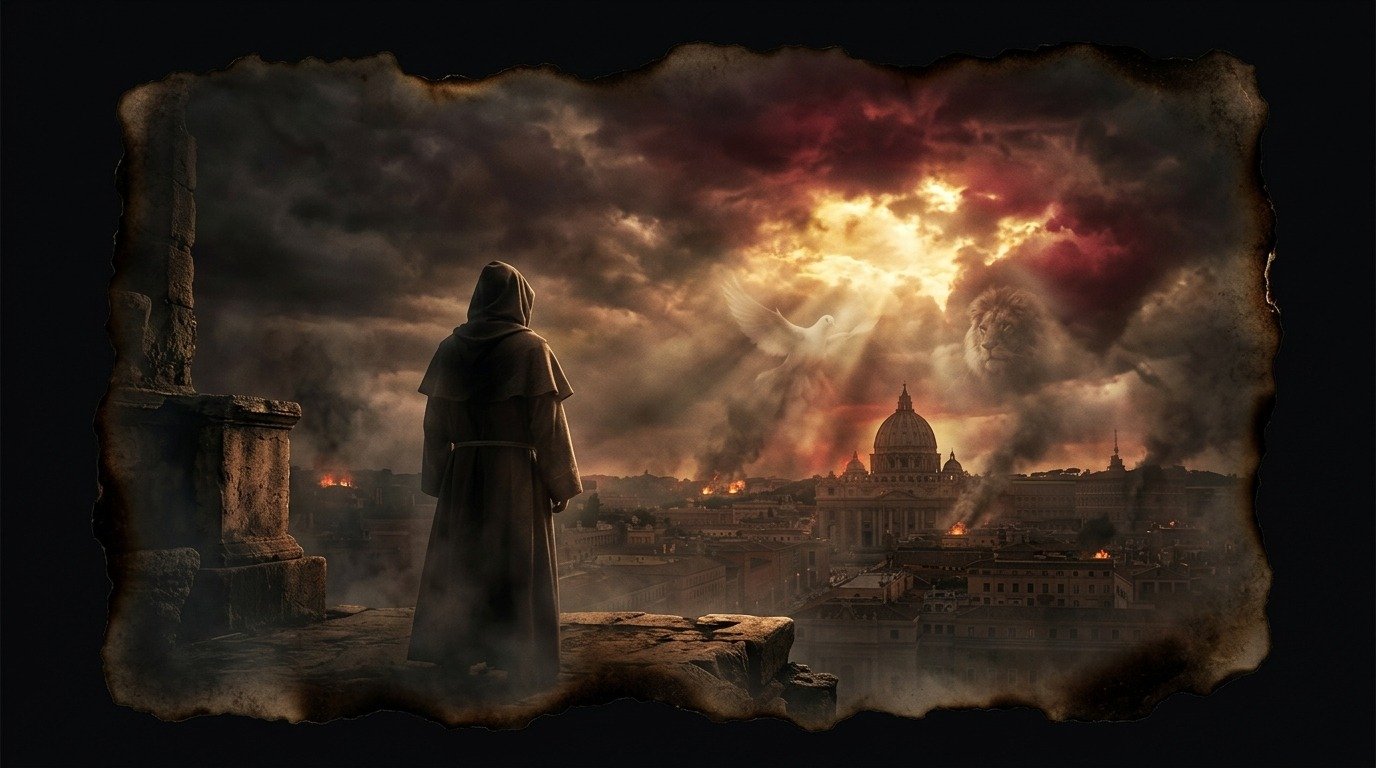
Each motto on the list cryptically alludes to the coat of arms, the birthplace, or a crucial event of each pope's pontificate. The final paragraph of the text breaks the pattern of short phrases to issue an explicit warning: during the final persecution of the Church, Peter the Roman will rule his flock amid great tribulations, and when these end, the city of seven hills will be destroyed, and the fearsome Judge will judge his people.
The Enigma of the Latin Mottoes
The vision of Saint Malachy functions like a historical hourglass. Believers in the prophecy point out with amazement how the mottoes fit the actual pontiffs with precision. For example, Pope Leo XIII (1878–1903) was matched with the motto *Lumen in caelo* (Light in the sky), and his family shield contained a shooting star. John Paul II (1978–2005) was assigned *De labore solis* (Of the labor of the sun, or solar eclipse); the Polish pontiff was born on the day of a solar eclipse and was buried during another.
The penultimate motto, *De gloria olivae* (From the glory of the olive), corresponded to Benedict XVI. Defenders of the prophecy associated this motto with the Benedictine Order, which is linked to the olive branch. Upon the end of his pontificate in 2013, the list reached its final slot: the end of liturgical times.
The Origin in the Archives of Rome
Tradition holds that Saint Malachy traveled to Rome in 1139 to report to Pope Innocent II. Upon sighting the Eternal City from the hills, the archbishop fell into a mystical trance and began feverishly writing the 112 Latin phrases he saw in his vision. Malachy delivered the manuscript to the pope to console him in times of schism, and the document remained archived and forgotten in the Vatican for more than four hundred and fifty years until Arnold de Wyon discovered it and brought it to light.
However, historical records show a different picture. There is no mention of the prophecy between Malachy's death in 1148 and its publication in 1595. Historians and analysts of the era discovered that the first 74 mottoes (the popes prior to 1590) are astonishingly accurate because they were based on papal biographies that had already been written, whereas the subsequent mottoes became much more vague and symbolic, suggesting that the text was drafted in the 16th century to influence the conclave that was to elect the successor of Urban VII.
The Fear of the Last Pope
Despite doubts about its authenticity, the prophecy of Saint Malachy grew in the collective imagination as one of the most influential eschatological warnings in Christendom. During the conclaves of the 20th century, the anticipation of learning the new pontiff's motto generated intense debates in the press and among the faithful. The idea that the end of the papacy was near fueled apocalyptic currents inside and outside the Church, especially during the Cold War and the fall of the Soviet bloc.
The resignation of Benedict XVI in 2013 unleashed a wave of conspiracy panic. According to the strict count of the prophecy, the next pope would be the last. With the election of Francis, the eyes of the world turned to the Vatican to search for connections to "Peter the Roman." Interpreters pointed out that the Argentine pope adopted the name Francis in honor of Saint Francis of Assisi, whose father was named Peter, and that as a Jesuit and Bishop of Rome, he directly assumed the governance of the Eternal City during a time of deep institutional crisis.
The Verdict of Time
Modern historical research unanimously considers the manuscript to be a 16th-century forgery, likely designed to favor the candidacy of Cardinal Girolamo Simoncelli, whose place of origin coincided with one of the mottoes on the list. The Catholic Church has never recognized the prophecy as dogma or as official revelation, keeping it in the category of private revelation without theological value.
The prophecy, however, remains alive in popular culture. Francis died in April 2025 without Rome being destroyed, and the conclave elected Leo XIV, the first pope born in the United States. His election reopened the debate: for some interpreters, the list ended with Francis and no longer has anything to say; for others, Peter the Roman is not a specific pope but rather a final era of the Church that the prophecy does not date.
The list of Saint Malachy remains written on the reverse side of papal history, as a somber reminder that, for many, the throne of Saint Peter has an expiration date written in stone.
Comments
Share information, an experience, or a source to help enrich this entry. They are automatically reviewed before being published.
Loading comments...