Prophecy of the Condor and the Eagle
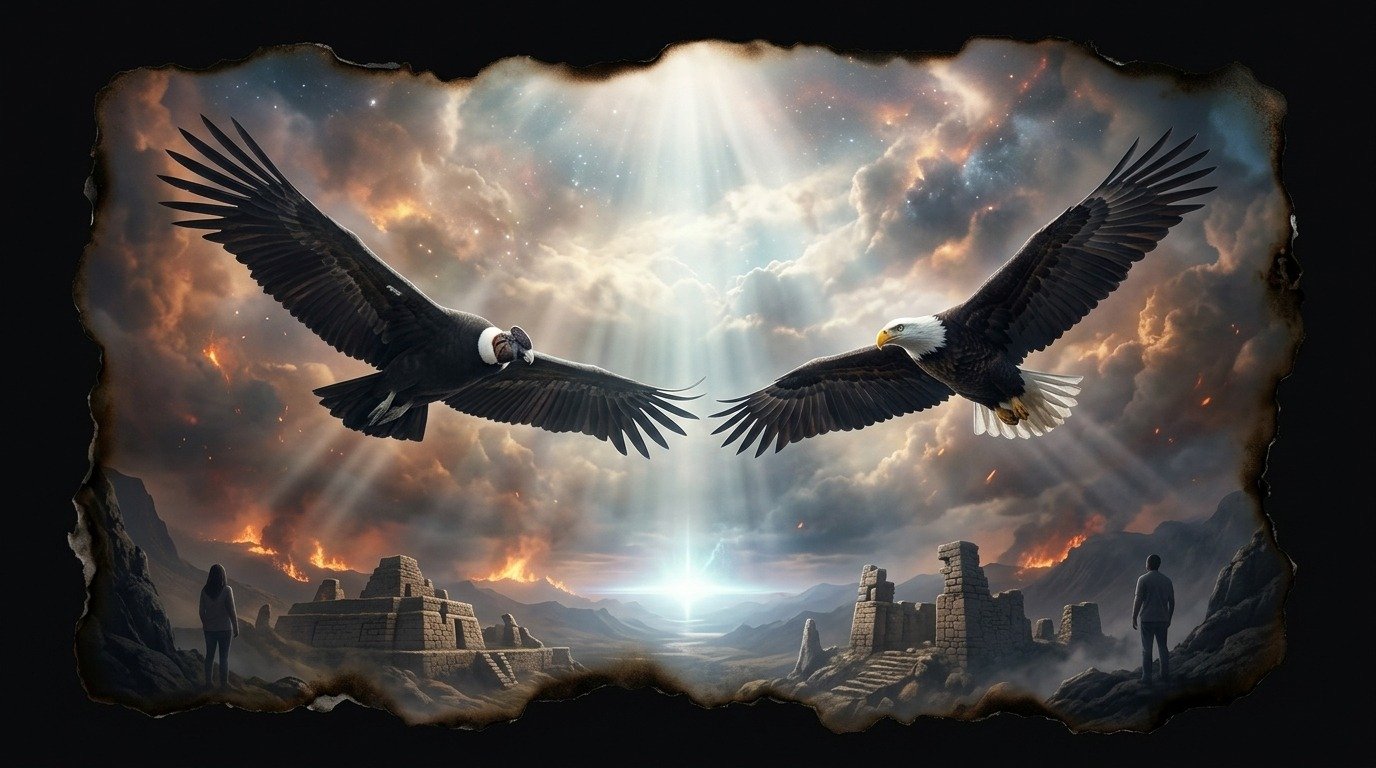
The Prophecy of the Condor and the Eagle: The Reunion of the Peoples of the Americas
In July 1990, during the First Intercontinental Gathering of Indigenous Peoples in Quito, Ecuador, elders and leaders from various tribes across the continent officially proclaimed the Prophecy of the Condor and the Eagle. This ancestral tale foretells that, after a five-hundred-year period of division, pain, and domination that began with the arrival of European colonizers, a new era of reconciliation would begin. In this cycle, the peoples of the North (represented by the Eagle, reason, and technology) and the peoples of the South (represented by the Condor, the heart, and connection to the earth) would unite to restore the planet's balance and prevent its mass destruction. The prophecy is governed by the measurement of time in "pachakutis," cosmic cycles of five hundred years according to Andean cosmology. The fifth Pachakuti, which formally began at the end of the 20th century, is the setting for this reunion. If the Condor and the Eagle fail to fly together in the same sky, tradition warns, humanity will suffer an irreversible ecological and spiritual collapse, losing the opportunity to save its own home.
The Dance in the Sky of the New Time
The prophecy describes the destiny of humanity through the flight of two majestic birds. The Eagle represents the mind, scientific development, material strength, and the drive to transform the environment—characteristics historically associated with the cultures of the Northern Hemisphere. The Condor represents intuition, spiritual wisdom, a deep connection with nature, and a sense of community—traits preserved by the Indigenous nations of the South. For centuries, the tale details that these two forces walked separate paths. The Eagle dominated the material world with its metal claws and far-reaching vision, but in its rise, it lost its connection to the spirit and the earth, becoming blind to its own self-destruction. For its part, the Condor kept alive the memory of the sacred fire and respect for Pachamama, but suffered persecution and isolation, growing physically weak. The prophecy warns that the isolation of both energies only leads to collective death. The shift in the cycle demands that the two birds fly wing to wing, sharing the same celestial space so that the Earth may recover its health and humanity its dignity.
The Roots of a Shared Vision
The exact origin of the prophecy is lost to time, but it belongs to the oral memory of the Indigenous nations of the Andes, such as the Quechua and Aymara, and connects directly with the stories of North American tribes, such as the Hopi and the Lakota. For generations, shamans and wisdom keepers transmitted this message in secret, waiting for the moment when world conditions would allow its global revelation. The context of its mass dissemination at the end of the 20th century was not accidental. It coincided with the preparations for the five-hundred-year anniversary of Christopher Columbus's voyage in 1992. While the Western world planned celebrations, Indigenous peoples organized to redefine the meaning of the date. They found in the prophecy of the Condor and the Eagle the political and spiritual tool to heal the wounds of the past and propose a civilizational alternative to the climate crisis that was already beginning to emerge in global debates.
The Union That Ignited the Continent
Following the Quito gathering in 1990, the prophecy ceased to be a local myth and became a driving force for transcontinental activism. Indigenous organizations from Canada, the United States, Mexico, Central America, and the Andean South began holding marches, fire ceremonies, and spiritual runner gatherings that covered thousands of kilometers, uniting the far ends of the continent. The tale deeply impacted modern environmental movements. For many Western activists, the prophecy offered a spiritual framework to understand the urgency of the ecological crisis. It was interpreted not as an announcement of the physical end of the world, but as the death of a destructive system of exploitation and the birth of a global ecological consciousness where science (the Eagle) finally submits to respect for life (the Condor).
Steps Toward the Common Horizon
Today, followers of this tradition maintain that the prophecy is being actively fulfilled through contemporary political and Indigenous alliances. They point to milestones such as the joint protests of North American tribes and scientific researchers against pipeline construction at Standing Rock, or climate summits where traditional leaders present their demands to international organizations. Modern science, as it begins to validate the knowledge of traditional Indigenous medicine and the importance of biodiversity conservation promoted by native peoples, is seen by believers as the exact moment when the Eagle recognizes the value of the Condor. The prophecy does not speak of a divine miracle falling from the sky, but of a collective and conscious effort to change the course of history before the final cycle closes. The sky of the Americas remains the stage for this tension. The prophecy remains open, reminding those who hear it that the destiny of the world is not written in stone, but in the ability of two different worlds to learn to fly at the same pace.
Comments
Share information, an experience, or a source to help enrich this entry. They are automatically reviewed before being published.
Loading comments...