Secrets of Fátima
Secrets of Fátima: The Visions of Fire That Paralyzed the Vatican
On July 13, 1917, the midday sun beat down heavily on the pasture of Cova da Iria, near the small Portuguese village of Fátima. Three shepherd children—Lucia dos Santos, ten years old, and her cousins Francisco and Jacinta Marto, nine and seven—gazed at a radiant figure suspended over a small holm oak. The apparition stretched out her hands, and from them sprouted a beam of light that seemed to open the earth beneath the children's feet. What they saw next made them scream in terror. Jacinta's face turned so pale that her parents feared for her health. That afternoon, the apparition entrusted the children with a message divided into three parts. For decades, those words became the best-kept secret of the Catholic Church, an enigma that fueled prophecies about the end of the world, global conspiracies, and the fate of the popes.
A Sea of Fire and the Wounded Pope
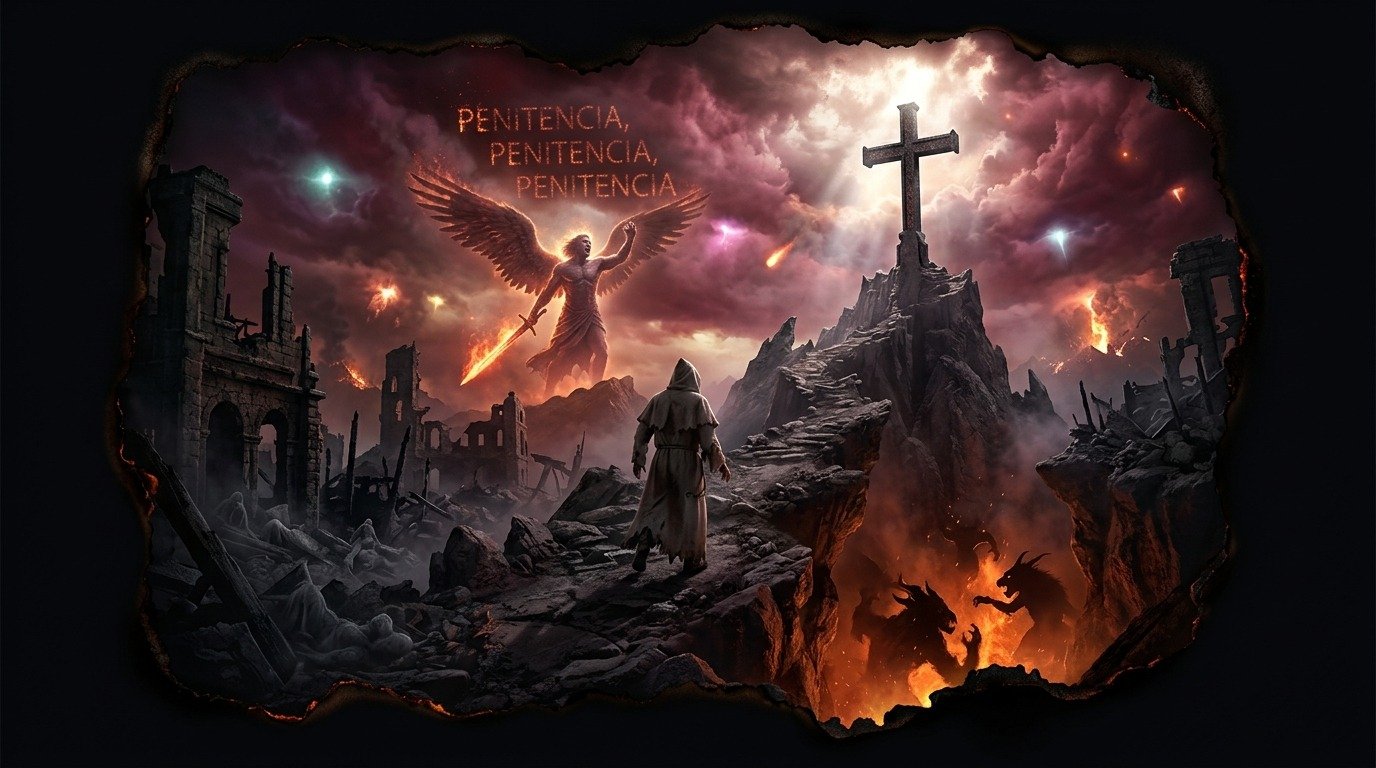
The revelation of Fátima consists of three messages, known as the three secrets, although they were actually three parts of the same vision. Lucia dos Santos, the only one of the visionaries who survived to adulthood and became a Carmelite nun, wrote them down years later. The first part was a terrifying vision of Hell. Lucia described a great sea of fire that seemed to be beneath the earth, in which demons and souls were plunged like transparent and black embers, carried along by the flames that issued from them. The demons were distinguished by their horrible and disgusting shapes of frightful and unknown animals. The second part of the secret was a geopolitical prophecy. The message warned that the First World War was going to end, but that if humanity did not stop offending God, a worse one would begin during the pontificate of Pius XI. To announce this new conflict, the sky would be illuminated by an unusual light at night. The apparition requested the consecration of Russia to prevent this nation from spreading its errors throughout the world, promoting wars and persecutions of the Church. The third secret was kept under the strictest mystery during the second half of the 20th century. Written by Lucia in 1944, the text was sent to the Vatican in a sealed envelope with instructions not to be opened until the year 1960, because then "it would be understood more clearly." The vision presented an angel with a flaming sword in his left hand that seemed about to set the world on fire, crying out in a loud voice: "Penance, penance, penance!" Under this light, a bishop dressed in white—whom the children immediately identified as the Holy Father—climbed a steep mountain, at the summit of which was a large cross. Before reaching it, the Pope passed through a city in ruins, trembling and praying for the souls of the corpses he encountered along his path. Upon reaching the top, several soldiers killed him with firearms and arrows, doing the same to bishops, priests, and laypeople.
The Miracle in a Bleeding World
The apparitions occurred in a context of extreme tension. Portugal was plunged into a deep political crisis following the fall of the monarchy in 1910 and the establishment of a strongly anticlerical republic. In addition, the country was participating in the First World War, sending thousands of young men to the battlefields of Flanders. Local authorities saw the children's visions as a provocation and an attempt at clerical manipulation. The administrator of the region went so far as to arrest and imprison the three shepherds in August 1917, threatening to fry them in boiling oil if they did not reveal the secrets that the mysterious lady had entrusted to them. The children stood firm in their silence. The veracity of their accounts received a definitive boost on October 13, 1917, during the final apparition. Before a crowd estimated at seventy thousand people under a torrential rain, the so-called Miracle of the Sun took place. Witnesses watched as the clouds parted and the sun began to spin upon itself like a wheel of fire, changing color and appearing to plunge toward the earth in a zigzag path. The crowd's clothing, soaked by the rain, dried completely in a few minutes.
The Enigma Under Lock and Key in the Cellars of Rome
While Francisco and Jacinta died shortly thereafter due to the Spanish flu epidemic, Lucia entered a convent. In 1941, by order of her bishop, she wrote down the first two parts of the secret in her memoirs. The announcement of a second major war preceded by an unusual night light caught the world's attention: on January 25, 1938, a gigantic aurora borealis visible across Europe and parts of North America illuminated the night sky, shortly before Nazi Germany annexed Austria, starting the path toward World War II. However, it was the third secret that unleashed apocalyptic fever. When the year 1960 arrived, Pope John XXIII read the contents of the sealed envelope but decided not to reveal it to the public, arguing that it did not belong to his time. His successor, Paul VI, made the same decision. The Vatican's silence unleashed waves of rumors. Books, pamphlets, and lecturers claimed that the third secret announced the end of the papacy, an imminent nuclear war, the fall of a meteor, or the great apostasy within the Church itself.
The Shot in the Square and the Revelation
The mystery reached its critical point on May 13, 1981, exactly on the anniversary of the first apparition of Fátima. In St. Peter's Square, Turkish terrorist Mehmet Ali Ağca shot Pope John Paul II at point-blank range. The pontiff miraculously survived; the bullet grazed his main artery without rupturing it. John Paul II attributed his survival directly to the Virgin of Fátima, asserting that a motherly hand had deflected the projectile's trajectory. It was John Paul II himself who decided to put an end to the mystery. In the year 2000, during the beatification of Francisco and Jacinta in Portugal, the Vatican announced the official publication of the third secret of Fátima, accompanied by a detailed theological analysis written by Cardinal Joseph Ratzinger, then prefect of the Congregation for the Doctrine of the Faith. For the Vatican, the vision of the bishop dressed in white falling dead under the soldiers' gunfire represented the suffering of the Church in the 20th century and, specifically, the assassination attempt against John Paul II, whose life was preserved by divine intervention. The official revelation did not silence all doubts. Traditionalist sectors maintained that the Vatican's interpretation was partial and that the original prophecy described the actual death of the pontiff, not his survival, leading them to believe that there was a hidden part of the text that the Church still did not dare to show. The bullet that seriously wounded John Paul II was given by the Pope to the Bishop of Leiria-Fátima. Today, that lead projectile is permanently set into the gold crown of the statue of the Virgin that presides over the Portuguese sanctuary. The bullet fits with millimeter precision into the hollow space that the jeweler had left empty, beneath the globe holding the cross, decades before the assassination attempt.
Comments
Share information, an experience, or a source to help enrich this entry. They are automatically reviewed before being published.
Loading comments...