Prophecies of Merlin
The Prophecies of Merlin: The Destiny of Britain Written in the Blood of Dragons
In the year 1135, the Welsh cleric Geoffrey of Monmouth presented the *Prophetiae Merlini* (The Prophecies of Merlin) in England, a text written in Latin that had an immediate impact on medieval Europe. The manuscript contained a series of dark and apocalyptic revelations attributed to the famous wizard Merlin, who, according to the work, had experienced a vision of the future of the British Isles marked by betrayal, dynastic bloodshed, and a final cataclysm that would disintegrate the order of the universe.
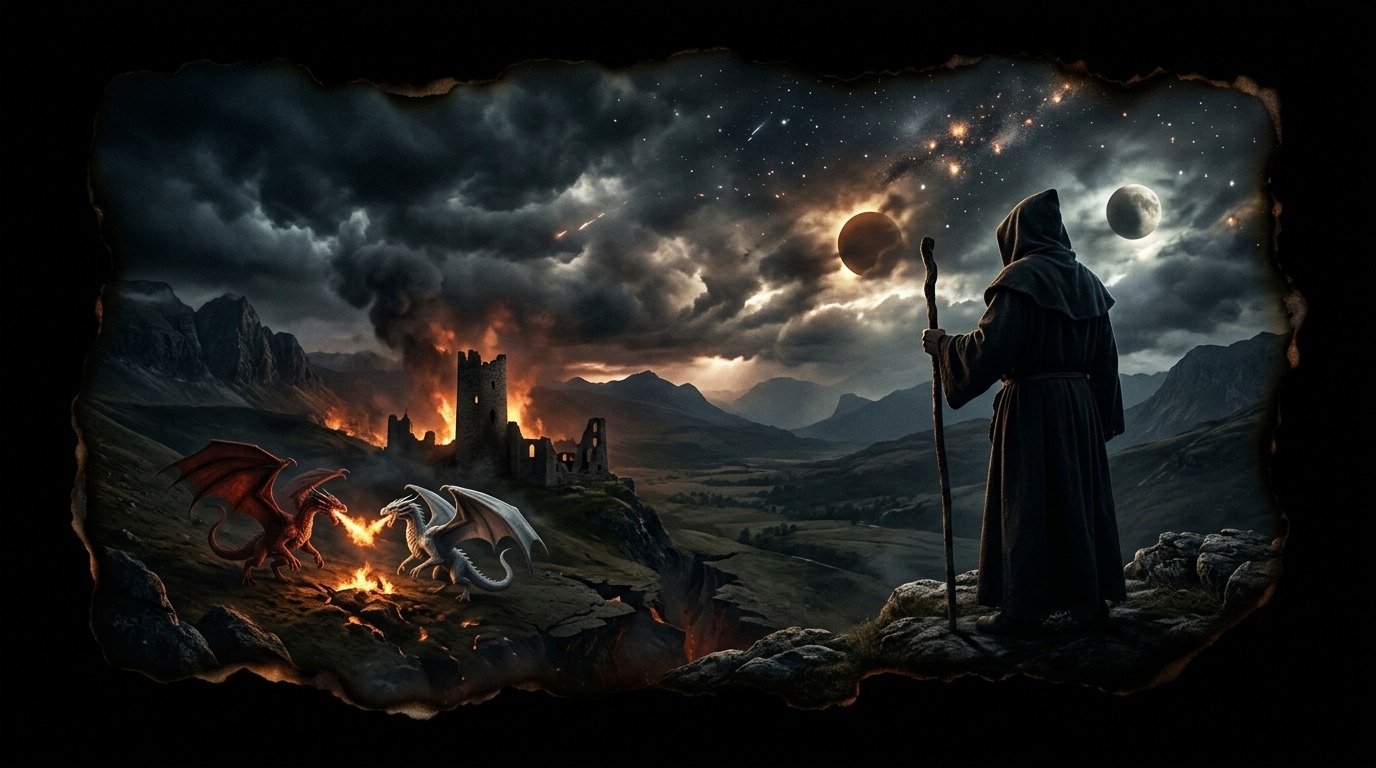
The trigger for these prophecies was a dramatic scene at the court of the British king Vortigern: the systematic collapse of the foundations of a tower that the monarch was attempting to build. Merlin, presented as a youth of mysterious origin, revealed that beneath the earth lay a pool with two sleeping dragons, one white and one red. Upon digging, the beasts awoke and began a fight to the death, a combat that Merlin interpreted as the endless war between the invading Saxons and the native Britons, marking the beginning of a series of predictions that spanned centuries of history.
The Fall of Kingdoms and Cosmic Collapse
Merlin's vision is a parade of violent and zoological metaphors where kings are represented as lions, wolves, and serpents devouring their own lands. The text accurately describes the arrival of foreign invaders, the division of the kingdoms of Britain, and the loss of the legitimate crown. The wizard prophesies that the Lion of Justice will reign, but that after his death the country will plunge into confusion, churches will be destroyed, and rivers will run red with feudal slaughter.
However, the climax of Merlin's prophecy goes beyond feudal politics and delves into pure eschatology. The wizard predicts that the earth will open, the seas will evaporate in an instant, and the order of the firmament will break. The stars will leave their orbits and collide with one another, the sun will lose its light, and the moon will veer off course, leaving the world plunged into a primordial chaos where the elements of creation will once again blend into nothingness.
The Cleric Who Invented the Political Myth
Geoffrey of Monmouth compiled and wrote these prophecies at a time of extreme vulnerability for England: the period known as the Anarchy, a bloody civil war for succession to the throne between Empress Matilda and her cousin Stephen. Geoffrey used ancient Welsh legends and oral traditions to shape a text that responded directly to the collective fear of his era. By attributing the predictions to Merlin—a character he himself helped popularize by combining the figure of the mystical bard Myrddin Wyllt with that of the military leader Ambrosius Aurelianus—he legitimized his work with the prestige of antiquity.
The success of the *Prophetiae Merlini* was resounding. The text was later incorporated into his major work, the *Historia Regum Britanniae*, becoming one of the most copied and read books of the Middle Ages. Kings, clerics, and nobles throughout Europe sought copies of the text to try to decipher whether their own names or those of their enemies were hidden behind the descriptions of Merlin's beasts.
The Manual of Dynastic Legitimacy
For centuries, Merlin's prophecies were used as a powerful weapon of political propaganda. In medieval and Renaissance England, any faction disputing the throne sought a passage from Geoffrey's text that could be interpreted in their favor. Edward I used the predictions to justify his bloody conquest of Wales in the 13th century, claiming that the end of Welsh independence fulfilled the destiny foretold by the wizard.
Later, during the Wars of the Roses and the rise of the Tudor dynasty, Henry VII leveraged his Welsh ancestry to present himself as the "Red Dragon" that Merlin had prophesied would reclaim the throne for the ancient Britons. The prophecies were so influential and potentially subversive that, during the reign of Elizabeth I, the English Parliament went so far as to ban the publication of unauthorized prophecies using Merlin's name, fearing they would incite civil rebellion.
The Echo of the Vision in Real History
Although many of Merlin's predictions were obscure and open to any interpretation, historians point out that the vast majority of the "predictions" in the first half of the text referred to events that had already occurred or were occurring during Geoffrey of Monmouth's time, written in cryptic language to simulate premonition. The prophecies directed at the distant future, such as the end of the world and cosmic collapse, never materialized, remaining as a masterpiece of medieval apocalyptic literature.
The real impact of the work did not lie in its divinatory accuracy, but in its ability to shape Arthurian mythology and the national identity of Great Britain. Merlin ceased to be a simple madman of the Welsh woods to transform into the supreme prophet of Western literature, the man who saw the end of time before the kingdoms of men even began to be built.
The image of the two dragons fighting beneath the ruined tower remains the most potent symbol of Merlin's prophecies, an eternal reminder that beneath the foundations of civilization there always lie ancient forces waiting for the moment to awaken and sweep everything away.
Comments
Share information, an experience, or a source to help enrich this entry. They are automatically reviewed before being published.
Loading comments...