Sedlec Ossuary
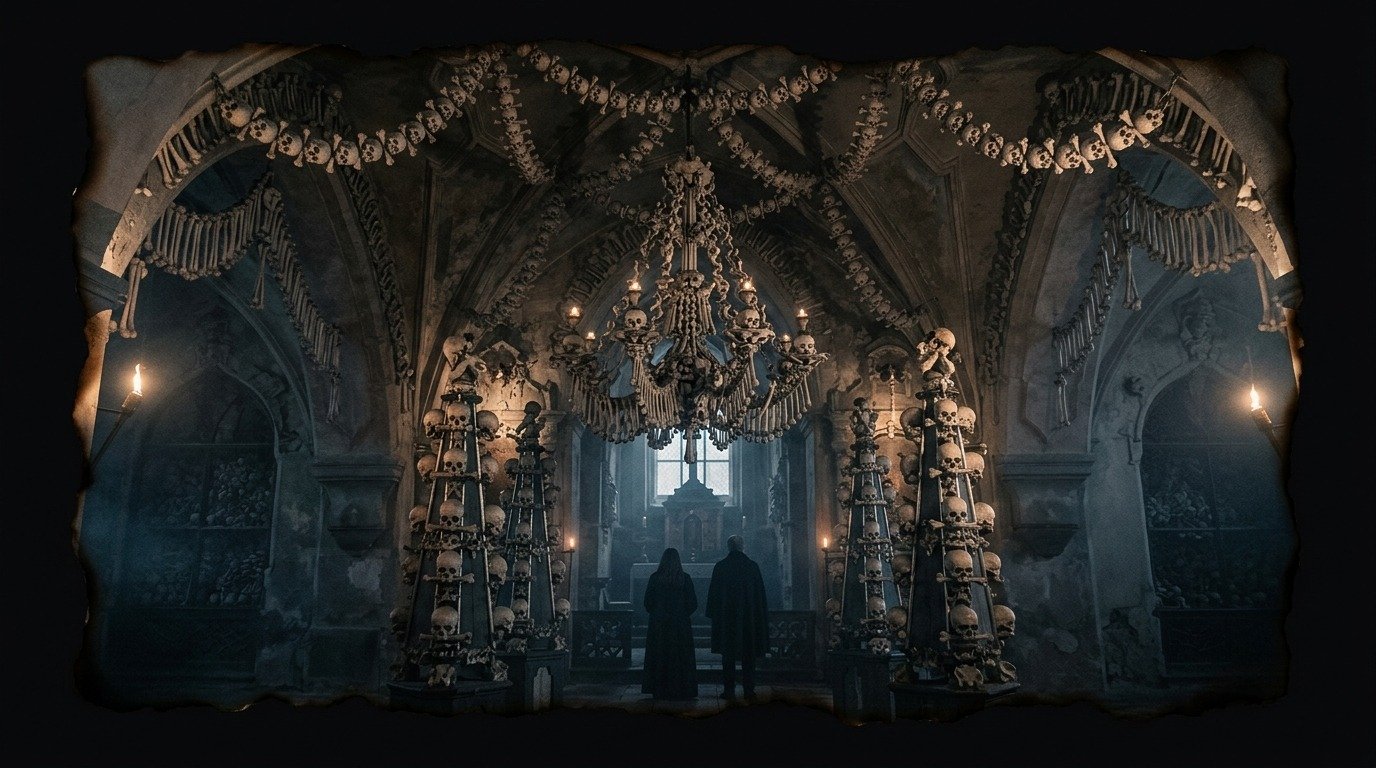
Sedlec Ossuary: the chapel where the bones pray
The signature of the dead
In 1870, woodcarver František Rint submerged a human skull in a vat of chlorinated lime. He waited for the bone to turn a chalky white color, carefully removed it, and joined it with thousands of others to shape a colossal chandelier. Rint did not work in an ordinary workshop; he was in the basement of the Church of All Saints in Kutná Hora, surrounded by the skeletal remains of more than forty thousand people. His task was to organize the chaos of death and turn human fragility into permanent decoration.
The soil of Jerusalem
The history of the ossuary began in 1278, when Abbot Henry of the Cistercian monastery of Sedlec was sent to the Holy Land by King Ottokar II of Bohemia. Upon his return, the abbot brought with him a handful of earth from Golgotha and scattered it over the local cemetery. This act turned the graveyard into sacred ground, the most desired burial site in Central Europe. Everyone wanted to rest in Sedlec. The Black Death of 1348 and the bloody Hussite Wars of the 15th century filled the cemetery with tens of thousands of corpses. When the Gothic church was built in the center of the grounds, thousands of graves were exhumed. The task of stacking the bones in the basement was entrusted in 1511 to a half-blind Cistercian monk, who erected six gigantic pyramids with the remains of the faithful. The bones waited in the shadows until the noble Schwarzenberg family purchased the monastery properties and hired Rint.
The abbot and the miracle of sight
Local legend claims that the Cistercian monk who stacked the first bones was completely losing his sight due to the long hours in the damp basement. Desperate to finish his sacred task, he prayed to the souls of those whose remains he was organizing. Upon placing the last skull of the fourth pyramid, his vision suddenly returned. The inhabitants of Kutná Hora claim that the souls of the ossuary protect those who show respect for their remains, but curse with blindness and madness anyone who tries to steal a single tooth from the walls.
The chandelier of death
Anyone who descends the stairs of the Sedlec Ossuary immediately feels the cold, chalky-tasting air that characterizes the place. In the center of the nave hangs Rint's masterpiece: a giant chandelier containing at least one specimen of every bone in the human body. Garlands of skulls drape from the vaults, connecting the corners of the room, and on the sides stand four chalices made entirely of femurs and pelvises. The Schwarzenberg family coat of arms stands out on one of the walls, reproduced with terrifying anatomical fidelity. In the right corner of the shield, a raven made of small bones pecks at the eye socket of a Turkish soldier's skull. Visitors walk in absolute silence, aware that every inch of the decoration they behold belonged to a real person who walked those same streets centuries ago.
The truth behind the wood
The ossuary is a real historical monument of the Czech Republic. Anthropological research confirms that the bones mostly belong to victims of the great plague epidemic of the 14th century and the massacres of the Hussite crusades. Rint did not act out of morbid curiosity, but under the Baroque concept of *memento mori* ("remember you must die"). The bleaching with chlorinated lime was a sanitary measure to disinfect the remains and give them aesthetic uniformity before their assembly using wire and iron nails.
The final stroke
On the right wall of the ossuary, near the exit stairs, a signature carved into the wall can be read. It says "František Rint" and, just below, the date "1870". The artist wrote his name using only human finger bones, linking his identity forever to the fate of the souls he organized.
Comments
Share information, an experience, or a source to help enrich this entry. They are automatically reviewed before being published.
Loading comments...