Belchite
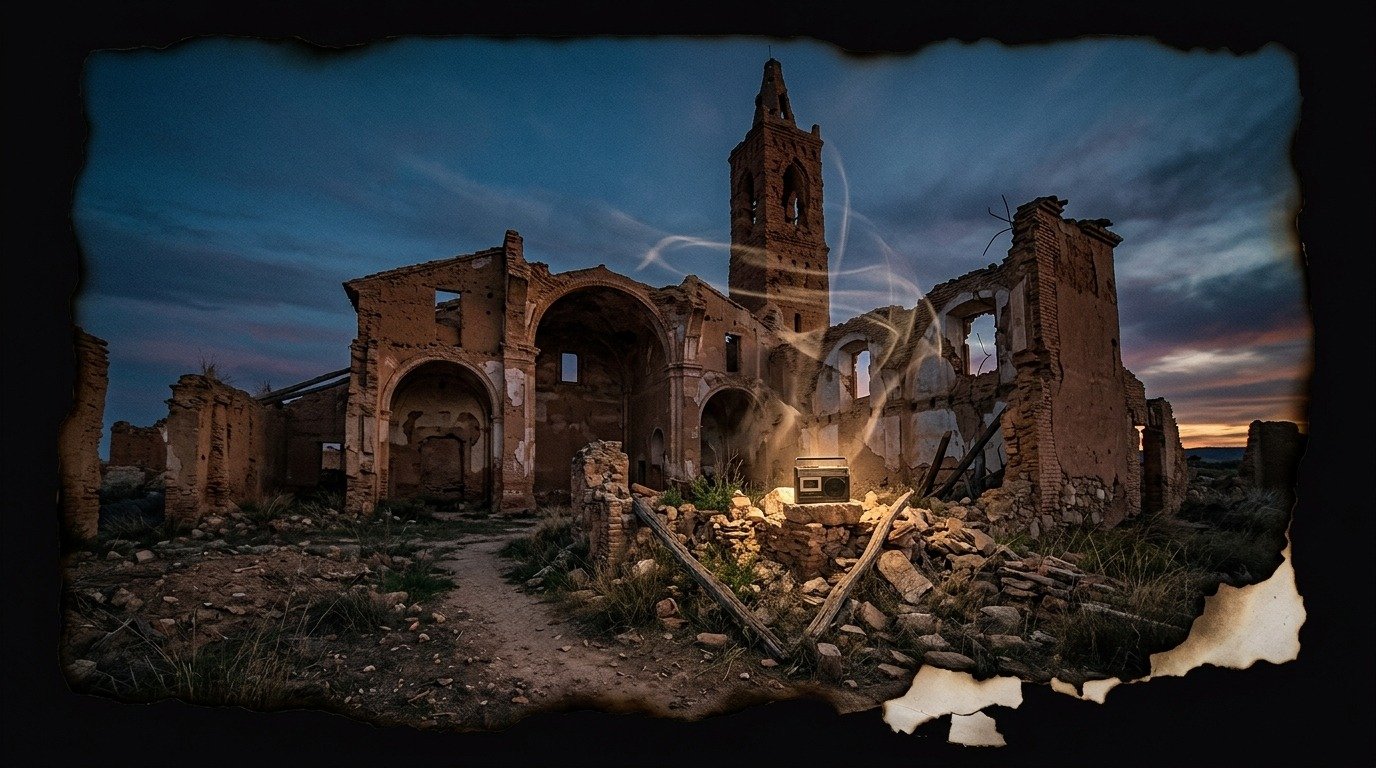
Belchite: The Town That Became a Scream of Stone
The Fourteen-Day Siege
On August 24, 1937, the sky over the province of Zaragoza stopped belonging to the living. At more than forty degrees Celsius (104°F) in the shade, the Republican army began a fierce offensive to take Belchite, a town of narrow streets turned into a fortress by the rebel troops. For fourteen summer days, the civilian population and soldiers crowded into basements and improvised trenches without water, under constant artillery and aerial bombardment. The water in the cisterns rotted, the smell of decay invaded every corner, and thirst drove many to madness. When the battle ended on September 6, casualties exceeded five thousand people. The houses were skeletons of adobe and brick, and the churches had their roofs open to the sky. At the end of the war in 1939, Francisco Franco decided not to rebuild the historic town; he ordered it to be left intact as a monument of war propaganda and to build a New Belchite right next to it. The ruins of old Belchite remained fenced off, mute, and heavy with death.
The Echo Trapped in the Adobe
The extreme tragedy of Belchite did not dissolve with the passing of the decades; it remained engraved in the very matter of the place. The inhabitants who moved to the new town and the watchmen of the old site began to notice that the silence of the ruins was never absolute. Shepherds prevented their flocks from crossing the ruined arches of the town at night, claiming that the animals refused to enter, terrified by an invisible tension. Local legend claims that the souls of those who died thirsty and mutilated in the basements of Calle Mayor remain trapped within the perimeter of the ruins. There is talk of laments rising from the ground when the cierzo wind blows, and of the silhouette of a woman walking barefoot, searching for water near the destroyed church of San Martín de Tours. The reddish, dusty soil of Belchite preserves the memory of pain in an almost physical way.
The Voices That Science Cannot Silence
Today, Belchite is considered the epicenter of EVP (electronic voice phenomena) research in Spain. Starting in the 1980s, parapsychologists and mystery journalists began placing reel-to-reel tape recorders inside the church of San Martín and at the Arco de la Villa. What they recorded forever altered the perception of the place. On the tapes, not only did white noise appear; the engines of fighter planes diving, the whistle of mortar shells crossing the air, bursts of machine-gun fire, and screams of pain in old Spanish were clearly recorded. The most famous and disturbing recording is the tolling of a church bell ringing loudly in the center of the ruins, a physically impossible sound since all of Belchite's bells were melted down or destroyed during the fighting of 1937. Those who walk through its fenced streets today during authorized night visits describe sudden drops in temperature that freeze the breath in the middle of summer and an oppression in the chest that disappears immediately upon crossing the outer boundary of the ruins.
What the Stone Hides
Behind the nightmare atmosphere lies an unquestionable physical reality. Old Belchite is a collection of adobe, brick, and plaster ruins that has suffered the erosion of the Aragonese climate for more than eighty years. Scientists and skeptics point out that the structure of the town functions as a giant acoustic resonance chamber. The cierzo wind, blowing fiercely through broken lancet windows, collapsed roofs, and underground cellars, generates whistles, infrasound, and noises that the human brain naturally interprets as laments or voices. Likewise, the instability of the structures produces constant creaks that mimic footsteps on the rubble.
A Last Look at the Ground
Before the daylight fades completely over the bell tower of San Martín, the visitor who looks at the ground can see the rusted bullet casings that still emerge from the red earth after every rain. Belchite does not need invented ghosts; its broken walls are the exposed body of a historical wound that refuses to heal.
Comments
Share information, an experience, or a source to help enrich this entry. They are automatically reviewed before being published.
Loading comments...