Catacombs of Paris
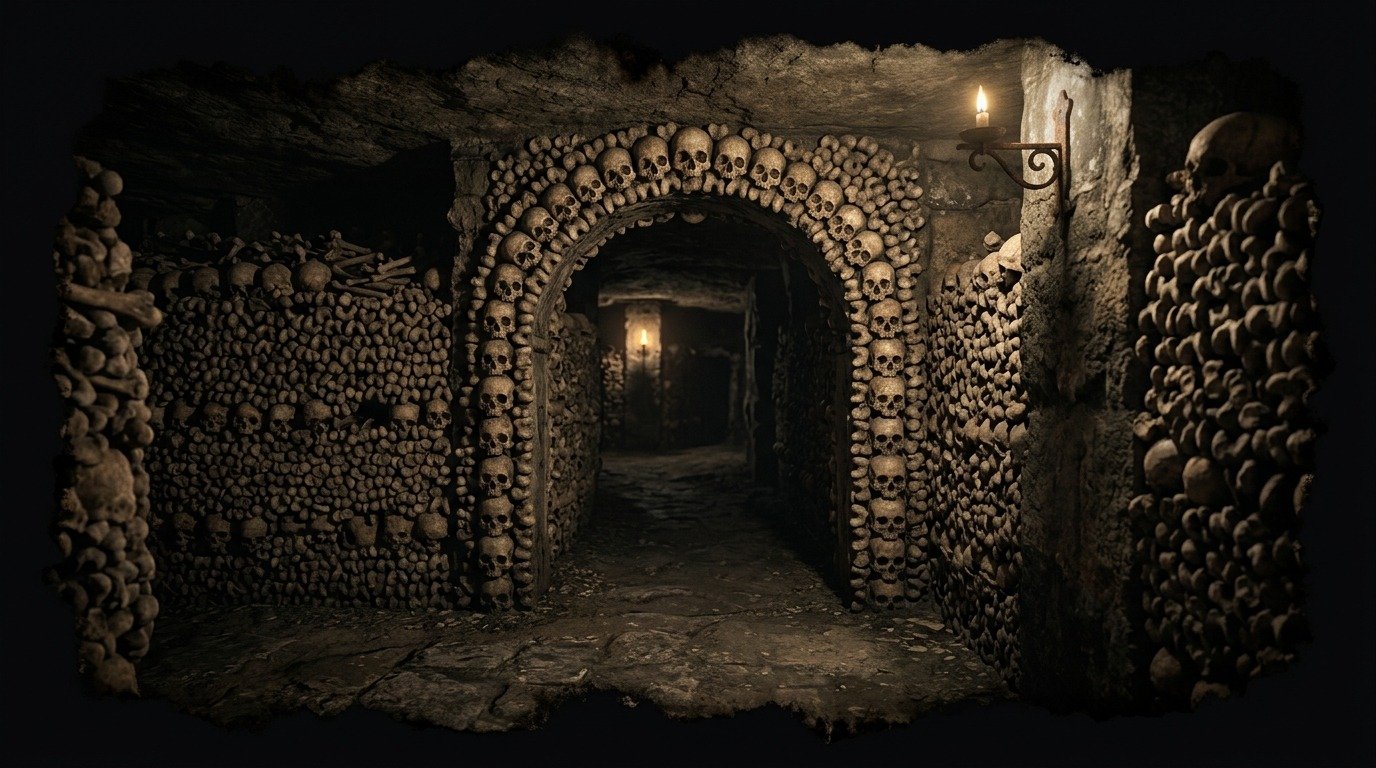
Catacombs of Paris: the silent empire that holds up the City of Light
On the afternoon of May 30, 1780, the basement of a warehouse on Rue de la Lingerie, right next to the Holy Innocents' Cemetery, collapsed under unbearable pressure. It did not cave in due to water leaks or an earthquake: an avalanche of black soil, pestilential gases, and hundreds of decomposing corpses burst through the stone walls and buried the basement. The largest cemetery in Paris, saturated after ten centuries of uninterrupted burials, had just exploded from the bowels of the earth.
The great relocation of the dead
By the late 18th century, Paris was drowning in its own dead. The Holy Innocents' Cemetery was a giant mass grave where flesh no longer decomposed; the saturation was such that the ground had risen two meters (6.6 feet) above the level of the neighboring streets. The smell in the surrounding houses soured milk, rotted meat in kitchens, and caused people to faint. The health crisis forced the Council of State to make a drastic decision: to close the urban cemeteries and empty their contents.
The chosen destination was the ancient quarries of Tombe-Issoire, a network of underground tunnels from which limestone had been quarried to build the city since Roman times.
The relocation began in 1786. Every night, for more than two years, the same ritual was repeated: carts covered with black tarps, escorted by priests chanting the office of the dead under torchlight, crossed the streets of Paris carrying tons of human bones. The remains from the parish cemeteries were dumped haphazardly down the ventilation shafts of the old quarries.
It was in 1810 when Louis-Étienne Héricart de Thury, inspector general of quarries, decided to transform this chaos of bones into a monument that could be visited. Under his direction, workers aligned femurs and tibias to form symmetrical walls, and embedded skulls in geometric patterns to create altars, columns, and niches of a macabre neoclassical order. It is estimated that the remains of six million people rest down there.
The voices of the labyrinth
The official ossuary occupies just a fraction of the quarries, which stretch for more than three hundred kilometers (186 miles) beneath the soil of Paris. The rest is a dark and forbidden labyrinth where getting lost means, almost with absolute certainty, dying of hypothermia or madness.
Those who illegally enter the restricted areas—an active underground community known as "cataphiles"—claim that the absolute silence of the depths is a myth. After midnight, the limestone walls transmit an indecipherable murmur that seems to come from all directions at once. Those who have heard this sound swear that the voices are not echoes from the outside, but a hum that urges explorers to turn off their flashlights and let themselves be carried away by the darkness.
The most famous story of a disappearance in this labyrinth is that of Philibert Aspairt. On November 3, 1793, in the midst of the French Revolution, this doorkeeper of the Val-de-Grâce hospital entered the quarries through a staircase located in the courtyard of the medical center. He carried a single candle and was looking for the cellars of a nearby convent. He never returned. His body was found eleven years later, in 1804, a few meters (yards) from an exit, identified only by the keys on his keyring and his uniform clothing. They buried him in the exact spot where he fell, and his grave remains a point of pilgrimage for underground explorers today.
The abandoned chamber and panic underground
The air in the catacombs is dense, humid, and maintains a constant temperature of fourteen degrees Celsius (57 degrees Fahrenheit). The smell of wet stone and ancient dust saturates the lungs of visitors from the very first step.
At the entrance of the ossuary, a stone lintel warns in French: *"Stop! This is the empire of death"*. Upon crossing the threshold, walls of bones hem in the path. The empty sockets of thousands of skulls stare intently at the living from the walls.
The most famous story of panic in the tunnels has been circulating on the internet for years and has never been verified: that of a video camera found in a deep, forbidden gallery with its tape intact. The video shows a man walking with a flashlight in hand through narrow passages. Suddenly, the pace of his steps quickens. He looks back repeatedly, breathing heavily. Panic takes hold of him; he begins to run erratically, stumbling against the walls, until he finally drops the camera on the ground and runs off, disappearing into the absolute blackness. The man's identity was never known, and many believe the video is a hoax; but anyone who has gone down without a guide understands why the story never dies.
In 2004, the Paris police discovered something equally disturbing in a gallery beneath the Palais de Chaillot: a clandestine movie theater with a giant screen, professional projector, seats carved into the rock, and a surveillance system with cameras pointing at the access tunnels. When the police squad returned days later to confiscate the equipment, the place had been completely dismantled. On the floor, only a note remained: *"Do not try to find us"*.
What is known
Historically, the catacombs were not designed as a mystical sanctuary, but as an emergency engineering solution to prevent the physical collapse of Paris. The limestone quarries had left the city's subsoil so fragile that, in December 1774, a section of Rue d'Enfer collapsed completely, swallowing houses and carriages. The consolidation of the tunnels and the subsequent relocation of the bones saved the French capital from sinking into its own foundations.
The symmetrical and ornamental design of the bone walls does not respond to dark rituals, but rather to a physical need: the femurs and tibias were stacked in front to act as solid retaining walls, while smaller and lighter bone fragments were poured behind them to fill the gaps and prevent the galleries from giving way under the weight of the streets above.
Climbing the final spiral staircase that returns the visitor to the surface, one exits directly onto an ordinary street of modern Paris, filled with shops and cafes. The contrast is immediate, but the feeling of having walked beneath the support of six million silent skeletons does not fade easily.
Comments
Share information, an experience, or a source to help enrich this entry. They are automatically reviewed before being published.
Loading comments...