Highgate Cemetery
Highgate Cemetery: Vampire Fever in the Shadows of London
The Night of the Stakes
On the night of March 13, 1970, a crowd armed with wooden stakes, crucifixes, and torches climbed the gates of Highgate Cemetery. The London police were overwhelmed by hundreds of people who invaded the Victorian pathways, spurred on by press reports claiming that a real vampire inhabited the cemetery's catacombs. The collective hysteria ended with desecrated graves, opened coffins, and police patrolling among the Gothic mausoleums in search of monster hunters.
The Garden of Victorian Death
Highgate opened its gates in 1839 as part of the "Magnificent Seven," a series of private cemeteries built on the outskirts of London to alleviate the overcrowding of parish churchyards. Designed by architect Stephen Geary, the cemetery quickly became the most fashionable burial place of the Victorian era. Its western section is notable for the Egyptian Avenue and the Circle of Lebanon, a ring of catacombs excavated around a giant cedar tree that was already there before the cemetery. During the 19th century, Highgate welcomed celebrities such as Karl Marx and the poet Christina Rossetti. However, after World War II, the owning company went bankrupt. The cemetery was abandoned. Ivy climbed up the marble angels, tree roots broke through the stone pathways, and the roofs of the mausoleums collapsed, plunging the place into a Gothic gloom ideal for the birth of the myth.
The King of the Dead of Wallachia
The legend of the Highgate Vampire began in the late 1960s. Witnesses claimed to have seen an unusually tall man, dressed in a long cloak and top hat, gliding between the graves without touching the ground. The myth grew when two local occultists, David Farrant and Seán Manchester, publicly declared that the figure was a "vampire king" of Eastern European origin, who practiced black magic in medieval England and whose coffin had been moved to Highgate by his followers. Neighbors reported finding foxes with their throats slit and drained of blood on the cemetery pathways, and claimed that anyone who looked directly into the red eyes of the apparition was paralyzed with terror.
The Forest of Tombs
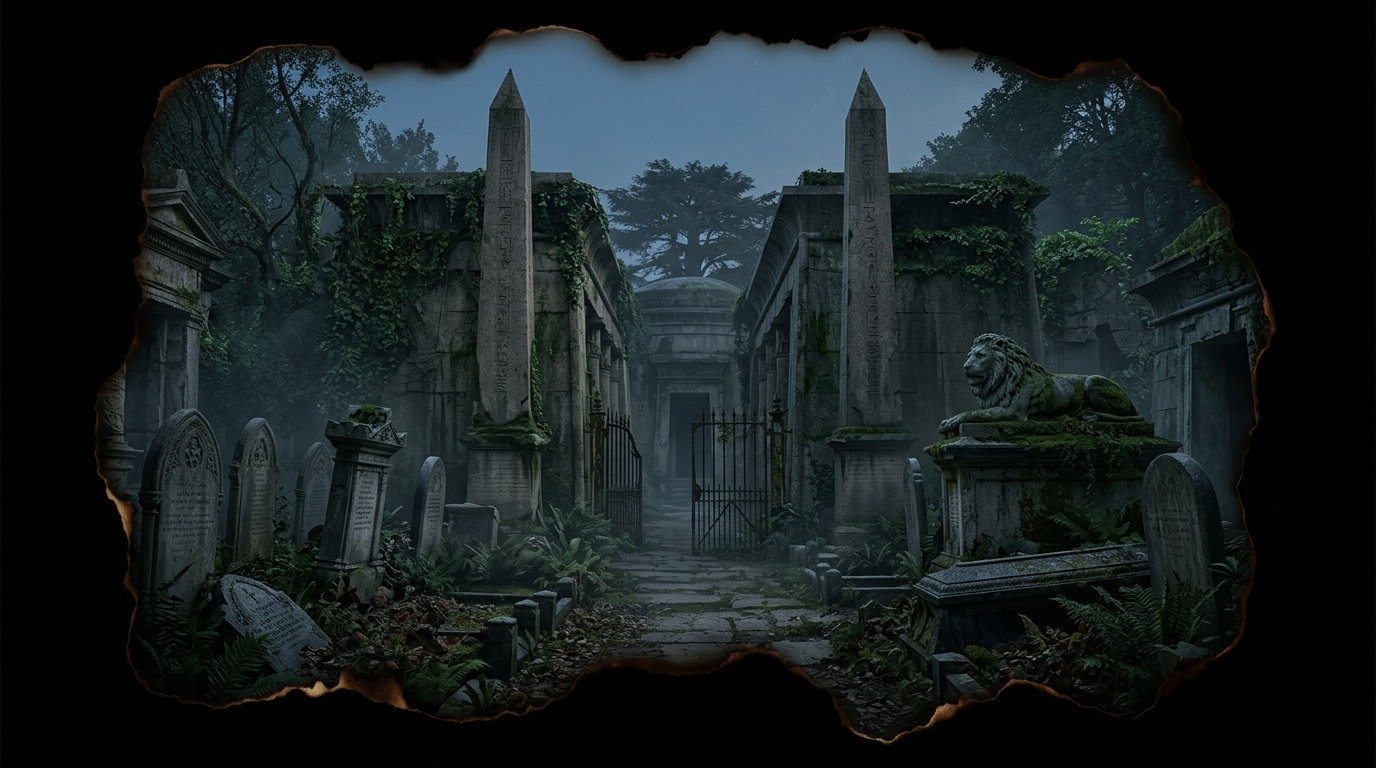
Today, the western section of Highgate can only be visited in small groups accompanied by official guides. The atmosphere remains damp, cold, and silent. Ferns grow over forgotten graves, and moss covers the inscriptions on the leaning tombstones. Upon entering the Egyptian Avenue, the air suddenly turns cold. The stone passageway, guarded by two massive obelisks, leads to the Circle of Lebanon. There, the heavy iron doors of the family vaults show signs of having been forced open in the past. Visitors report a constant feeling of being watched from the slits of the dark mausoleums.
Hysteria and Neglect
Highgate is a private cemetery currently managed by the Friends of Highgate Cemetery, who rescued the site from ruin in the 1970s. Historical investigations showed that the wave of vampire sightings was the result of suggestion caused by the cemetery's state of neglect and the intense media campaign by Farrant and Manchester, who competed for press attention. The dead animals were foxes, which were very abundant in the abandoned cemetery, having died of natural causes or been attacked by other animals.
The Stone Guardian
Not far from the Circle of Lebanon, a stone lion sleeps atop the grave of George Wombwell, a famous Victorian menagerist. With its moss-covered claws and its gaze fixed on the path, the stone feline seems to be the only real custodian of the secrets that the Highgate woods insist on hiding.
Comments
Share information, an experience, or a source to help enrich this entry. They are automatically reviewed before being published.
Loading comments...