Capuchin Catacombs
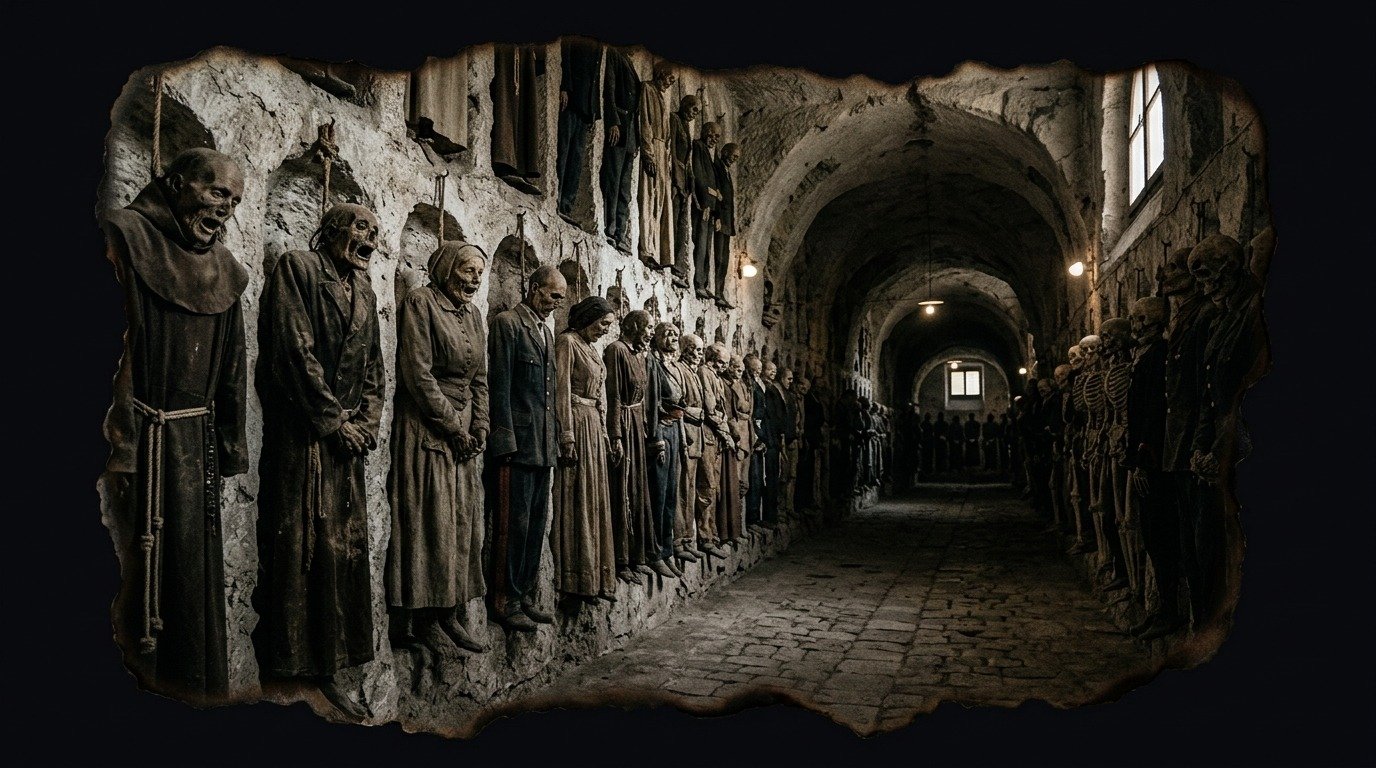
Capuchin Catacombs: The Basement Where Death Dresses in its Finest
The Awakening of the Monks
On the morning of October 16, 1599, the Capuchin monks carried the body of Brother Silvestro da Gubbio down to the basement of the Palermo monastery. They did not bury him in the earth or lock him in a stone niche. They dressed him in his brown habit, adjusted the cord around his waist, and placed him standing in a niche carved into the rock wall. Silvestro was the first. With him began a silent parade that would transform the convent's basements into the world's largest display of exposed dead.
The Prestige of the Mummy
The monastery, built in the mid-16th century, discovered that the conditions of its crypts—the dry air, the composition of the limestone rock, and a constant draft—naturally dehydrated the bodies before decay could destroy them. What began as an emergency solution for the monks' lack of space quickly became the ultimate status symbol for the Sicilian aristocracy. During three centuries, the wealthiest families of Palermo paid fortunes to have their loved ones preserved and hung on the walls. The process was meticulous: the bodies were placed on grids of terracotta pipes for eight months to drain all fluids, then washed with vinegar, exposed to the open air, and dressed in their finest clothes. If the family stopped paying the monastery's maintenance fees, the body was removed from its niche and kept in a storeroom until the debt was settled.
The Blinking of the Little Girl
The most unsettling section of the catacombs belongs to the children. In a small chapel at the end of the corridor rests Rosalia Lombardo, who died at the age of two in 1920 from pneumonia. Her devastated father hired the famous embalmer Alfredo Salafia to save her from turning to dust. Rosalia looks asleep under the glass of her coffin: she retains her golden hair, intact eyelashes, and a yellow bow on her forehead. The convent's night guards swear that Rosalia opens and closes her eyes during the day. Those who pass by her in the afternoon claim to have seen her blue pupils revealed beneath her half-closed eyelids, as if the little girl were about to wake up from a hundred-year nap.
The Labyrinth of Dust
To walk through the Capuchin Catacombs today is to move through damp corridors under the dim light of high skylights. The smell is a heavy mixture of ancient dust, old fabric, and candle wax. The more than eight thousand bodies are strictly divided by sector: men, women, professionals (doctors, lawyers, and military officers who still wear their worn-out uniforms), priests, and monks. Many bodies are suspended from hooks on the wall, leaning forward as if watching the visitor from above. Their slack jaws give the impression that the mummies are screaming or laughing in absolute silence. The vibration of tourists' footsteps sometimes causes a trickle of dust to fall from a top hat or a black lace glove to subtly move.
What Science Explains
The phenomenon of Rosalia Lombardo has a physical explanation confirmed by the scientists who studied her airtight coffin. Changes in temperature and humidity throughout the day expand and contract the girl's eyelids, creating the optical illusion that she is opening her eyes. In addition, light from the side windows strikes her half-open eyes at different angles, accentuating the effect. The secret of her flawless preservation was revealed when Salafia's notes were found: the embalmer replaced the girl's blood with a chemical formula of formalin to kill bacteria, alcohol to dry the body, glycerin to prevent the skin from dehydrating completely, salicylic acid to combat fungi, and zinc salts to give rigidity to the tissue.
The Last Look
Brother Silvestro da Gubbio remains in his corner, holding a cardboard sign that recalls the date of his death. His dark, leathery face welcomes visitors to a basement where death is not an absence, but a presence standing upright on its own bones.
Comments
Share information, an experience, or a source to help enrich this entry. They are automatically reviewed before being published.
Loading comments...