Pripyat
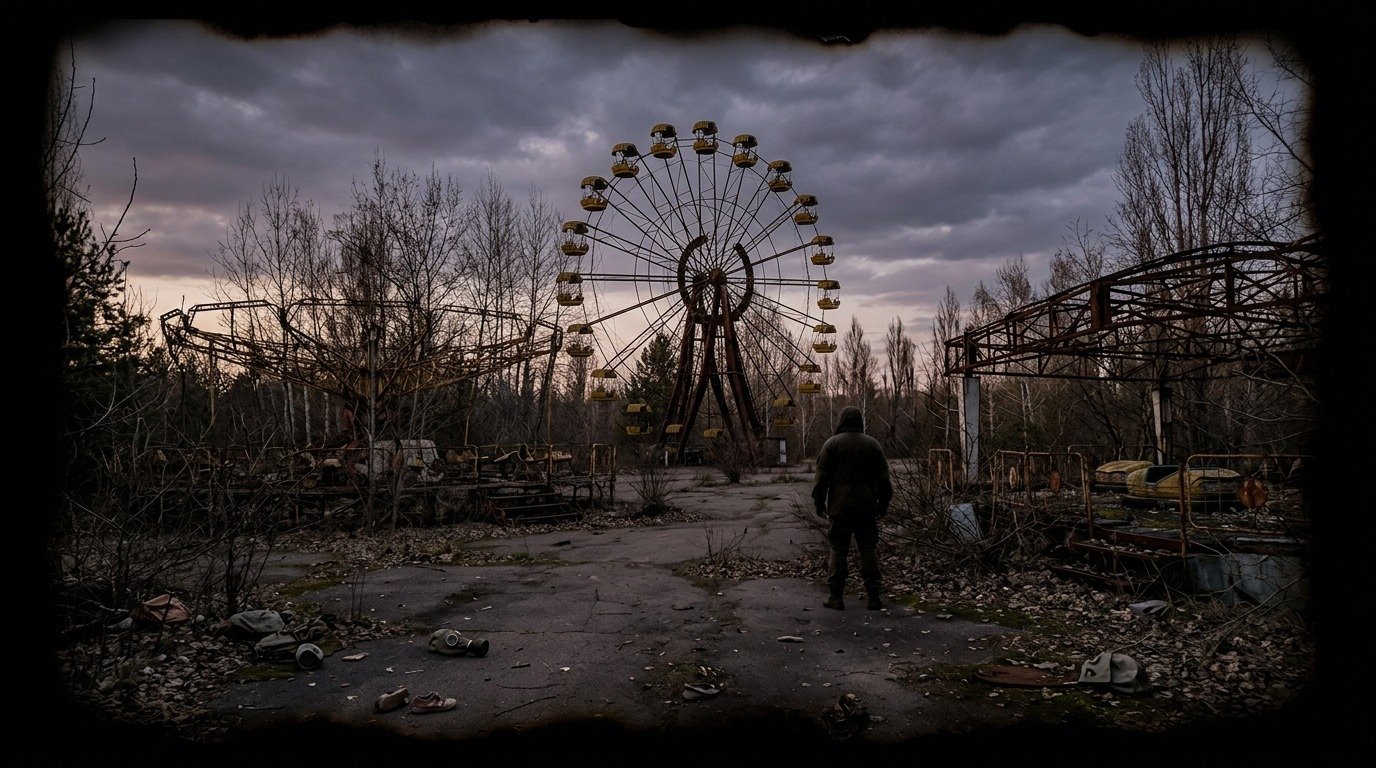
Pripyat: The Amusement Park Frozen at the End of the World
The Two-Minute Evacuation Order
At two o'clock in the afternoon on April 27, 1986, the calm voice of a woman interrupted the regular programming of Pripyat's local radio. She announced an "unfavorable radiological situation" at the Chernobyl Nuclear Power Plant, located just three kilometers (1.8 miles) from the city. With bureaucratic calmness, she ordered the fifty thousand residents to pack baggage for three days, take their documents, and go out into the street. Twelve hundred yellow buses sent from Kyiv were waiting in line. Children left their toys on the rugs, women left food cooking on the stoves, and men abandoned their half-repaired cars. No one knew that reactor number 4 of the plant had exploded thirty-six hours earlier, releasing into the atmosphere hundreds of times more radioactive material than the Hiroshima bomb. No one ever returned.
The Jewel of the Atomic Crown
Pripyat was no ordinary city; it was the pride of the Soviet Union. Founded in 1970 to house the scientists, engineers, and workers of the nuclear power plant, it was a young city, with an average age of twenty-six. Designed with wide avenues, fifteen primary schools, Olympic-sized swimming pools, a palace of culture, and an amusement park that was scheduled to open on May 1st of that same year. It was an oasis of modernity and supply in the middle of the Ukrainian steppe. The tragedy transformed it, in a single day, into a massive reinforced concrete coffin surrounded by the Red Forest, a pine forest that died and turned a bright ocher color due to the intensity of the radiation received in the first hours of the disaster.
The Black Bird and the Shadows of the Reactor
A legend that began to circulate years later says that, in the days leading up to the explosion on April 26, several plant operators and residents of Pripyat saw a massive, dark creature with gigantic wings and red eyes flying over the silhouette of reactor 4. Locals called this apparition the "Black Bird of Chernobyl," a presence that brought with it shared nightmares and anonymous phone calls warning of the disaster. After the catastrophe, the legend transformed into denser apparitions. The liquidators, those soldiers and workers tasked with cleaning up the lethal zone, swore they saw semi-transparent human figures walking through the hallways of Hospital No. 126, where the first firefighters who fought the radioactive fire without protection had died. Today, the few visitors report seeing human shadows silhouetted against the walls of empty buildings; dark shapes that seem etched into the concrete by the light of an invisible explosion.
A Museum of Absence
The abandonment turned Pripyat into a sanctuary of melancholy and physical danger. Those who enter the exclusion zone describe an absolute silence, interrupted only by the cawing of crows and the metallic, intermittent clicking of Geiger counters as they approach radiation "hot spots." Tree roots break through the asphalt of the avenues, wolves run through the corridors of the Energetik Palace of Culture, and school classrooms present a dantesque scene: thousands of children's gas masks strewn on the floor, open school notebooks with homework that was never graded, and plastic dolls covered in radioactive dust on rusted iron beds. The amusement park's Ferris wheel, with its yellow gondolas that never officially carried children, stands in the middle of the central courtyard like a rusted iron monument to a future that never happened.
The Agony of the Atom
The science behind Pripyat is exact and cold. The city's danger does not stem from mystical forces, but from the unstable isotopes deposited on every centimeter (0.39 inches) of its surface. Cesium-137, strontium-90, and plutonium-239 are clung to the moss growing on the pavement, to the floorboards, and to the dust floating in the air of the ruined buildings. Although gamma radiation levels in the streets have dropped enough to allow short guided tours of a few hours, entering the buildings is strictly forbidden due to the risk of structural collapse from lack of maintenance and the harshness of the Ukrainian winter. Since the 2022 Russian invasion, which occupied the zone for weeks, tourist visits have been suspended. The plutonium deposited in Pripyat's soil will take twenty-four thousand years to lose half of its radioactive activity.
The Creaking of the Ferris Wheel
When the wind blows from the Pripyat River, the structure of the yellow Ferris wheel creaks with a high-pitched sound that reverberates throughout the deserted plaza. That motionless metallic structure is the ultimate reminder that human time can stop in a second, while the atom continues its slow and lethal decay in the darkness.
Comments
Share information, an experience, or a source to help enrich this entry. They are automatically reviewed before being published.
Loading comments...