Day of the Dead (Día de Muertos)
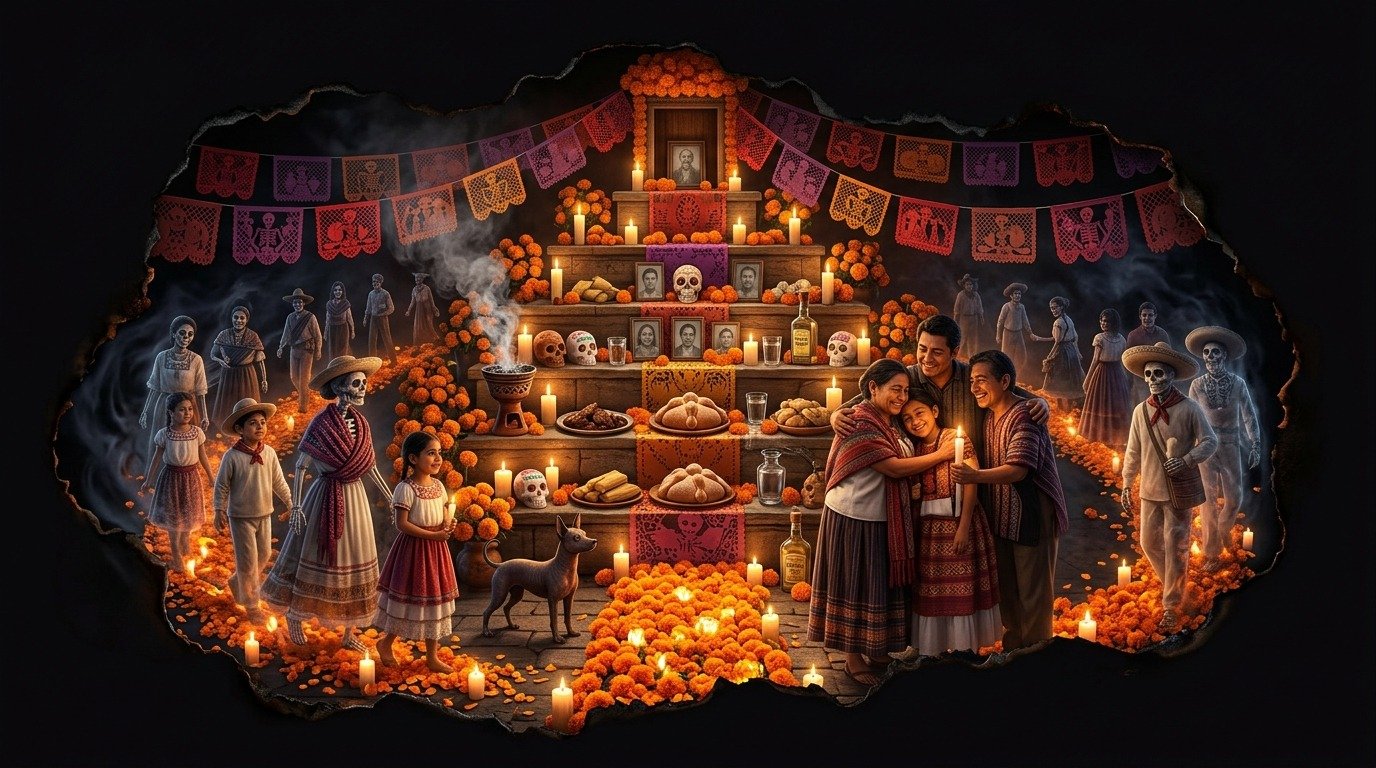
Día de Muertos: the nights when the dead return home
What is Día de Muertos
Día de Muertos is the Mexican celebration in which, according to tradition, the souls of the deceased return from the afterlife to visit their families. It is celebrated mainly on November 1st and 2nd: on the 1st, the deceased children, the "angelitos" (little angels), arrive, and on the 2nd, the adults. To welcome them, families set up altars with their favorite food, candles, cempasúchil flowers, and their photos, and spend the night in cemeteries next to their graves. It is not a time of mourning: it is a celebration of reunion. In 2008, UNESCO inscribed it as an Intangible Cultural Heritage of Humanity.
The origin: the months the Aztecs dedicated to the dead
Long before the arrival of the Spanish, the Mexica already dedicated two festivals of the year to their dead: the "little feast of the dead," for children, and the "great feast of the dead," for adults. They fell in the middle of summer and were under the protection of Mictecacíhuatl, the Lady of the Dead, wife of Mictlantecuhtli, the lord of the underworld.
For the Mexica, death was not an end but a journey. Anyone who died a common death undertook a four-year journey through the nine levels of Mictlán, the realm of the dead, accompanied by a dog that helped them cross the river of the underworld. The living did not forget them: they brought them offerings to sustain them on the way.
When the Spanish arrived, the Church tried to erase these festivals. They could not. What they did was move them on the calendar to make them coincide with All Saints' Day and All Souls' Day, on November 1st and 2nd. Thus, a mestizo celebration was born: with Catholic prayers, crosses, and candles, but with its pre-Hispanic soul intact.
When each deceased person arrives
In many regions of Mexico, the calendar of visits is precise:
- **October 28th:** in some towns, those who died violently or in accidents are welcomed. - **October 31st and November 1st:** the children arrive. - **November 2nd:** the adults arrive.
Upon finishing, the souls return to the afterlife, and the family shares the food from the offering. Many claim that this food no longer tastes the same: that the dead took its essence with them.
The altar of the dead: each object has a purpose
The altar, or offering, is the heart of the celebration. It is not decoration: it is a map and a welcome for the soul traveling from the afterlife.
- **Cempasúchil flower.** Its intense orange color and strong scent guide the souls. Paths are marked with its petals from the door or from the cemetery to the altar, so the deceased does not get lost. - **Candles.** They illuminate the return. In some houses, one is placed for each deceased person. - **Water.** To quench their thirst after the long journey. - **Sal.** To purify and so that the body does not become corrupted on the journey back and forth. - **Copal.** The resin that the Mexica burned for the gods: its smoke cleanses the place and elevates prayers. - **Food and drink.** What the deceased enjoyed in life: their favorite stew, their tequila, their cigarettes, their sweets. - **Pan de muerto.** A round bread decorated with strips of dough in the shape of bones and a small ball on top representing the skull, or a tear. - **Sugar skulls.** Often with the name of the deceased written on the forehead. - **Papel picado.** The colorful paper flags represent the wind and the fragility of life. - **The photo of the deceased.** So they know the altar is for them. - **A xoloitzcuintli dog**, made of clay or paper, on some altars: the guide that helps them cross the river of the dead.
Altars also have levels. Those with **two levels** represent heaven and earth; those with **three** represent heaven, earth, and the underworld; and those with **seven** represent the seven steps the soul must climb to reach rest.
The night in the cemetery
In places like Janitzio, in Michoacán, or Mixquic, in Mexico City, families spend the entire night in the cemetery. They clean the graves, cover them with flowers and candles, eat, sing, and talk to the deceased as if they were sitting right there. For those seeing it for the first time, the cemetery illuminated in orange and fire in the middle of the night is one of the most impressive images in the world.
The skulls that laugh at death
Humor is part of the festival. In the 19th century, **literary calaveritas** were born: mocking verses written about living people, as if they had already died, to laugh at their flaws. Newspapers published them about politicians and famous figures. From that same satirical tradition came the most famous character of Día de Muertos: La Catrina, the elegant skeleton created by the printmaker José Guadalupe Posada.
Día de Muertos today
In recent decades, the festival has become global. After a 2015 James Bond film showed a Day of the Dead parade in Mexico City that did not actually exist, the city decided to create it, and since 2016, hundreds of thousands of people march in it every year. The 2017 animated film *Coco* brought Mictlán, cempasúchil, and xoloitzcuintles to the entire planet.
Behind the painted skulls and parades lies the same idea from more than five hundred years ago: the dead do not fully leave as long as someone remembers them and leaves a candle lit for them.
Difference with Halloween
Although they fall on almost the same dates, they are not the same. Halloween comes from the Celtic festival of Samhain and revolves around fear: the spirits that cross over that night are threats that one must protect themselves from with costumes. Día de Muertos revolves around love: the spirits that arrive are those of one's own family, and they are welcomed with food, flowers, and music.
Comments
Share information, an experience, or a source to help enrich this entry. They are automatically reviewed before being published.
Loading comments...