Bhangarh Fort
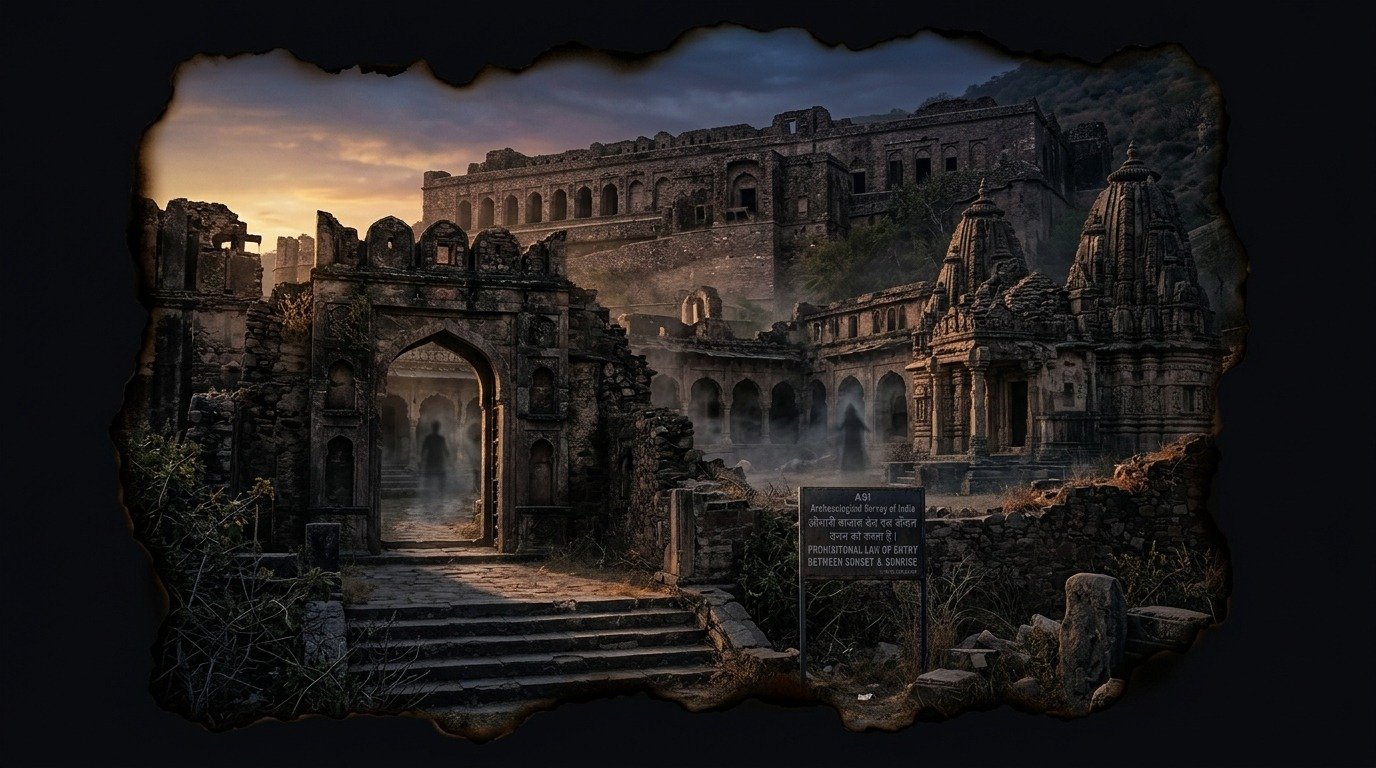
Bhangarh Fort: The Empire of Forbidden Shadows
The Cursed Fort of Rajasthan
On the edge of the Sariska Forest Reserve, where thorny brush devours the Aravalli Hills, stand the ruins of Bhangarh Fort. This is not merely a collection of stones crumbled by the passage of centuries, but an entire settlement that was abandoned overnight at the end of the 18th century. Founded in 1573 by Raja Bhagwant Das for his younger son, Bhangarh was once a thriving walled city, with majestic temples, vibrant markets, and a tiered royal palace that overlooked the valley. Today, the silence that reigns there is so dense it takes your breath away. Those who cross its imposing stone gates soon perceive that the air feels heavier, laden with an ancient resentment that India's scorching sun cannot dissipate.
The legend that accounts for the ruin of the place splits local folklore into two tragic paths. The first speaks of an ascetic, Baba Balu Nath, who lived in a humble hermitage on the grounds and gave his blessing to build the fort under one unshakeable condition: "The moment the shadow of your palaces touches my sanctuary, the city shall cease to exist." The arrogance of a later prince led him to erect a column that cast its shadow over the mystic's temple, unleashing a curse that buried the life of the place. The second path, more popular and violent, tells of the obsessive love of a dark magician, an adept of tantric occultism named Singhia, for the beautiful Princess Ratnavati. After attempting to bend the young woman's will using a perfume imbued with a love potion, the deception was discovered; the princess threw the vial against an immense boulder, which, under the effect of the spell, rolled down the hill, crushing the magician. With his last breath, Singhia cursed the fort and all its inhabitants to die a violent death and remain trapped in a limbo without reincarnation. A few months later, a bloody war with the neighboring kingdom of Ajabgarh massacred the entire population of Bhangarh.
Echoes of the Ghost Market and the Oppression of the Air
The accounts of those who have dared to wander through the ruins describe phenomena that defy sanity. Locals claim that, as night falls, the deserted galleries of the Johari Bazar stone market come back to a ghostly life. Unintelligible whispers, the clinking of invisible jewelry, distant laughter of women, and the metallic echo of clashing swords in a perpetual battle are heard. Those who walk through the interior of the ruined palace describe an intense feeling of suffocation, as if the space were actively reclaiming the intruder's oxygen, accompanied by a pungent odor that shifts between ceremonial incense and decaying flesh.
Documented testimonies from daring visitors mention encounters with shadows that glide along the ground even though there is no sunlight to cast them. Some local folklore researchers have recorded drastic temperature changes in a matter of seconds, as well as a strange static that drains the batteries of electronic equipment almost the instant they cross the fort's threshold. However, the most disturbing phenomenon is psychological: an uncontrollable urge to leave the place, a primal panic that grips the chest and drives visitors to run toward the exit before the last light of day is completely extinguished on the horizon.
The Government Ban and Disappearances in the Gloom
What truly distinguishes Bhangarh from other historical sites with ghost legends is the institutional recognition of its danger. The Archaeological Survey of India (ASI) has placed an official metal sign a few meters (yards) from the entrance that strictly prohibits access to the fort between sunset and sunrise. The guidelines allow no exceptions: the gates are locked, and security guards leave the premises, refusing to patrol the interior in the dark.
This government ban is not a mere concession to local superstitions. Historical records and testimonies from surrounding villages tell of people who, defying the warnings, spent the night within the walls and never returned, or were found the next day in a state of irreversible catatonia. Although skeptics argue that the real dangers of the night in Bhangarh are linked to wild fauna descending from the hills—including leopards and venomous snakes—or to the instability of structures that could collapse in the dark, the atmosphere of the place whispers otherwise. Bhangarh remains as a monument to wounded pride and black magic, a corner of the Earth where the past refuses to die and the present is forbidden to enter after the sun goes down.
Comments
Share information, an experience, or a source to help enrich this entry. They are automatically reviewed before being published.
Loading comments...