Borley Rectory
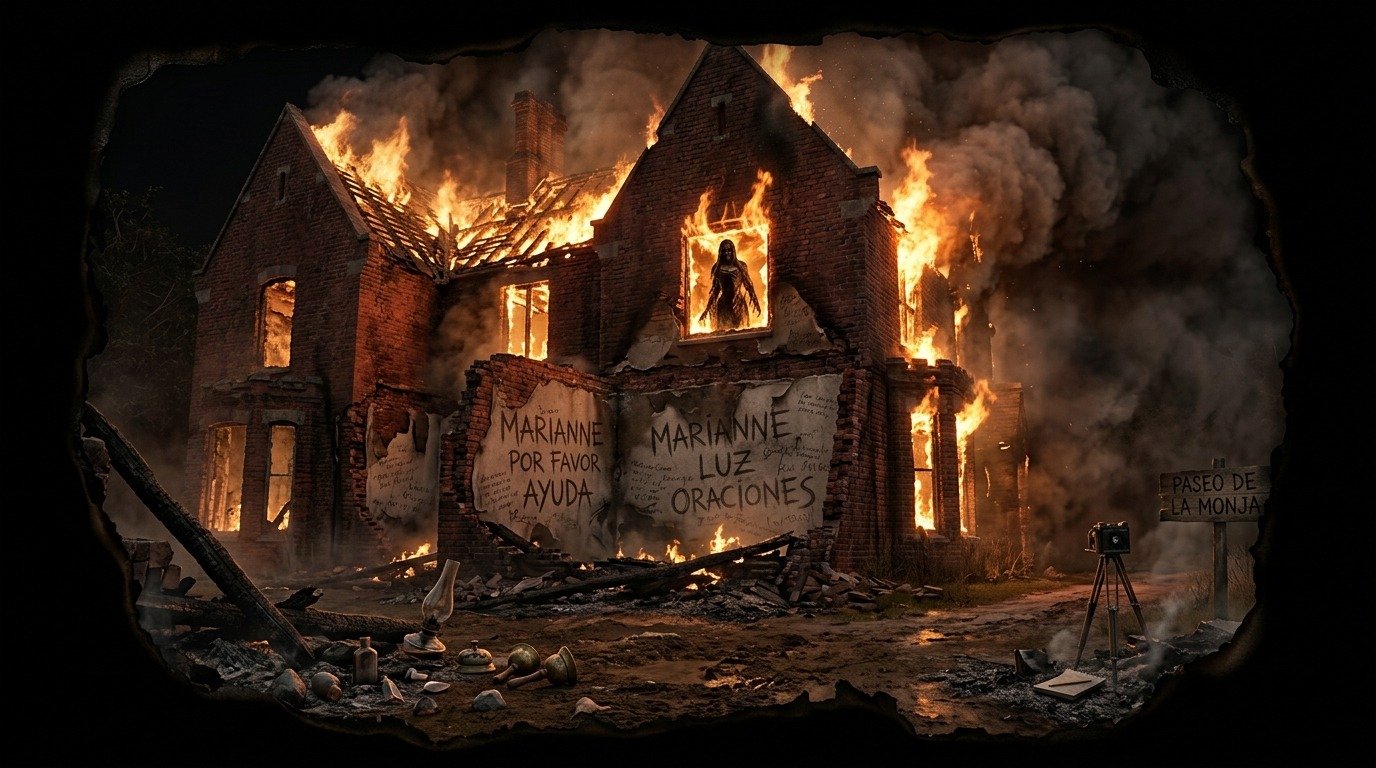
Borley Rectory: A Labyrinth of Brick, Ash, and Suspicion
Original Sin on Consecrated Ground
Built in 1862 in a remote corner of Essex, England, Borley Rectory was designed to house the Reverend Henry Bull and his large family. The building, an imposing red-brick structure in the Victorian Gothic style, was erected on the ruins of a 14th-century Benedictine monastery. Almost immediately, the property dragged a dark legend along with it: it was said that a monk from the monastery had fallen in love with a nun from a nearby convent. They both tried to escape in a carriage but were captured; the monk was decapitated and the nun was walled up alive inside the convent walls. Although modern historians have found no records of such a monastery or of the gruesome punishment, the legend served as the mythological engine for the phenomena that would torment the successive clergymen who attempted to inhabit the house.
The Torment of the Foysters and the Writing on the Walls
The earliest accounts spoke of a female figure dressed in black—"the Borley nun"—who walked along the garden path, dubbed the "Nun's Walk," in broad daylight. However, the paranormal activity reached its most violent and documented peak in the 1930s, with the arrival of the Reverend Lionel Foyster and his wife Marianne. During their stay, the house seemed to become a hotbed of poltergeist activity: service bells that rang on their own despite having their wires cut, stones and bottles thrown out of nowhere breaking windows, and furniture that moved on its own to block doors. The most unsettling aspect of the Foysters' period was the appearance of strange messages written freehand on the plaster walls of the rectory. The scribbles, which seemed to be scrawled by a childish or trembling hand, pleaded directly with Marianne: "Marianne, please help" and "Marianne, light, prayers."
The Psychic Laboratory of Harry Price
The case caught the attention of Harry Price, a famous and ingenious British psychic researcher who saw in Borley the perfect opportunity to conduct the first large-scale scientific study of a haunted house. In 1937, after the Foysters' departure, Price rented the rectory for an entire year. He recruited a team of 48 volunteer observers, mostly university students and skeptics, whom he instructed with a strict data-recording protocol. For months, the team documented unexplained temperature fluctuations, the sound of footsteps, rhythmic thuds, and the mysterious appearance of objects. Price published two highly successful books that established Borley in the public eye as "the most haunted house in England." However, Price's reputation suffered a severe blow after his death in 1948. The Society for Psychical Research (SPR) conducted an exhaustive independent investigation of the case and published the famous "Borley Report," which accused Price of having deliberately inflated the phenomena, and even of having thrown stones and coins himself during the sessions to impress journalists. It was also discovered that Marianne Foyster, a woman dissatisfied with her marriage and of an unstable character, admitted to having faked many of the poltergeist phenomena to scare her husband and justify her absences from the rectory.
The Purifying Fire and the Ruins of the Myth
The tragic fate of Borley Rectory was sealed on the night of February 27, 1939. The estate's new owner, Captain W. H. Gregson, was unpacking boxes in the library when an oil lamp mysteriously overturned, starting a fire that quickly consumed the brick and wood structure. Witnesses from the village claimed to see the figure of the spectral nun watching the fire from one of the upper-floor windows as the flames devoured the building. The charred ruins of the rectory stood for a few more years, attracting ghost hunters and the curious, until they were completely demolished in 1944. Today, only the empty land surrounded by trees remains, along with the old Borley parish church, located across the road. Silence has returned to the place, but mystery researchers continue to debate whether Borley was the epicenter of a genuine and inexplicable paranormal storm or the most brilliantly orchestrated hoax of 20th-century England.
Comments
Share information, an experience, or a source to help enrich this entry. They are automatically reviewed before being published.
Loading comments...