The Winchester House
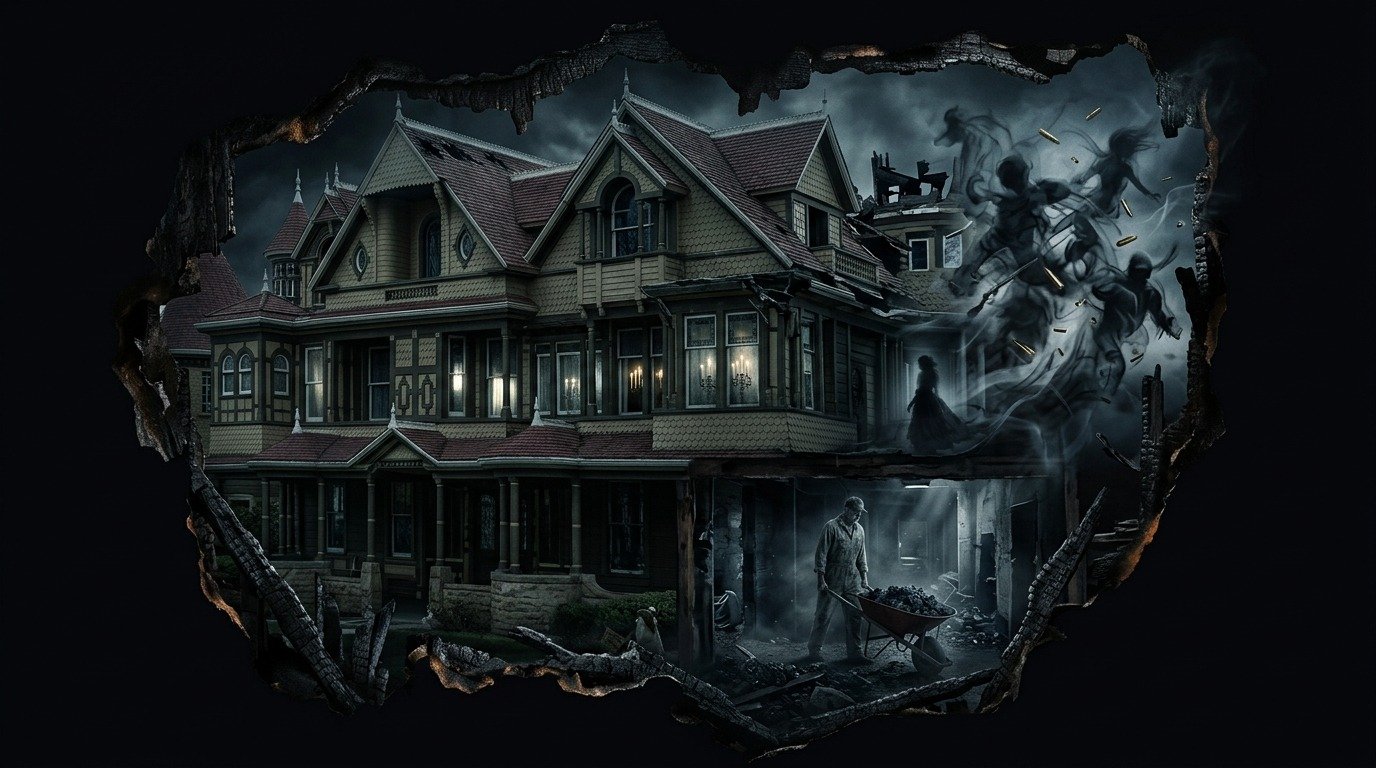
The Winchester House: The Infinite Labyrinth of Guilt
The Obsession of the Golden Widow
In the city of San Jose, California, stands one of the strangest architectural works in the world: the Winchester Mansion. After the death of her husband William Wirt Winchester, heir to the repeating rifle empire, and the early passing of her only daughter Annie, Sarah Winchester fell into a grief from which she would never recover. Devastated by the tragedy and seeking answers to the pain that consumed her, Sarah consulted a spiritualist medium in Boston in 1884. The revelation she received would change the course of her life and give rise to the mansion: the Winchester family was cursed by the spirits of the thousands of people who had lost their lives because of the rifles that bore their last name. According to the medium's instructions, Sarah had to move west and continuously and uninterruptedly build a house to shelter those lost souls. As long as the hammers did not stop sounding, death could not claim her. With an immense fortune at her disposal of nearly one thousand dollars a day tax-free, Sarah purchased a modest eight-room farmhouse in the Santa Clara Valley and began a monumental construction project that went on twenty-four hours a day, seven days a week, for thirty-eight years, stopping only on the day of her death in September 1922.
An Architecture to Cheat Death
Without architectural blueprints and guided solely by the supposed instructions she received from the spirits in a private seance room to which only she had access, Sarah designed a chaotic and incomprehensible structure. The house reached seven stories in height before the devastating 1906 San Francisco earthquake, which collapsed the upper floors. The mansion's design seems conceived to confuse and trap both intruders from the physical world and entities from the astral plane. Those who walk through its hallways run into spiral staircases with steps just a few centimeters (a couple of inches) high that lead to solid ceilings, doors that when opened reveal drops of several meters (several feet) into the outdoor gardens, windows built into the floors that look down into lower rooms, and blind chimneys that end before reaching the roof. The presence of the number thirteen is obsessively engraved throughout the property: windows with thirteen panes of glass, staircases with thirteen steps, chandeliers for thirteen candles, and drains with thirteen holes. Sarah firmly believed that this intricate labyrinth would protect her life and appease the wrath of the specters seeking vengeance for the deaths caused by Winchester weapons.
The Guardians of the Labyrinth and the Weight of Metal
Testimonies of unexplained activity in the mansion began long before Sarah passed away, but they intensified when the property was opened to the public as a tourist attraction. Museum guides and visitors regularly report the presence of footsteps echoing in empty rooms, the rustle of silk skirts brushing against the walls of narrow hallways, and the sigh of a woman whom some identify as Sarah Winchester herself, still watching over her eternal labyrinth. One of the most frequently sighted and documented specters on the premises is known as "the wheelbarrow man," a supposed construction worker dressed in overalls who is seen pushing a wheelbarrow full of coal or ashes in the house's basement, or tirelessly repairing a section of wall that no longer exists. Lights turn on and off without human intervention in the deepest areas of the structure, and visitors often experience a sudden, suffocating oppression upon entering the Seance Room. Declared a historical landmark and California heritage site, the Winchester House stands today as a monument to guilt, the grief of a lonely widow, and the thin line separating genius from madness in the pursuit of spiritual immortality.
Comments
Share information, an experience, or a source to help enrich this entry. They are automatically reviewed before being published.
Loading comments...