Bran Castle
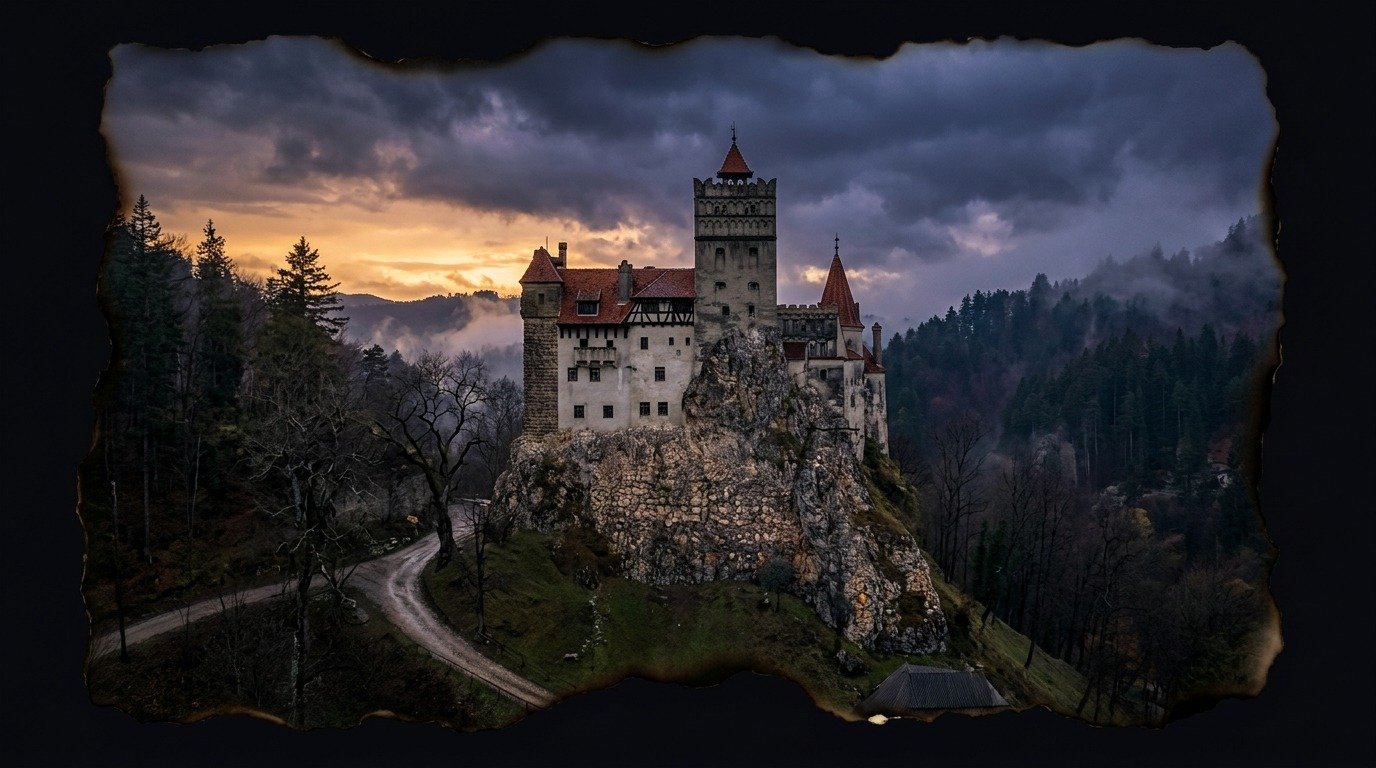
Bran Castle: The Fortress the World Chose for Dracula
On the night of November 19, 1377, King Louis I of Hungary signed a document that would change the fate of the Transylvanian border. He authorized the Saxons of the city of Brașov to build, with their own hands and resources, a stone fortress atop a steep rock overlooking the Bran Gorge. The purpose was purely military: to halt Ottoman invasions and control the passage of merchants along one of Europe's most dangerous routes. Those men did not know they were building the stage for the darkest myth in Western literature.
A Border of Blood and Stone
For centuries, Bran Castle functioned as a customs checkpoint and an unforgiving military garrison. Its limestone walls and red clay roof tiles withstood sieges, fires, and the onslaught of the Carpathian winter. In the 15th century, the shadow of Vlad III, known as Vlad the Impaler, fell over the fortress. In 1459, during his campaigns to consolidate his power in Wallachia, Vlad crossed the gorge and attacked the Saxons of Brașov, destroying their crops and impaling thousands of people on the neighboring hills. A local tradition, which no document confirms, holds that after being captured by King Matthias Corvinus in 1462, the feared prince spent a few days locked up in Bran before being transferred to his captivity in Hungary. El castle survived the decline of the Ottoman Empire and the passage of centuries. In 1920, the city of Brașov gifted the fortress to Queen Marie of Romania, who transformed the cold military outpost into a royal summer residence, decorating it with antique furniture and opening windows to let in the light, though without being able to erase the severe atmosphere of its corridors.
The Strigoi of the Carpathians
Long before the writer Bram Stoker wrote his famous novel, the peasants of the villages near Bran, such as Moieciu and Șimon, already knew nightly terror. In Romanian folklore, there is a firm belief in the *strigoi*, cursed souls of the dead who fail to find rest and leave their graves at night to feed on the life force of their relatives and livestock. For generations, the inhabitants of the Bran Valley rubbed garlic on the windows of their homes and the doors of their stables every St. Andrew's Eve to keep these creatures away. The castle, silhouetted against the night sky atop its cliff, always represented to the locals the epicenter of those ancient forces that the church could not contain.
The Cold That Crosses the Walls
Those who visit the castle today experience a strange combination of fascination and physical oppression. Upon entering the secret staircase—a narrow stone passage hidden behind a fireplace that connects the first floor to the third—the temperature drops suddenly. Local guides and night security guards frequently report the sensation of being watched in the inner courtyard, a space dominated by a stone well where the whispers of the wind are often mistaken for human voices. In the torture chamber, where medieval iron instruments are displayed, visitors report sudden nausea and a persistent smell of dampness and rusted metal that modern ventilation systems fail to eliminate.
The Origin of the Nightmare
Historical truth demystifies part of the legend, but not its magnetism. Bram Stoker never set foot in Romania; he wrote his masterpiece from the libraries of London, and in the novel, the Count's castle is in the Borgo Pass, in northern Transylvania, not in Bran. But when the world went looking for a real castle for Dracula, it found in Bran exactly what it imagined: asymmetrical towers, walls over an abyss, and a gorge shrouded in mist. Although the true headquarters of Vlad the Impaler was Poenari Castle, now in ruins, the intact silhouette of Bran became the ultimate magnet for myth-seekers, forever linking the historical reality of a ruthless warrior with the fiction of the vampire.
The Last Will
For decades, in a crypt carved into the rock next to the castle, rested a small casket containing the heart of Queen Marie of Romania, who had requested that it be separated from her body upon her death. In 2015, it was moved to Pelișor Castle in Sinaia, but the empty crypt remains there. When the thick Carpathian mist rises from the river and wraps the towers in a white shroud, that crevice in the cliff still seems to guard the stone fortress that the world chose to house its worst nightmares.
Comments
Share information, an experience, or a source to help enrich this entry. They are automatically reviewed before being published.
Loading comments...