Frankenstein Castle
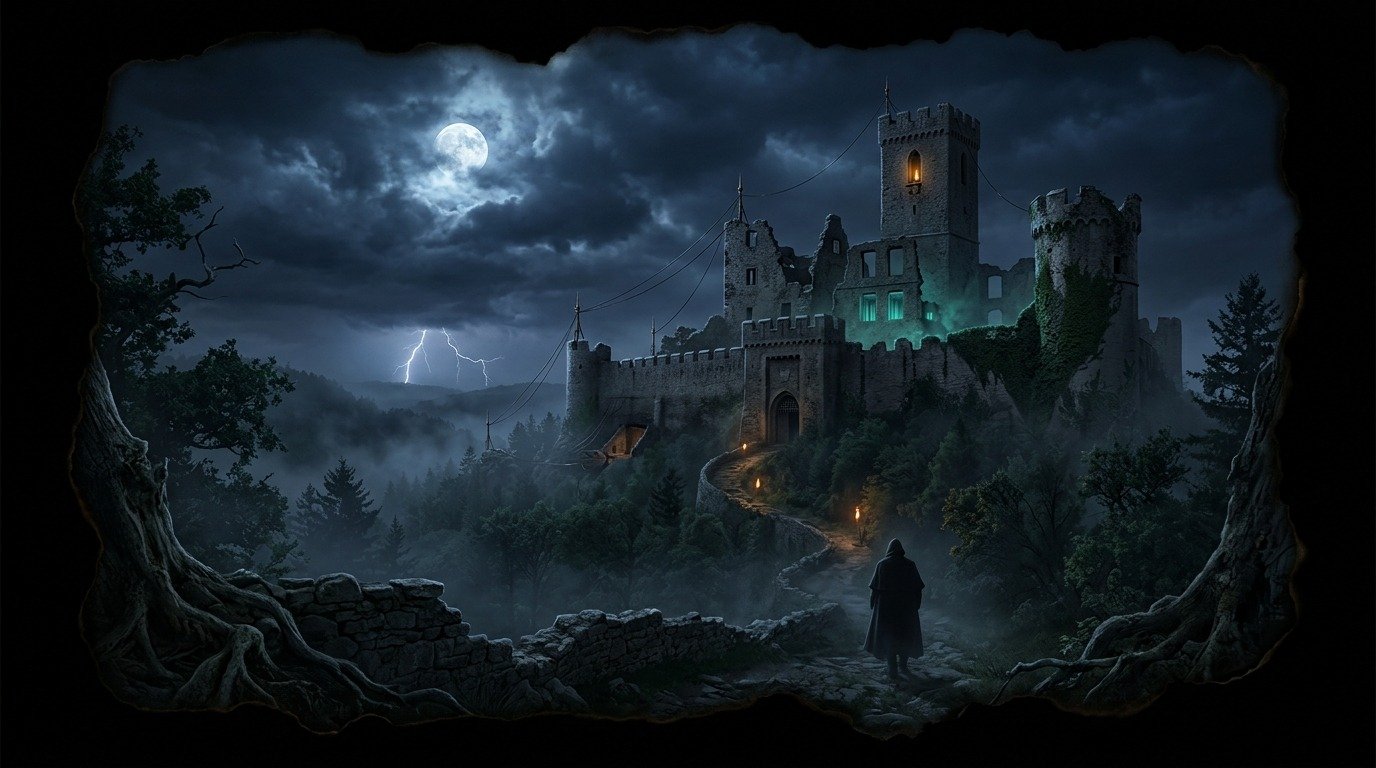
Frankenstein Castle: the cradle of the alchemist who challenged the limits of creation
Legend has it that, in a winter of the early 18th century, a nauseating smell of burned bone and distilled fat drifted down from the slopes of Mount Magnetius toward the valleys of Darmstadt. High above, silhouetted against the gray German sky, the outline of Frankenstein Castle housed an improvised laboratory within its ruined walls. There, surrounded by glass flasks, crucibles, and animal viscera, Johann Konrad Dippel worked in absolute secrecy. His obsession was not gold, but finding the formula to transfer the soul of a dying body to another recently deceased.
A fortress of stone and shadows
Frankenstein Castle was built in the year 1252 by Baron Conrad II Reiz of Breuberg, who adopted the name of the fortress for his lineage. For centuries, the complex functioned as an impregnable defensive bastion, protected by deep moats and massive walls that withstood sieges and plagues. However, the fate of the place changed forever on August 10, 1673, when Johann Konrad Dippel was born within those very stone walls. Dippel grew up to be a man of brilliant intelligence and shifting morals. A theologian, physician, and alchemist, he signed his treatises under the name *Frankensteinensis*. Expelled from several cities for his heretical ideas, he returned to the castle of his childhood to perform anatomical experiments that horrified the inhabitants of the region.
The oil of life and the grave robbers
Local legend claims that Dippel did not work only with animals. The villagers of Nieder-Beerbach guarded the local cemetery with lanterns and pitchforks, convinced that the alchemist carried fresh bodies up the steep castle path during moonless nights. In his damp cellars, Dippel boiled corpse remains in copper cauldrons to extract what he called "Dippel's oil," a thick, dark liquid obtained from the destructive distillation of bones and blood. The physician claimed that this potion was the elixir of eternal life, capable of curing consumption, epilepsy, and delaying old age. The myth's darkest side was born from his notes on metempsychosis, the doctrine of the transmigration of souls. A modern legend, unsupported by any document, tells that Dippel attempted to channel lightning energy during summer storms using copper funnels and iron wires, seeking to reanimate dead flesh. Mary Shelley traveled up the Rhine by boat in 1814, not far from there. Her travel diary does not mention the castle, and no one has been able to prove that she knew Dippel's story; but the coincidence of the name was enough to forever link the castle with her creature.
Presences in the ruins on the hill
Today, the ruins of the castle are a pilgrimage site for lovers of the paranormal, especially during Halloween night. Those who walk the wooded paths surrounding the powder tower report drastic temperature changes and inexplicable failures in electronic equipment. Investigators' magnetometers record spikes in electromagnetic activity near the fortress's ancient cellars. The guards who watch over the grounds at night claim that, in the early mornings of late April, on the anniversary of Dippel's death, the metallic clinking of test tubes and a dry cough can be heard echoing in the empty crypts, where the alchemist spent hours seeking to defeat death.
The truth behind the myth
Historically, Johann Konrad Dippel existed and was one of the most controversial minds of his time. In addition to his famous oil (which was used for centuries as an insect repellent and chemical component), Dippel co-discovered Prussian blue, the first modern synthetic pigment. He died on April 25, 1734, at Wittgenstein Castle. It was said to be from poisoning by his own preparations, although there was also talk of a stroke. Frankenstein Castle still stands on the hill of Darmstadt, partially rebuilt. Anyone who climbs to its battlements at sunset will feel the cold wind of the Rhine and, if they pay attention, will perceive a subtle trace of bitter almonds in the air, the scent of the poison that ended the real Frankenstein.
Comments
Share information, an experience, or a source to help enrich this entry. They are automatically reviewed before being published.
Loading comments...